
















 Back to Blogs
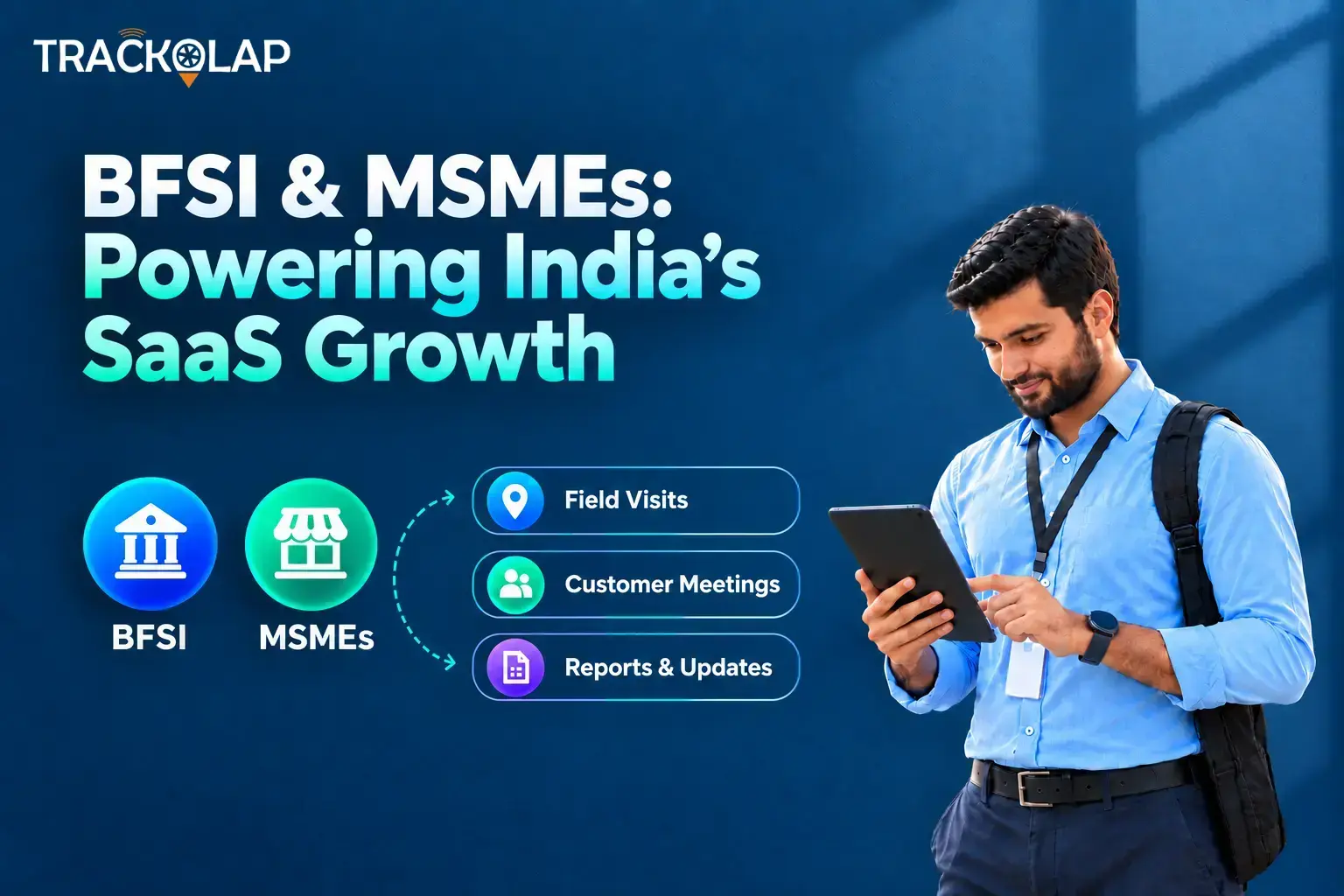
India’s banking, financial services, and insurance (BFSI) sector is no longer treating enterprise software as a discretionary upgrade. It has become, in the words of industry analysts covering the space, close to “a condition for survival.” What is less understood is where this shift is being led from. It is not the largest banks with thousand-crore IT budgets, nor is it the smallest unregistered shops still running on spreadsheets and paper registers. It is the mid-sized NBFC, the growing small finance bank, and the formalising MSME: the organisations big enough to feel the pain of manual operations, and lean enough to move fast once they decide to fix it.
For lenders whose business depends on people in the field (loan officers visiting borrowers, collection agents on recovery routes, sales executives sourcing new accounts), this shift shows up first and most visibly in one category: field force management software for NBFC operations. This article looks at why mid-sized BFSI and MSME businesses are driving India’s next SaaS wave, what the underlying data says, and which specific tools they are actually buying to run their field operations, compliance, and sales pipelines.
The Shift: Why BFSI and MSMEs Are Digitising Field Operations Now
Three forces are converging at once, and each reinforces the other.
The first is growth pressure. Reserve Bank of India sectoral credit deployment data shows non-banking financial company (NBFC) credit growing 14.9% year-on-year as of July 2026, up from 10.6% a year earlier, with retail loan growth accelerating even faster to 21.4% (Business Standard). Faster loan book growth means more field agents, more collection routes, and more onboarding visits, all of which break down quickly without a system to plan, track, and audit them.
The second is regulatory tightening. RBI’s scale-based regulatory framework and its digital lending guidelines have pushed NBFCs of every tier toward documented, auditable processes: for loan sourcing, for recovery conduct, and for how customer data is collected and stored in the field. A field team working off WhatsApp groups and paper collection sheets is not just inefficient; it is a compliance liability.
The third is competitive catch-up. A recent industry report on enterprise SaaS in Indian BFSI found that 61% of respondents see mid-sized institutions, not the largest players, leading the pace of SaaS adoption, and 57% expect B2B SaaS to be a significant growth catalyst specifically for small and medium businesses in the years ahead (The Tribune; ANI). Scalability was the single most-cited benefit, named by 70% of respondents: a direct reflection of the fact that mid-sized lenders need infrastructure that can grow with a rapidly expanding loan book without a proportional increase in back-office headcount.
Put together, this is a sector where growth, regulation, and technology adoption are all accelerating in the same direction, and field operations sit at the centre of that convergence. A loan book growing at nearly 15% a year cannot be serviced by adding headcount alone; it has to be serviced by giving the existing field team better tools to cover more ground, close more accounts, and leave a cleaner paper trail than a purely manual process ever could.
Beyond BFSI: The Same Pattern in MSME Distribution and Sales
The pattern showing up in NBFCs and small finance banks is not unique to lending. MSME manufacturers and distributors running their own field sales teams (for FMCG distribution, industrial supplies, or B2B services) face an almost identical set of problems: sales executives spread across a district or state, orders and collections tracked on paper or personal phones, and no reliable way for a sales manager to know whether a planned market visit actually happened. The same 57% of respondents who expect B2B SaaS to catalyse MSME growth are, in large part, describing this exact shift: from founder-led, memory-based field management to a system where every visit, order, and payment collection is logged and visible. This is why a single vendor serving both NBFC-style collections use cases and MSME-style distribution sales use cases, on one configurable platform, has become an efficient choice for group companies and diversified lenders that run both a lending arm and a distribution or channel-partner business.
The MSME Credit Gap and Why Field Reach Matters
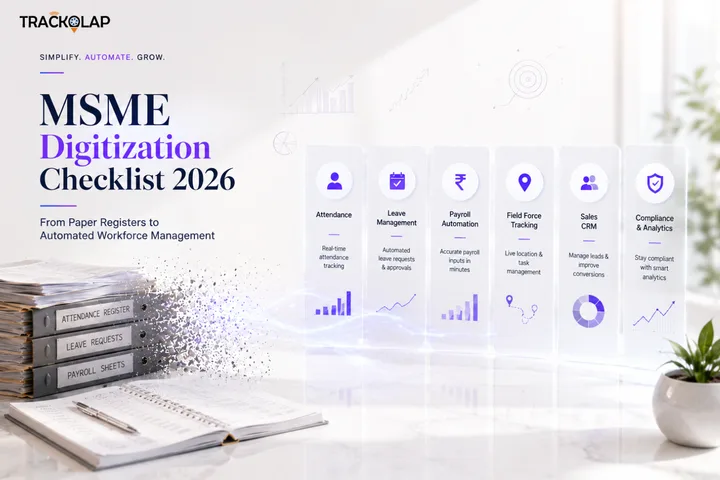
India’s MSME sector has crossed a formalisation milestone worth noting briefly: over 7.83 crore enterprises were registered on the government’s Udyam Registration Portal as of February 2026, according to the Press Information Bureau (PIB), up from just 0.79 crore in FY 2021-22. That is a large and rapidly growing base of borrowers that NBFCs, small finance banks, and MFIs are all competing to reach and underwrite.
Yet reach remains the bottleneck, not appetite. SIDBI’s own research places India’s MSME credit gap at roughly ₹30 lakh crore, or about 24% of total credit demand, with a large share of enterprises still lacking access to formal finance (SIDBI). Closing that gap is fundamentally a field-operations problem: it depends on how many borrowers a lender’s feet-on-street team can visit, verify, and onboard in a given month, and how reliably that team can be tracked, routed, and audited once loans are disbursed and collections begin.
This is exactly where field force management software for NBFC, MFI, and bank operations earns its place in the technology stack: not as a “nice to have” productivity tool, but as the operational layer that determines whether a lender can profitably serve the next few crore borrowers entering the formal credit system.
What Mid-Sized BFSI and NBFCs Are Actually Buying
Ask a mid-sized NBFC’s operations head what they’ve evaluated in the last twelve months, and the shopping list is consistent across the sector. It converges on a small number of categories, purchased either individually or, increasingly, as a bundled field-operations suite.
Field Force Management App. This is the anchor purchase: a single platform to manage every person working outside a branch or office, including loan officers, collection agents, insurance surveyors, and sales staff. On TrackOlap, this takes the shape of one unified dashboard where a branch manager sees live agent location, digital attendance with selfie and geo-tagged check-in, and daily activity reports side by side, with the mobile app logging visits offline in low-connectivity areas and syncing automatically once the agent is back in network range.
Task Management Software. Beyond location and attendance, TrackOlap lets managers assign structured tasks to field staff (daily visits, KYC verifications, service calls) through configurable task forms rather than open text. These forms can be locked to English, or English and Hindi, so field-entered data stays clean, blocks unsupported characters at the point of entry, and moves into core banking systems and third-party CRMs without the integration failures that mixed-language data usually causes. Managers get real-time visibility into what is assigned, in progress, and completed, without waiting for an end-of-day report.
Field Employee Tracking Software. Distinct from generic GPS tracking, this category is built around accountability and safety for staff who are constantly moving between customer locations: verifying it is the assigned agent, at the assigned location, at the assigned time. TrackOlap’s live tracking module adds geofenced check-in and check-out at customer sites, automatic route-deviation alerts when an agent strays from an assigned beat, and a historical movement playback that a compliance or audit team can pull up for any past date. For NBFCs handling cash collections or KYC visits, this is as much a fraud-control measure as a productivity one.
Employee Expense Management Software. Reimbursement claims for fuel, travel, and daily allowance are a common source of leakage and dispute in a distributed workforce. TrackOlap ties each claim to the underlying visit or task, applies policy-based limits automatically, and calculates claimed kilometres from odometer readings captured at punch-in and punch-out, removing manual distance entry and giving managers photographic proof with every claim. Claims exceeding a configured amount or distance variance are flagged automatically for review, and approved reimbursements can be settled directly to the employee’s bank account via UPI, closing the loop from claim to payout on the same platform.
Lead Automation Software. For the sales side of BFSI and MSME lending (sourcing new loan applicants, insurance policyholders, or merchant accounts), TrackOlap’s lead management captures enquiries from web forms, calls, and WhatsApp, auto-assigns them to the right agent by territory or current workload, and uses built-in WhatsApp CRM follow-ups to keep a lead warm between field visits, with full visibility into where each lead sits between first contact and disbursement or conversion.
Sales Task Management Software. Once a lead is assigned, TrackOlap’s task and opportunity module keeps daily targets, pipeline stage, and document-collection status visible to both the field executive and their manager on the same screen, with target-versus-achievement dashboards that close the loop between what was promised in a morning huddle and what actually happened on the ground by evening.
Sales Beat Planning Software. Route and territory planning determines how efficiently a field team covers its assigned geography. TrackOlap’s beat planning lets managers build visit routes by geography and priority, set differentiated visit frequency for high-potential customers versus overdue accounts, and then compare planned beats against actual visits logged by the tracking module: a capability that matters as much for a collections team chasing overdue EMIs as for a sales team building a new territory.
For NBFCs and MFIs specifically running loan collections and center-based operations, TrackOlap Collect adds a further layer purpose-built for that workflow: center and group-meeting management, field collection tracking, and repayment recording designed around how microfinance and small-ticket lending actually operates on the ground, rather than a generic sales tracker repurposed for collections.
Taken together, these categories describe less a wish list and more the baseline operating system that mid-sized BFSI institutions and formalising MSMEs are now expected to run on, and, on TrackOlap, they run as modules of one platform rather than as separate tools that need to be stitched together and reconciled by hand.

Field Force Management Software for NBFC: The Core Requirement
Put simply, field force management software for NBFC operations is a platform that gives a lender real-time visibility into its distributed workforce (loan officers, recovery agents, and sales executives), covering attendance, live location, task and target tracking, expense claims, and lead-to-disbursement workflow, all in one auditable system.
For an NBFC specifically, three requirements separate genuine field force software from a repurposed generic tracking app:
First, collections and recovery workflows built for the realities of loan servicing: overdue-bucket prioritisation, promise-to-pay capture, and receipt generation in the field, not just a location pin.
Second, compliance-ready audit trails, so that every customer visit, KYC capture, and collection attempt is timestamped and retrievable, supporting both RBI’s fair-practice expectations around recovery conduct and internal audit requirements.
Third, role-based visibility across a branch network, so that a regional manager overseeing dozens of loan officers across multiple branches can see performance, deviations, and risk in one dashboard rather than compiling it manually every week.
This is also where “MSME-friendly” matters as a distinct product requirement, not a marketing phrase. Mid-sized NBFCs and formalising MSME distributors do not have the implementation budgets or IT teams of a large bank. They need field force software that deploys quickly, works reliably on modest Android devices in low-connectivity areas, and prices predictably as the field team grows from twenty people to two hundred. TrackOlap addresses the first two requirements directly through TrackOlap Collect for collections and center management, and the third through digital attendance, live tracking, and audit-ready reporting that ship as configurable modules rather than a rigid, one-size-fits-all package.
Compliance and Data Security: The Non-Negotiable Layer
Buying decisions in this category are no longer made on productivity features alone. In the same industry survey cited earlier, 40% of BFSI respondents named data security, privacy, and cybersecurity as their single biggest technology challenge, the largest concern in the survey. That figure should not surprise anyone tracking India’s regulatory direction: the Digital Personal Data Protection (DPDP) Act now shapes how customer data collected in the field (photographs, geolocation, KYC documents) must be stored, processed, and shared, while RBI’s digital lending guidelines set clear expectations around data minimisation and borrower consent in loan sourcing and recovery.
For an NBFC evaluating field force software, this means the vendor conversation has to include data residency, access controls, and consent capture, not as an afterthought, but as a core part of the product. A platform that cannot answer these questions in writing before a pilot begins is not ready for a regulated lender’s field operations.
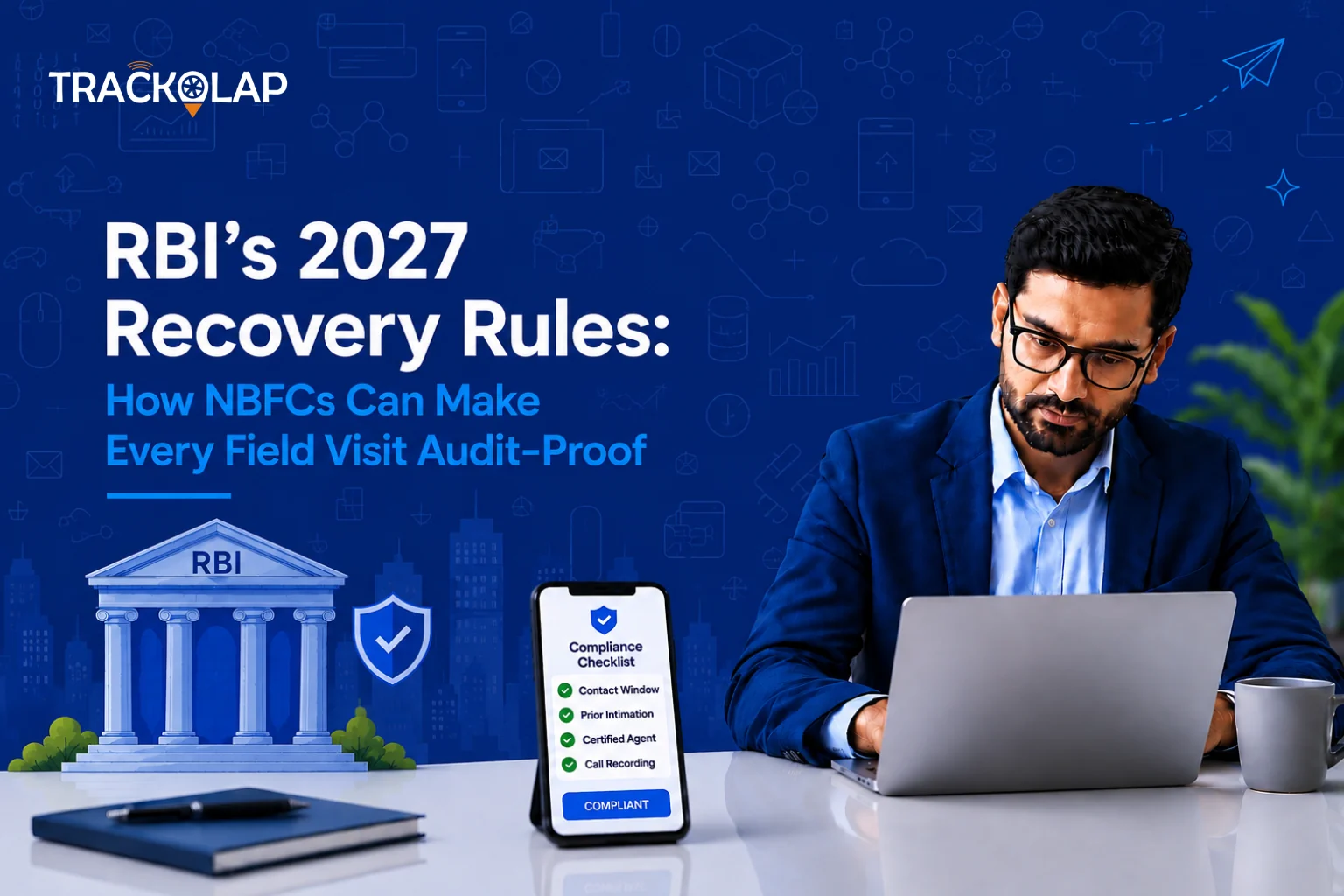
TrackOlap’s MSME/NBFC-Friendly Bundles
TrackOlap has built its field force management platform around exactly this profile of customer: the mid-sized NBFC, small finance bank vendor, MFI, and formalising MSME distributor that needs enterprise-grade field visibility without enterprise-grade deployment overhead. Serving over 1,000 customers across field-heavy sectors, TrackOlap brings together live employee tracking, digital attendance, lead automation with WhatsApp CRM, sales task and opportunity management, beat planning, employee expense management, and the purpose-built TrackOlap Collect module for MFI center management and loan collection, all on one platform with one login, one reporting layer, and one support relationship, rather than five point solutions that each need their own contract and integration.
The design intent behind TrackOlap’s MSME/NBFC-friendly bundles is straightforward. A lender or distributor should be able to onboard a field team in days, not quarters, starting with the modules that matter most to their operation: collections and center management for an MFI, lead-to-disbursement tracking for a growing NBFC’s sales arm, or the full suite for an organisation running both. Pricing scales with headcount rather than demanding a large upfront commitment, and every module shares the same underlying audit trail and role-based access controls that a regulated BFSI buyer needs to satisfy internal and RBI-facing compliance reviews. Whether the requirement is a standalone field employee tracking deployment for a fifty-person collections team, or a full bundle spanning lead automation, beat planning, expense management, and center collections for a branch network spread across several states, the same platform is meant to scale to it without a change of vendor, and without the reconciliation overhead of stitching together tools from four different providers.
Frequently asked questions
What is field force management software for NBFC operations?
Field force management software for NBFC operations is a platform that tracks and manages an NBFC’s distributed workforce in one auditable system. It covers loan officers, collection agents, and field sales staff, including live location, attendance, task assignment, expense claims, and lead-to-collection workflows.
Why are mid-sized BFSI firms adopting SaaS faster than large institutions?
Mid-sized BFSI firms adopt SaaS faster because they face the same scale and compliance pressures as large banks but need to move faster and with leaner IT teams to stay competitive. Industry survey data shows 61% of respondents see mid-sized institutions leading SaaS adoption in India’s BFSI sector.
How does field force software help close the MSME credit gap?
Field force software helps close the MSME credit gap by making it operationally viable for lenders to visit, verify, and service more borrowers per field agent. This directly addresses the reach constraint behind SIDBI’s estimated ₹30 lakh crore MSME credit gap.
Is field employee tracking software different from basic GPS tracking apps?
Yes. Field employee tracking software adds identity verification, task and target linkage, and compliance-grade audit logs for BFSI use cases, features generic consumer GPS apps do not provide.
Does TrackOlap support both sales and collections field teams?
Yes. TrackOlap covers both on the same system: lead automation and sales beat planning for new business sourcing, alongside field employee tracking and task management for collections and servicing teams.
How long does it take to roll out field force management software at an NBFC?
A well-designed platform should be usable within days of onboarding, not a multi-quarter implementation project. A mid-sized NBFC or MSME distributor can pilot with a single branch or territory, then roll out in phases to additional branches once the workflow is validated.
Conclusion
The data points in one direction: India’s BFSI and MSME sectors are not waiting for large-scale digital transformation programmes to modernise their field operations. Mid-sized NBFCs, small finance banks, and formalising MSMEs are moving first, driven by credit growth, regulatory expectations, and straightforward competitive necessity. The organisations that get ahead of this shift will be the ones that can put a well-managed, well-tracked, and compliant field force behind every rupee of new lending. For NBFCs and MSMEs evaluating that step, a platform like TrackOlap, built specifically around field force management, lead automation, and compliance-ready tracking, offers a practical starting point rather than a multi-year transformation project.



 D-5, Logix Infotech Park, Sector 59, Noida - 201301, Uttar Pradesh (India)
 contactus@trackolap.com
 7011494501






 Demo
at free of cost
Demo
at free of cost