
















 Back to Blogs
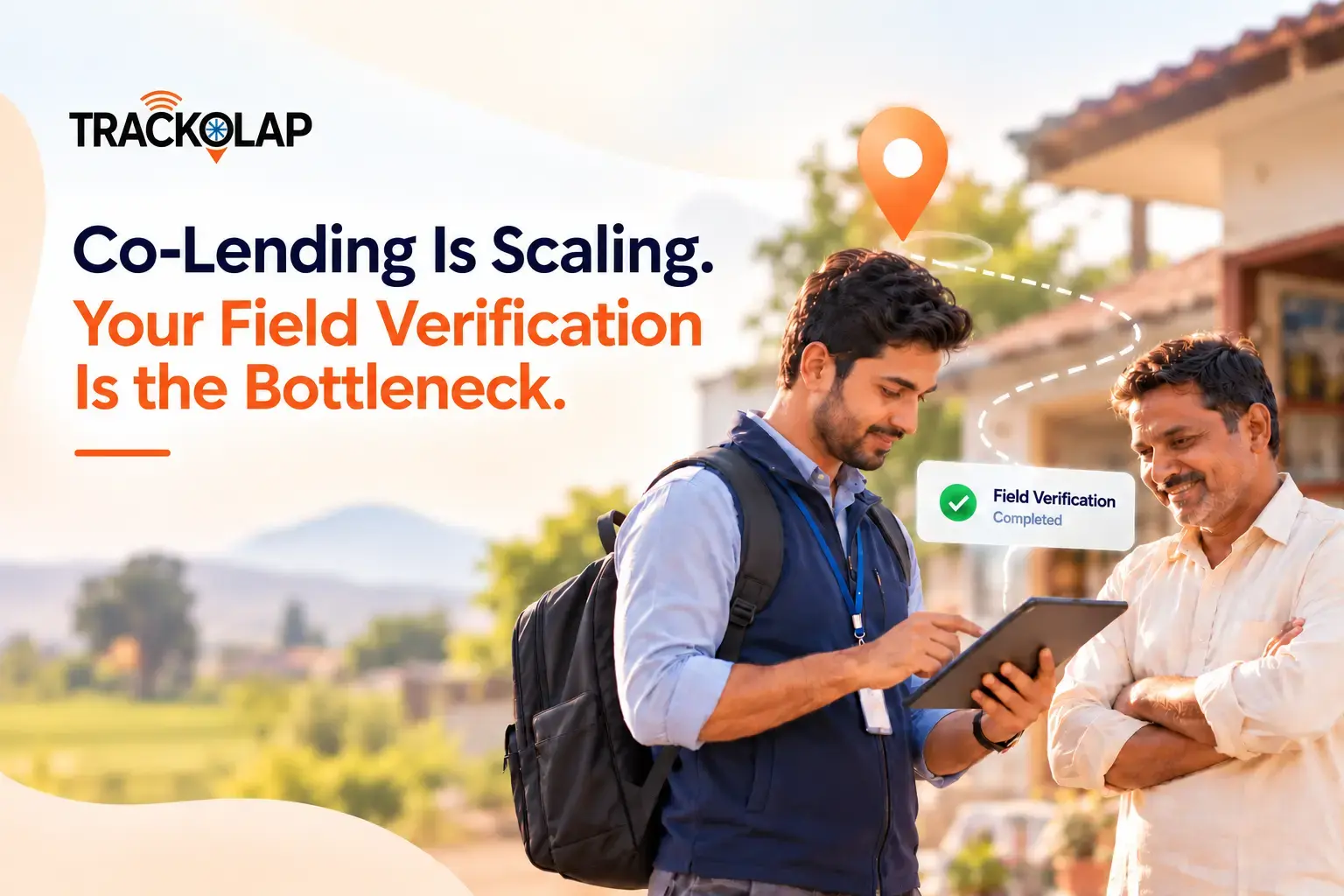
Quick answer: Co-lending in India has moved from a priority-sector experiment to a mainstream growth engine for banks and NBFCs. The limiting factor is no longer capital or credit appetite. It is the speed, consistency and auditability of field verification. Lenders that digitise field visits using field operations management software with GPS-verified, geo-fenced and face-verified workflows, such as those on TrackOlap, disburse faster while staying defensible before auditors and partner lenders.
Co-lending lets a bank's lower cost of funds meet an NBFC's reach into small towns, self-employed borrowers and micro-enterprises. According to ICRA, the co-lending book of mid-sized and small NBFCs grew from roughly ₹520 billion in March 2023 to about ₹800 billion by March 2024. The regulatory runway then widened further in 2025.
Yet a quiet constraint sits behind every one of those loans. Before disbursement, someone must visit the borrower's home, shop, farm or collateral. That person must confirm the address, see the business running, photograph the asset and file a report the partner bank will trust. In most lending operations, this step still depends on phone calls, WhatsApp photos, paper forms and self-reported travel claims.
When co-lending volumes double, that process does not scale. It breaks. This article explains why field verification has become the bottleneck, what the regulator now expects, and how TrackOlap's field force management platform turns verification from a delay into a competitive advantage.
What the RBI now expects from co-lending partners
On 6 August 2025, the Reserve Bank of India issued the Reserve Bank of India (Co-Lending Arrangements) Directions, 2025 (RBI/DOR/2025-26/139), effective 1 January 2026. The 2020 co-lending model was largely limited to bank–NBFC priority-sector lending. The new Directions extend co-lending to arrangements among commercial banks, All-India Financial Institutions and NBFCs, well beyond priority-sector loans.
Several provisions directly raise the stakes for field verification:
- Skin in the game: each regulated entity must retain at least 10% of every individual loan on its own books.
- 15-day clock: both lenders must reflect their shares within 15 calendar days of disbursement.
- Shared asset classification: if one partner classifies a borrower as SMA or NPA, the other must follow. One weak verification now hurts both balance sheets.
- Reliance on the originator: the partner lender may rely on the originating lender for the Customer Identification Process. The originator's field evidence therefore must stand up to the partner's scrutiny.
- Default loss guarantee is capped at 5% of outstanding loans, so partners cannot rely on guarantees to cover poor origination.
- Outsourcing discipline: lending services by agents must follow the RBI's outsourcing guidelines.
Verification standards themselves are set by the RBI Master Direction – Know Your Customer (KYC) Direction, 2016. It requires lenders to verify a customer's current address through positive confirmation, including contact point verification, in specified cases. That is exactly the job of a field officer.
Finally, the Digital Personal Data Protection Rules, 2025, notified by the Government of India in November 2025, operationalise the DPDP Act, 2023. Any verification workflow that captures borrower photos, locations or employee face images needs clear purpose, consent and secure storage.
The takeaway: the regulator has expanded the opportunity and tightened accountability at the same time. Field verification is where both meet.

Where manual field verification breaks down
Most lenders did not design their verification process. It grew over time from spreadsheets, messaging apps and branch habits. At low volumes, it works. At co-lending scale, five failure points appear.
1. Visits that cannot be proven
A report says the officer visited the borrower's shop at 11:40 a.m. There is no independent evidence of where the officer was, or whether the photo was taken at that address that day. A partner bank's audit team will eventually ask for that proof.
2. Proxy attendance and "desk verifications"
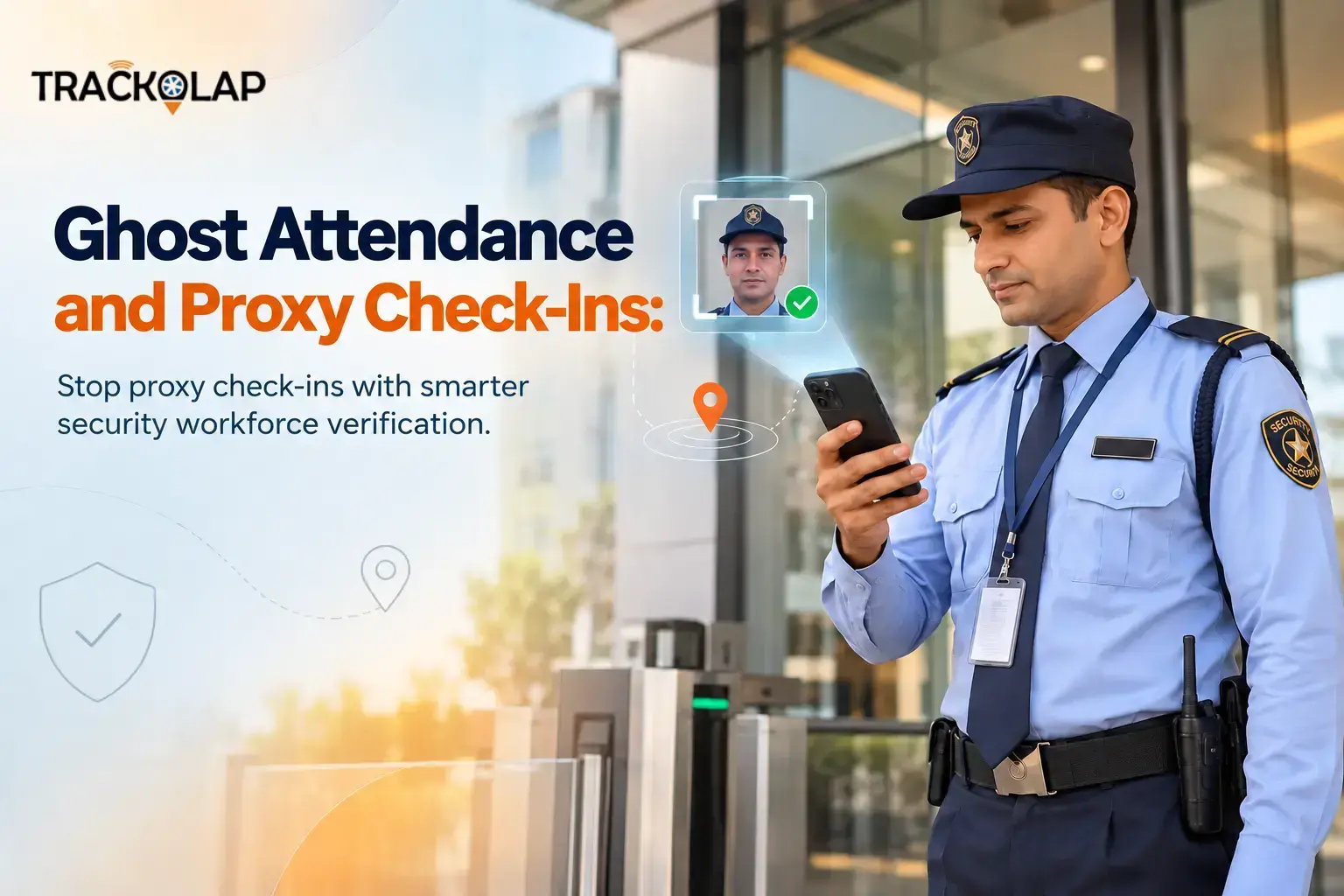
When targets are tight, some visits are completed from a tea stall or the branch. A colleague may even mark attendance for someone else. Without geo-fenced attendance and face verification, these gaps stay invisible until a cluster of loans turns delinquent.
3. Assignment chaos
Verification requests arrive from sales teams, DSAs, credit and partner lenders at once. Supervisors allocate them over calls and group chats. Cases get missed, duplicated or sent to an officer 40 km away while another sits idle nearby.
4. Turnaround time nobody can measure
With the 15-day window under the new Directions, every day between login and disbursement matters. Yet most operations cannot answer a basic question: how long does the average field verification take, and where does it stall?
5. Travel expenses on trust
Field officers claim conveyance based on self-reported kilometres. Finance teams either approve claims blindly or spend hours checking them. Inflated claims erode margins on small-ticket loans, while delayed reimbursement demotivates honest staff.
Each of these issues is a data problem. The visit happened, or it did not; the officer travelled 18 km, or 45. The fix is to capture that truth automatically, at the moment it happens.
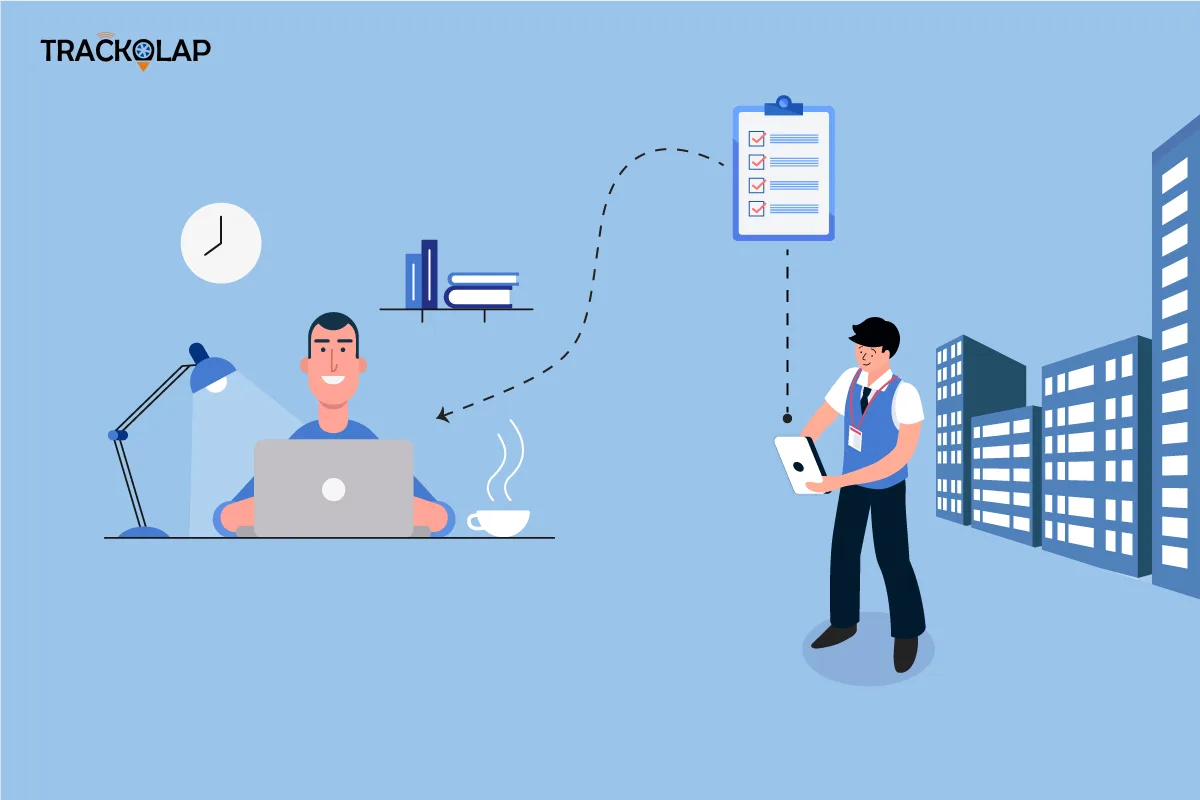
How TrackOlap removes the verification bottleneck
TrackOlap is field operations management software built for organisations whose revenue depends on people in the field, from loan verification and customer onboarding to collections. For banks, NBFCs, HFCs and verification agencies, it provides one system of record for every visit, from assignment to evidence to reimbursement.
Field visit management with geo-tagged evidence
Every verification becomes a structured visit in the mobile app. Officers check in at the borrower's location, and the app records GPS coordinates and a timestamp automatically. Photos of the residence, shop signboard, stock or collateral are geo-tagged at capture, not uploaded later from a gallery. Custom digital forms replace paper checklists, so each report follows the format your credit policy and partner lender require.
GPS and geo-fenced attendance
Geo-fenced attendance allows officers to mark their day only from approved locations, such as a branch, hub or assigned territory. Live and historical GPS tracking for field agents shows the actual route travelled, so supervisors can confirm that a visit happened where the report says.
Face verification to stop proxy work
Attendance and critical check-ins can require a live selfie matched against the officer's registered face. This closes the most common loophole in field operations: one person marking attendance or submitting visits for another. For a lender, it establishes that the named, authorised employee performed the verification, a point that matters under outsourcing and audit reviews.
Task and workflow management
Acting as customer onboarding software for the field leg of the loan journey, the platform receives every verification request as a task with a borrower, address, due time and priority. Supervisors assign them manually or by territory and proximity. Status moves from Assigned to In Progress to Completed, with escalation for overdue cases. Credit teams see progress in real time instead of chasing updates on calls.
Expense management with start and end odometer capture
The platform ties conveyance claims to evidence. At the start of the day, the officer photographs the vehicle odometer; at the end, they photograph it again. The system records both readings, calculates distance and compares it with the GPS route. Claims are computed against your per-kilometre policy and routed for approval. Finance teams stop disputing kilometres, and honest officers get reimbursed faster.
Collection agent tracking after disbursement
Verification is only the first half of the loan lifecycle. Because co-lending partners now share borrower-level asset classification, early-stage collections matter to both lenders. The same platform supports collection agent tracking: overdue accounts are assigned as tasks and every visit is GPS-stamped. Managers see which accounts were visited, by whom and when.
Dashboards and audit-ready reports
Managers see visits completed, turnaround time, pending cases by branch and officer productivity in one dashboard. Every visit carries its own audit trail: who, where, when, what was seen and what was recorded. Reports can be exported for internal audit, partner-bank reviews or regulatory inspections.
A co-lending verification visit on TrackOlap, step by step
Consider an NBFC originating an MSME loan under a co-lending arrangement with a bank. Here is how a single verification runs:
- Day start. The field officer opens the app at the branch. Geo-fenced attendance confirms location, and a face match confirms identity. The officer photographs the two-wheeler's odometer as the start reading.
- Assignment. The loan application creates a verification task with the borrower's residence and business address. The supervisor assigns it to the nearest available officer.
- Travel. GPS tracking records the route to the borrower's premises.
- Check-in. At the premises, the officer checks in. The app stamps GPS coordinates and time, confirming the visit is within the expected radius of the declared address.
- Evidence capture. The officer completes the digital verification form covering residence ownership, business activity, neighbour reference and stock. Geo-tagged photos of the premises and signboard are attached.
- Submission. The report reaches the credit team instantly, with location, timestamp and photos in one record. Credit can decide on the same day.
- Day end. The officer captures the closing odometer reading. The system computes distance, checks it against the GPS route and generates the conveyance claim for approval.
The result is a verification file that the originating NBFC can share with confidence and the partner bank can rely on, created without additional paperwork.

The business impact for lenders
Digitised field verification pays off across operations, risk and finance. The table below lists the metrics lenders should track before and after deployment.
| KPI to track | Manual process | With TrackOlap |
|---|---|---|
| Verification turnaround time | Unmeasured; depends on follow-up calls | Measured per case, branch and officer in real time |
| Proof of visit | Officer's word and gallery photos | GPS check-in, timestamp and geo-tagged photos |
| Proxy attendance risk | High; hard to detect | Controlled through face verification and geo-fencing |
| Case allocation | Calls and group chats | Territory- and proximity-based task assignment |
| Conveyance claims | Self-declared kilometres | Start and end odometer photos checked against GPS |
| Partner and audit readiness | Files assembled manually | Exportable audit trail per visit |
These gains compound. Faster verification shortens the path from login to disbursement, which helps lenders meet the 15-day booking window. Stronger evidence reduces the risk of fraud-led delinquencies that, under borrower-level classification, affect both co-lending partners. Controlled expenses protect the unit economics of small-ticket loans, where margins are thin.
There is also a partnership benefit. Banks choose NBFC partners partly on the quality of their origination. An NBFC that shows a bank a live dashboard of geo-verified visits presents a stronger case than one sending a spreadsheet.
Implementing TrackOlap in a lending operation
Rolling out digital field verification does not require replacing your loan origination system. A practical approach runs in four phases:
- Map the verification journey. List each verification type your credit policy and partner lenders require, such as residence, business, collateral and reference checks. Define the evidence each one needs.
- Configure the platform. Build digital forms for each verification type, set geo-fences for branches and territories, enable face verification, and load your conveyance policy for odometer-based expense management.
- Pilot one region. Start with one or two branches that carry significant co-lending volume. Measure turnaround time, visit completion and expense accuracy against the previous baseline.
- Scale and integrate. Extend to all branches, verification agencies and collection teams. Connect the platform to your LOS or CRM so verification tasks are created automatically when an application is logged.
Throughout, align data handling with the DPDP Act and Rules. Capture only what verification needs, inform employees and borrowers of the purpose, and restrict access by role.
Frequently asked questions
What are the RBI co-lending rules effective in 2026?
The RBI (Co-Lending Arrangements) Directions, 2025 apply from 1 January 2026. They allow co-lending among commercial banks, All-India Financial Institutions and NBFCs. Each lender must retain at least 10% of every loan, both must book their shares within 15 days of disbursement, and default loss guarantees are capped at 5%.
Why is field verification a bottleneck in co-lending?
Co-lending volumes are growing faster than manual verification can handle. Paper forms, unverifiable visits and poor case allocation slow disbursement. Under the new Directions, a weak verification also affects the partner lender's asset quality.
How does TrackOlap verify that a field visit actually happened?
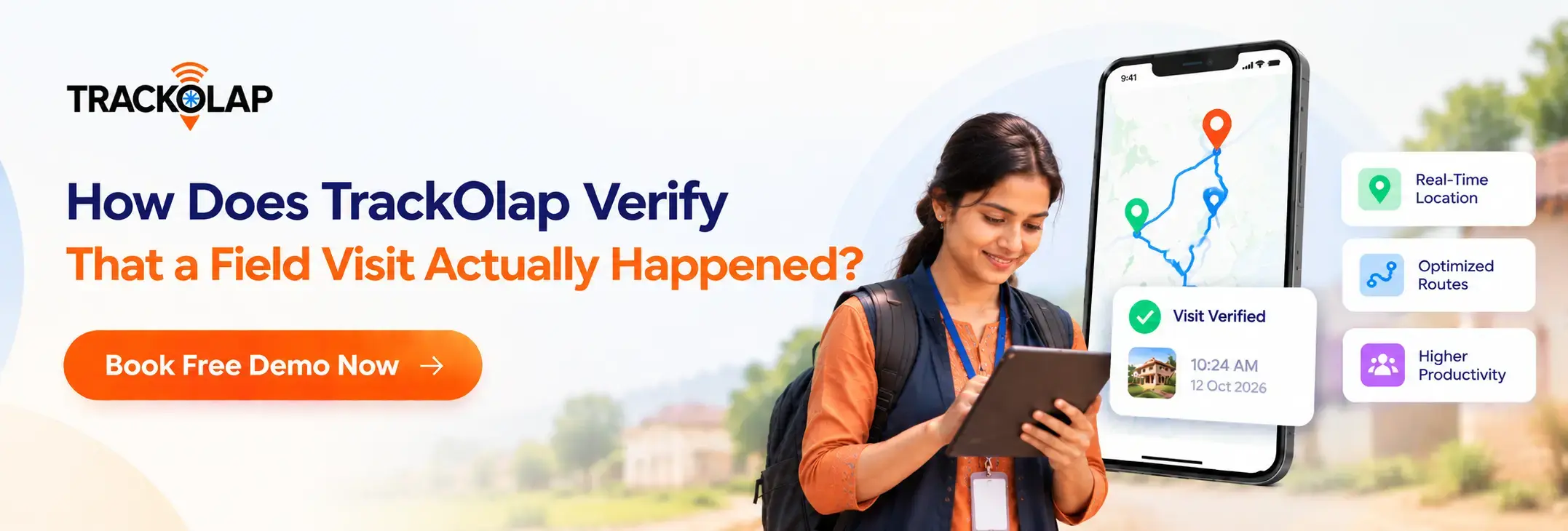
TrackOlap records GPS coordinates and timestamps at check-in, geo-tags photos at capture and tracks the officer's route. Supervisors can confirm that the visit took place at the declared address.
What is geo-fenced attendance?
Geo-fenced attendance allows employees to mark attendance only within a defined geographic boundary, such as a branch or territory. It prevents attendance from unauthorised locations.
How does face verification help lenders?
Face verification matches a live selfie with the employee's registered face during attendance or check-in. It prevents proxy attendance and confirms that the authorised officer performed the verification.
How does odometer-based expense management work?
Officers photograph the vehicle odometer at the start and end of the day. TrackOlap calculates distance, compares it with the GPS route and generates a policy-based conveyance claim for approval.
Is TrackOlap suitable for verification agencies working for banks?
Yes. Agencies can use TrackOlap to manage officers across cities, assign cases by proximity and share audit-ready evidence with each lender client.
Can TrackOlap be used for collections as well as verification?
Yes. TrackOlap works as field visit management for onboarding and as collection agent tracking after disbursement. Lenders use one app and one dashboard for both teams, with GPS tracking for field agents across the full loan lifecycle.
Conclusion: make verification your advantage
The 2025 Co-Lending Directions have opened the market to more partners, more products and more volume. They have also made each lender accountable for the other's origination quality. In this environment, the lender that can prove every field visit, quickly and consistently, will win the best partnerships and disburse the fastest.
Field verification does not need to remain the slowest step in the loan journey. With TrackOlap's field visit management, GPS tracking for field agents, geo-fenced attendance, face verification, task workflows, collection agent tracking and odometer-based expense management, it becomes a measurable, auditable and scalable process.
Ready to remove the bottleneck? Book a TrackOlap demo to see how banks, NBFCs and verification agencies run faster, verifiable field operations.


 D-5, Logix Infotech Park, Sector 59, Noida - 201301, Uttar Pradesh (India)
 contactus@trackolap.com
 7011494501






 Demo
at free of cost
Demo
at free of cost