
















 Back to Blogs
Distribution has always run on movement: a delivery van, a sales rep on a two-wheeler, a beat plan scribbled on paper decades ago and now buried inside a spreadsheet. What has changed is that movement itself has become a data problem, and the businesses solving it fastest are pulling ahead. Global technology majors are racing to redefine what “routing” means for commercial fleets, India’s own logistics numbers show freight and delivery volumes climbing every month, and distribution-led categories like FMCG are being forced to rethink how they cover territory efficiently. For any brand running feet-on-street sales or last-mile delivery, the question is no longer whether to adopt route optimization software for distribution. It is whether the one you have is doing anything more than showing a dot on a map.
The Global Signal: Why “Route Intelligence” Is Suddenly Everyone’s Priority
In September 2026, HERE Technologies used the IAA Transportation show to introduce what it calls AI-powered route intelligence for fleet operations, a deliberate departure from simple turn-by-turn navigation. The announcement bundled three capabilities: a time- and constraint-dependent route solver that adapts as real-world conditions change through the day, last-meter delivery guidance that learns from driver and delivery feedback, and an AI reasoning layer that explains why a route was chosen and what dispatchers should do when it breaks down. HERE’s routing engine already processes an estimated 225 billion kilometres of travel every month across commercial vehicle networks in more than 90 countries, which is the scale at which “a better plan” stops being enough and “knowing what to do next” becomes the differentiator, in the company’s own framing.
That announcement is a symptom, not an isolated event. Across the logistics-technology space, venture investment has been flowing steadily into route intelligence, warehouse-AI and freight-visibility startups through 2026, a sign that institutional capital sees unresolved inefficiency in how goods physically move. The gap is not in whether GPS exists, but in whether anyone is using the data GPS produces to make better decisions. For a distribution business in India, the takeaway is not that these tools are built for you; it is that the underlying problem (reactive routing, disconnected field data, and no feedback loop between “planned” and “actual”) is universal, and the vendors solving it globally are validating a demand curve that Indian distribution SaaS platforms are now expected to meet closer to home.
Route Intelligence vs. Plain GPS: What’s Actually Different
Route optimization software for distribution is a system that sequences and adjusts field visits (sales calls, deliveries, collections) using live location, historical visit data, traffic and territory constraints, rather than a fixed list a rep drives through in whatever order is convenient. Most distribution teams already run some form of employee GPS tracking software or an employee GPS tracking app, and that real-time employee GPS tracking answers one question well: “where is the rep right now?” Route intelligence answers three additional questions that a distribution business actually needs to run the business on: which sequence of outlets minimises drive time and fuel for a given beat; how a plan should change when a rep is running late, an outlet is closed, or a new drop is added mid-day; and whether the distance a rep claims to have travelled matches the distance the system actually recorded.
Plain GPS is a location feed. Route intelligence is a decision layer sitting on top of that feed: beat planning that assigns outlets to days and reps by geography and visit frequency, live tracking that shows deviation from plan in real time, and a compliance layer that reconciles claimed travel against system-tracked travel so route efficiency gains are not quietly eroded by expense leakage. A field employee monitoring system or field force tracking solution that stops at the location feed is doing half the job; a genuine field force route planning software has to close the loop between the plan and the record. That compliance layer is where most Indian distribution software falls short today, and it is where the recent product releases discussed below become directly relevant.
Why Distribution Routing Breaks at Scale in India
The scale of the problem doesn’t need a wall of statistics to make the point. India’s National Logistics Policy, run out of the Ministry of Commerce and Industry, and the PM GatiShakti infrastructure push exist precisely because moving goods across the country still costs more than it should (Invest India). But policy fixes roads and ports; it doesn’t fix a distributor’s beat plan. That part is solved one route, one rep, one outlet at a time.
FMCG feels this most acutely because it is a volume-and-frequency business, not a value-and-rarity one: thousands of small-value kirana stores and modern-trade counters, each needing a defined visit frequency and a beat sequence that has to add up day after day. Three structural problems recur across every distribution business: beat coverage that decays over time as reps quietly skip low-order outlets, visit frequency that is planned on paper but not enforced on the ground, and fuel cost that scales with kilometres driven, including kilometres that were never strictly necessary.
What Route Intelligence Looks Like Inside TrackOlap
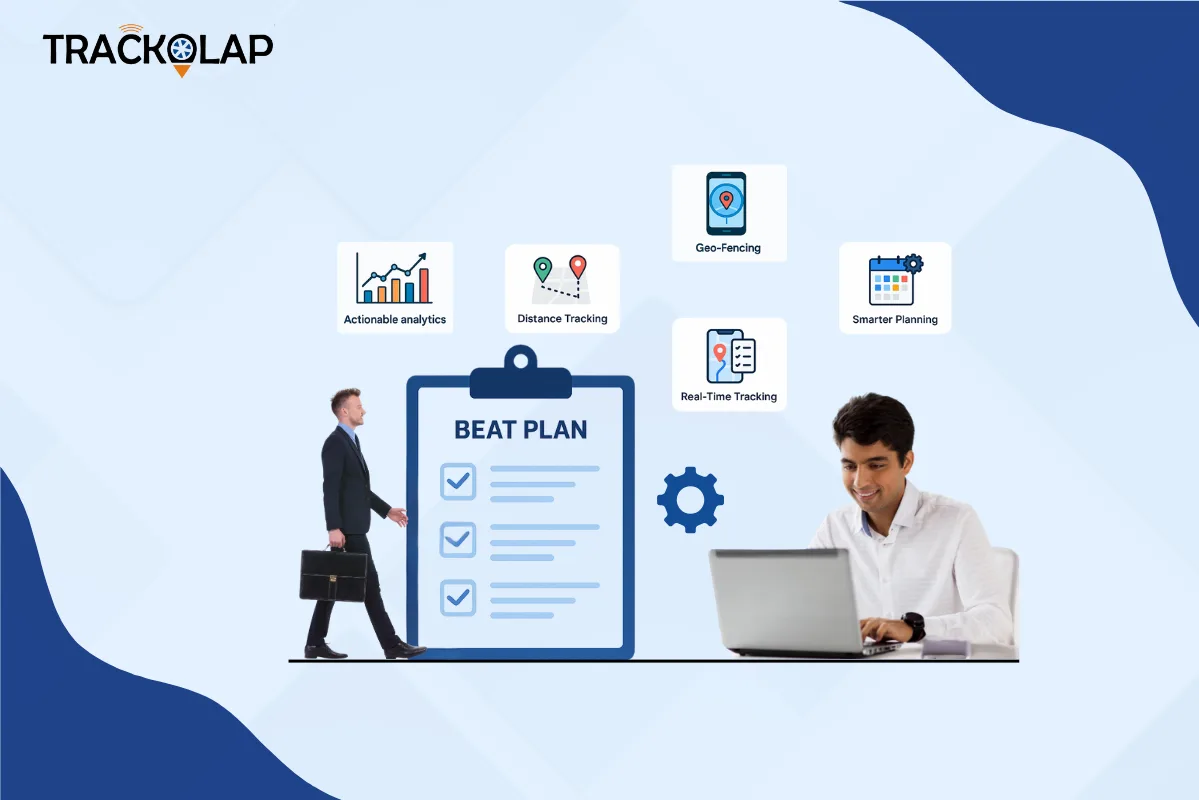
This is exactly the gap TrackOlap is built to close. Beat Planning is beat planning software for sales teams and field force route planning software in the fullest sense: it assigns outlets to reps and days by territory, visit frequency and priority tier, so a distributor’s beat management schedule stays consistent instead of being redrawn from memory every morning. Live Tracking is its real-time employee GPS tracking layer, an employee GPS tracking app for managers on the move and a field employee monitoring system for the back office, showing deviation from the beat plan the moment it happens, not at month-end reconciliation. Together, as a single field force tracking solution, it delivers what a genuine field force route optimization stack has to: a plan, a live feed against that plan, and a record of what actually happened.
Four recent releases show this playing out, one challenge at a time.
Automatic Claimed KM calculation using odometer readings eliminates manual distance entry from expense claims altogether. Odometer readings captured at Punch In and Punch Out are linked directly to expense claims, so Claimed KM is calculated automatically and cannot be edited by hand. Odometer images captured during attendance sit alongside the expense record for verification, visible to both the employee and the approving manager. This exists because route efficiency gains are only real if the distance data feeding them is real. An odometer-backed claim is the difference between a genuine fuel-cost saving and a number that looks good on a dashboard but doesn’t survive an audit.
Expense flagging for review is the answer to exactly that discrepancy. Claims are automatically flagged when the amount exceeds a configured limit, or when the gap between system-tracked GPS distance and odometer-recorded distance exceeds a configured threshold: the precise signature of a rep driving a route other than the one planned, or reporting one that didn’t happen. Flagged claims surface clearly in the Expense Listing and Expense Details on both web and mobile, with the reason attached, so managers review outliers instead of auditing every claim line by line. It turns route-plan enforcement around: instead of only planning the route, it verifies afterward that the plan was followed.
Language input validation for task forms solves data consistency for pan-India field teams. Admins configure Text and Textarea fields on task forms to accept English only, or English plus Hindi, and unsupported characters or language mixes are blocked until the entry is corrected. For a distribution business running beats across multiple states and language regions, this makes sure task data (order remarks, visit notes, outlet feedback) arrives standardised and usable, rather than becoming free text nobody can aggregate. Clean field data is what makes beat-planning intelligence possible in the first place; route optimization is only as good as the visit and outlet data feeding it.
In-progress task reassignment is the fix for a gap beat planning alone can’t close. Admins reassign a pending or in-progress task (an unfinished outlet visit, an open collection, a survey started but not closed) from one employee to another, with complete visibility and accountability preserved throughout. Information already submitted stays locked and cannot be edited by the new assignee; each subsequent assignee adds their own updates on top of it, and every reassignment and update is logged in a full audit trail. The result: a rep calling in sick, going on leave, or being pulled onto an urgent job no longer means an outlet drops off the day’s coverage or a task’s history gets overwritten. The beat holds, and the record of who did what stays intact.
The Wider TrackOlap Product Stack Behind Route Intelligence
Live Tracking and Beat Planning are the core of how TrackOlap delivers route intelligence, but it doesn’t stop there. It solves the surrounding problems too, through a connected Sales CRM stack most distribution teams are already using.
Field Sales Automation turns a beat plan into a working sales call, not just a list of stops. Order booking, van-sales billing and stock updates happen at the outlet itself, on the rep’s device, so the route a rep drives and the revenue that route produces are captured in the same system, with no separate paper trails or apps to reconcile later.
Expense Management keeps route-driven costs honest. This is where odometer-based Claimed KM calculation and automatic expense flagging, both above, actually live. The module is built on one principle: route optimization only pays off if the fuel and mileage numbers behind it are real.
Attendance & Leave Management anchors the whole day’s travel record to a verified start and end point. Punch In and Punch Out odometer captures feed straight into the distance calculations Expense Management uses, so a rep’s attendance record and route record are the same data, never two systems to cross-check by hand.
Task Management keeps beat-linked field work (visit notes, collection tasks, outlet surveys) clean and covered. Language input validation and in-progress task reassignment both live here, making sure a beat stays intact even when the rep on it changes.
Sales CRM is the hub all of this sits on, alongside Lead Management, Opportunity and Target modules. Route intelligence here isn’t a bolt-on routing feature. It’s wired into the same CRM a rep already works from for leads, targets and orders, so territory and beat planning are set against actual sales targets, not as a separate exercise.
TrackOlap Collect extends this same expertise to a different vertical: field collection agents for MFIs, NBFCs and small finance banks visiting borrower centres on a fixed schedule. Center management and field collection tracking here run on the identical logic as FMCG beat planning: a defined visit sequence, live tracking against it, and a verified record of what actually happened at each stop.
The ROI Math for a 50-Rep Distribution Team
Fifty reps. Real numbers. No fluff.
50 reps × 55 km/day × 25 days ≈ 68,750 km/month, about ₹2.75 lakh in fuel before any optimization. TrackOlap’s Beat Planning routinely cuts 12-15% of that distance: ₹33,000 to ₹41,000 saved every month.
Reclaimed drive time (30-40 min/rep/day) becomes 2,500 to 4,000 extra outlet visits a month, capacity you didn’t hire for.
Annualised: ₹4-5 lakh in fuel savings, thousands of extra visits, zero extra headcount.
What to Demand From Any Route Optimization Software for Distribution
Before signing another year of a routing or field-tracking contract, a distribution or FMCG business should be able to answer four questions about the tool it is using. Does it plan beats by outlet priority and visit frequency, or does it simply record where reps have been after the fact? Does it reconcile claimed travel against system-tracked travel automatically, or does expense approval still rely on a manager’s judgment call? Does it flag anomalies such as cost outliers and distance mismatches proactively, or does someone have to go looking for them at month-end? And does it capture field data in a form clean enough to actually analyse across states, languages and teams? A platform that answers yes to all four is delivering route intelligence. One that answers yes only to the first is still, functionally, GPS.
Whether it is marketed to you as a field force tracking solution, an employee GPS tracking app, or beat planning software for sales teams, the label matters less than how many of those four questions it can actually answer.
Frequently asked questions
What is route optimization software for distribution?
It is software that plans and adjusts field visit sequences (sales beats, deliveries, collections) using live location, historical visit patterns and territory rules, so that reps and vehicles cover the most outlets with the least unnecessary travel, rather than simply tracking where a vehicle has already been.
How is route intelligence different from basic GPS tracking?
GPS tracking reports location. Route intelligence uses that location data, alongside planned beats and claimed-versus-actual distance, to plan ahead, flag deviations, and verify that expense claims match the distance genuinely travelled, turning a location feed into an operating decision layer.
Does route optimization software work for FMCG and distribution businesses in India specifically?
Yes, and arguably more so than for generic logistics use cases. FMCG distribution in India runs on high visit frequency across a large number of small-value outlets, spread across widely varying language regions and road infrastructure. Those are exactly the conditions where beat planning, GPS-verified expense reconciliation and standardised field-data capture produce compounding returns.
How much can a distribution business realistically save with route optimization software?
For a team of roughly 50 field reps, fuel-cost savings alone typically fall in the 12-15% range once backtracking and out-of-sequence travel are eliminated, with additional gains from reclaimed field time that convert directly into extra outlet coverage. These figures should be modelled against your own fleet size, fuel cost and beat structure rather than taken as a fixed benchmark.
Is route optimization software the same as employee GPS tracking software?
Not quite. Employee GPS tracking software and real-time employee GPS tracking apps show where a field employee is right now; route optimization software for distribution uses that same location data to plan beats in advance, flag route deviations, and verify travel claims. That makes GPS tracking one input into a broader field force route planning software rather than the end product itself.
Closing
This solves the problem end to end. Live Tracking and Beat Planning put route intelligence at the core; odometer-verified Claimed KM, automatic expense flagging, language-validated task data and in-progress task reassignment close every gap around it. The result is a beat plan that holds even when the rep on it changes, an expense line that can be trusted, and field data clean enough to act on. If your current routing tool can only show you where a rep has been, TrackOlap is built to show you everything else.


 D-5, Logix Infotech Park, Sector 59, Noida - 201301, Uttar Pradesh (India)
 contactus@trackolap.com
 7011494501






 Demo
at free of cost
Demo
at free of cost