








 Back to Blogs
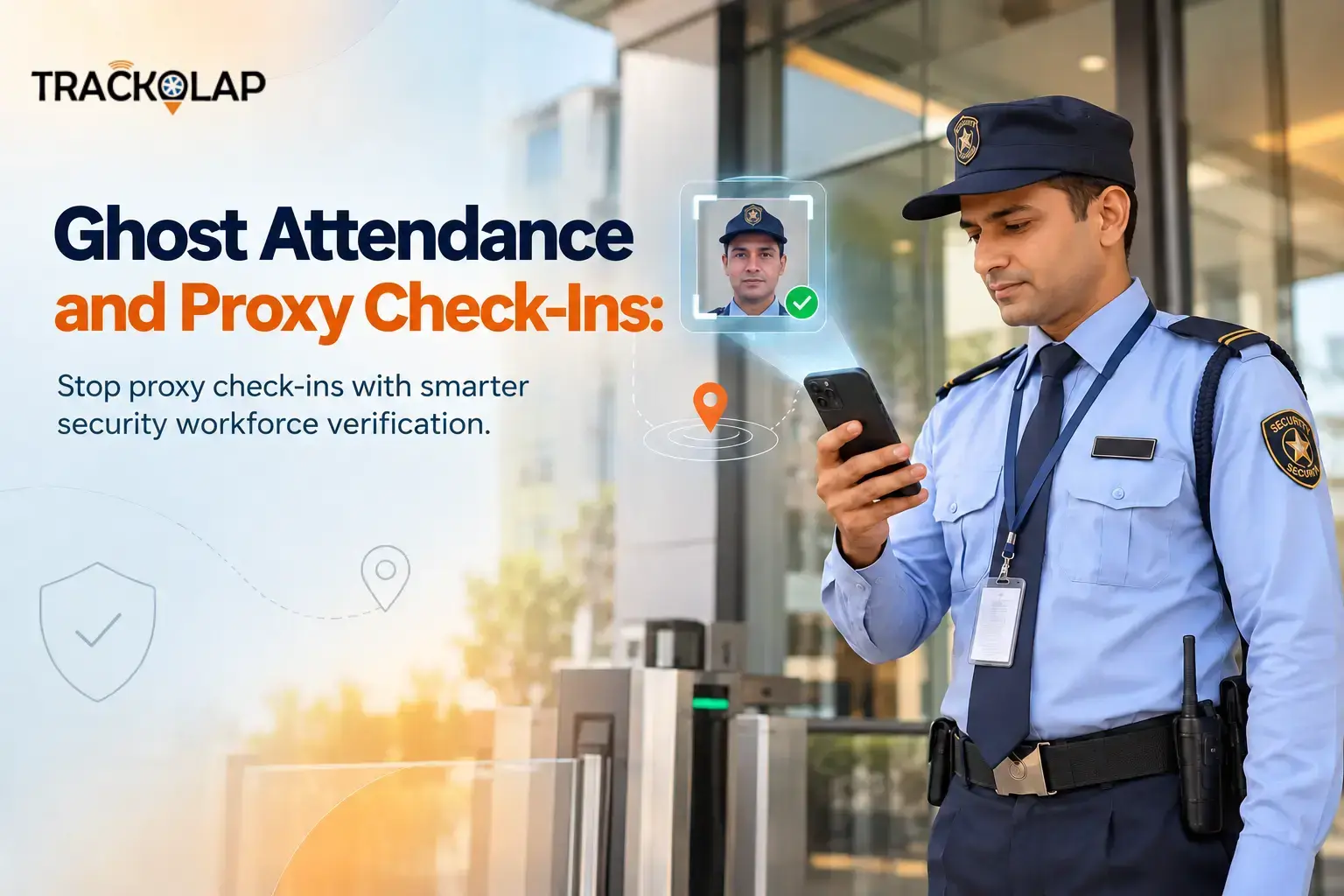
Quick Answer: How Can Security Agencies Stop Ghost Attendance and Proxy Check-Ins?
Security agencies can eliminate ghost attendance by replacing paper registers and shared biometric devices with a mobile attendance management system and employee tracking app such as TrackOlap. The platform combines geofenced attendance, live selfie and face verification, GPS-stamped guard patrols, and automated payroll reconciliation. Every check-in is tied to the right person, at the right post, at the right time, and leaves an audit trail that supports PSARA and labour-law compliance.
Introduction: In Private Security, Presence Is the Product
In the private security business, the product a client pays for is presence. A guard who is not at the gate, the ATM kiosk, the warehouse or the hospital lobby is not just an absent employee. It is an unprotected asset, a breached contract and a reputational risk.
Yet across India, many security agencies still rely on handwritten muster rolls, supervisor phone calls and site registers to confirm that guards reported for duty. These methods make it easy for two of the industry's most expensive problems to grow unnoticed: ghost attendance and proxy check-ins.
This guide explains what these practices are, why the security sector is especially exposed, what the regulatory landscape expects, and how TrackOlap's employee tracking software helps agencies prove, not just claim, that every shift was covered.
What Are Ghost Attendance and Proxy Check-Ins?
Ghost attendance is the recording of attendance for a shift that was never actually worked, or for a worker who does not exist. In a security agency, it typically takes three forms:
- Ghost employees: names on the deployment roster and payroll who have left, were never hired, or exist only to draw wages.
- Ghost shifts: a real guard is marked present for a shift, often a night or double shift, that he or she did not perform.
- Ghost hours: a guard reports late or leaves early, but the register shows the full twelve-hour duty.
Proxy check-ins, also called buddy punching or proxy attendance, happen when one person marks attendance on behalf of another. A colleague signs the register, a supervisor enters a name over the phone, or a guard shares a card, PIN or even a fingerprint mould with someone else.
The two problems are closely linked. Proxy check-ins are the method; ghost attendance is the result. Both inflate billing and payroll, weaken client trust, and leave posts unguarded.
Common proxy and ghost attendance methods in security operations
| Method | How it works | Why manual systems miss it |
|---|---|---|
| Register signing by a colleague | Another guard signs the duty register for an absent guard | Signatures are rarely verified against an ID |
| Supervisor phone confirmation | Field officer confirms presence verbally to the control room | No location or identity proof is captured |
| Shared biometric or RFID card | One card or device is used for several guards | Device confirms the card, not the person |
| Unauthorised substitution | An untrained, unverified outsider covers the shift | The roster still shows the original guard |
| Backdated entries | Missed shifts are filled in at month end | Paper has no timestamp |
Each of these gaps has the same root cause: the attendance record proves that someone wrote something, not that the right guard was at the right post at the right time.

Why Security Agencies Are Especially Vulnerable
The private security industry is one of India's largest employers of frontline, field-based staff. Its operating model creates conditions in which attendance fraud is easy to commit and hard to detect.
1. Highly distributed deployment
A mid-sized agency may manage hundreds of posts across residential societies, factories, banks, malls, hospitals and construction sites in several cities. Supervisors cannot be physically present at every post at every shift change, so the head office depends on second-hand reports.
2. Round-the-clock shift patterns
Guarding runs in 8-hour and 12-hour rotations, including night shifts, weekend duties and relievers for weekly offs. Every handover is a point where a shift can be silently skipped or covered by an unverified substitute.
3. High attrition and frequent substitution
Security staff turnover is high. Guards resign, transfer between sites or are replaced at short notice. When the roster changes faster than the paperwork, ghost names remain on payroll and unauthorised substitutes fill gaps.
4. Shared or weak verification devices
Fixed biometric machines at client sites are often shared, offline, or easily bypassed. A card-based or PIN-based system confirms a credential, not a person. Many sites have no device at all.
5. Billing based on manpower deployed
Most guarding contracts bill clients per guard per shift or per month. If attendance data is inflated, the agency overbills the client. If attendance data is incomplete, the agency underbills itself. Either way, disputes follow.
6. Night-time and remote posts
Perimeter guards at warehouses, solar parks, telecom towers and industrial estates work alone, often at night. These are exactly the posts where sleeping on duty, early exits and proxy check-ins are most likely, and least likely to be caught.
Together, these factors mean that manual guard attendance management is not just inefficient. It is structurally unable to prove presence.
The Regulatory and Compliance Context in India
Workforce verification is not only an operational best practice. Indian law places clear obligations on private security agencies around who they deploy, how they record work and how they pay for it.
Private Security Agencies (Regulation) Act, 2005 (PSARA)
The Private Security Agencies (Regulation) Act, 2005 governs the licensing of private security agencies in India. Under PSARA, agencies must obtain a licence from the State Controlling Authority, and every guard deployed must meet prescribed eligibility, training and character-verification requirements. The Ministry of Home Affairs operates the national PSARA portal for licensing, and has issued the Private Security Agencies Central Model Rules, 2020 to standardise training, verification and record-keeping across states.
Why it matters for ghost attendance: an unauthorised substitute standing in for a verified guard is not just a payroll issue. That substitute may not be police-verified or trained as PSARA requires, which exposes the agency's licence and the client's premises to risk.
The Labour Codes
India's four Labour Codes, administered by the Ministry of Labour and Employment, consolidate earlier labour laws. The Code on Wages, 2019 and the Occupational Safety, Health and Working Conditions Code, 2020 require employers to maintain accurate records of wages, working hours, overtime and attendance, many of which can be maintained electronically. Accurate, tamper-evident attendance data is the foundation for compliant wage calculation and overtime payment.
Social security contributions: EPF and ESI
Security guards are typically covered under the Employees' Provident Fund and Employees' State Insurance schemes. Contributions to EPFO and ESIC are calculated on wages earned. Ghost employees on the payroll can lead to incorrect filings, while unrecorded genuine shifts can lead to short payment of statutory dues.
Digital Personal Data Protection Act, 2023
Modern attendance systems collect selfies, facial templates and location data. The Digital Personal Data Protection Act, 2023, administered by the Ministry of Electronics and Information Technology, and its implementing rules require that personal data be processed for a lawful purpose, with notice and consent, and with reasonable security safeguards. Agencies should choose a platform that collects only what is needed, secures it, and restricts location tracking to duty hours.
The Real Cost of Ghost Attendance for Security Agencies
Ghost attendance rarely appears as a single large loss. It accumulates quietly across payroll, billing, compliance and client relationships.
Direct financial leakage
Consider an illustrative agency deploying 500 guards at an average monthly cost of ₹18,000 per guard. If just 2% of recorded shifts are ghost or proxy shifts, the agency pays for roughly 10 guard-months of work that never happened, about ₹1.8 lakh every month or more than ₹21 lakh a year. Statutory contributions on those inflated wages add to the loss.
Client penalties and contract loss
Most corporate, banking and facility-management clients now include service-level agreements with penalties for unmanned posts. A single incident, such as a theft during a shift that was marked as covered, can trigger penalties, a forensic audit of past invoices, or termination of the contract.
Compliance and licence risk
If an unverified substitute is found on duty, the agency may be in breach of PSARA licence conditions. Inaccurate attendance also undermines wage, overtime and social-security records required under the Labour Codes.
Operational blind spots
When attendance data is unreliable, managers cannot plan relievers, spot chronic absenteeism, or identify sites that need more supervision. Decisions are made on assumptions rather than evidence.
Erosion of trust
Honest guards resent colleagues who are paid for shifts they did not work. Clients start questioning every invoice. Over time, the agency's brand shifts from "reliable partner" to "vendor to be audited".
The conclusion is simple: the cost of not verifying attendance is far higher than the cost of a verification system.
How TrackOlap Strengthens Workforce Verification for Security Agencies
TrackOlap is an employee tracking software and attendance management system that helps security agencies move from claimed attendance to verified attendance. Instead of trusting a signature or a phone call, the platform verifies four things at every check-in: identity, location, time and activity.
1. Geofenced attendance: the guard must be at the post
The employee tracking software lets administrators draw a virtual boundary, or geofence, around each client site. Guards can mark attendance from the mobile app only when they are physically inside the assigned geofence. A check-in from home, a tea stall or another site is blocked or flagged automatically.
2. Live selfie and face verification: the right person, not a proxy
Each check-in requires a live selfie captured in the app. Face verification compares it with the guard's registered profile, so a colleague cannot mark attendance on someone else's behalf. This directly addresses buddy punching and proxy check-ins, without depending on shared biometric hardware at the site.
3. Time-stamped, tamper-evident records
Every attendance entry carries a server-side timestamp and GPS coordinates. Late arrivals, early exits and missed shifts are recorded as they happen, which removes the scope for backdated month-end entries.
4. Real-time guard tracking during duty hours
With duty-hour live location tracking, control rooms can see whether guards remain on post throughout the shift. If a guard leaves the geofence, supervisors receive an alert and can arrange a reliever before the post is left exposed.
5. Guard tour and patrol verification
For patrolling duties, the platform supports checkpoint-based guard tours. Guards confirm each checkpoint on their route, and managers can review patrol completion, timing and missed checkpoints. This proves not only that a guard was present, but that the guard was working.
6. Shift and roster management
Agencies can create shift rosters, assign guards to posts, and manage relievers and weekly offs in one place. When a scheduled guard does not check in, the system highlights the uncovered post immediately rather than at the end of the month.
7. Supervisor and field officer visibility
Site visits by field officers and supervisors can be logged with location and photo evidence, giving management confidence that inspections are actually taking place.
8. Attendance-to-payroll and billing reconciliation
Because attendance is verified at source, the data flows cleanly into payroll, overtime and client billing. Agencies can share verified attendance reports with clients as proof of service, which reduces invoice disputes.
9. Dashboards, alerts and analytics
Real-time dashboards show present, absent, late and on-leave counts across all sites. Analytics help managers spot repeat absentees, sites with frequent substitutions and supervisors whose posts consistently show gaps.
Manual registers vs. a digital attendance management system
| Capability | Manual register or basic device | TrackOlap |
|---|---|---|
| Identity proof | Signature or card | Live selfie with face verification |
| Location proof | None | Geofence and GPS coordinates |
| Timestamp | Handwritten | Automatic, server-side |
| Proxy prevention | Weak | Built in |
| Patrol verification | Not available | Checkpoint-based guard tours |
| Uncovered post alerts | Discovered later | Real time |
| Payroll and billing | Manual compilation | Verified, exportable reports |
| Client proof of service | Photocopies | Shareable digital reports |
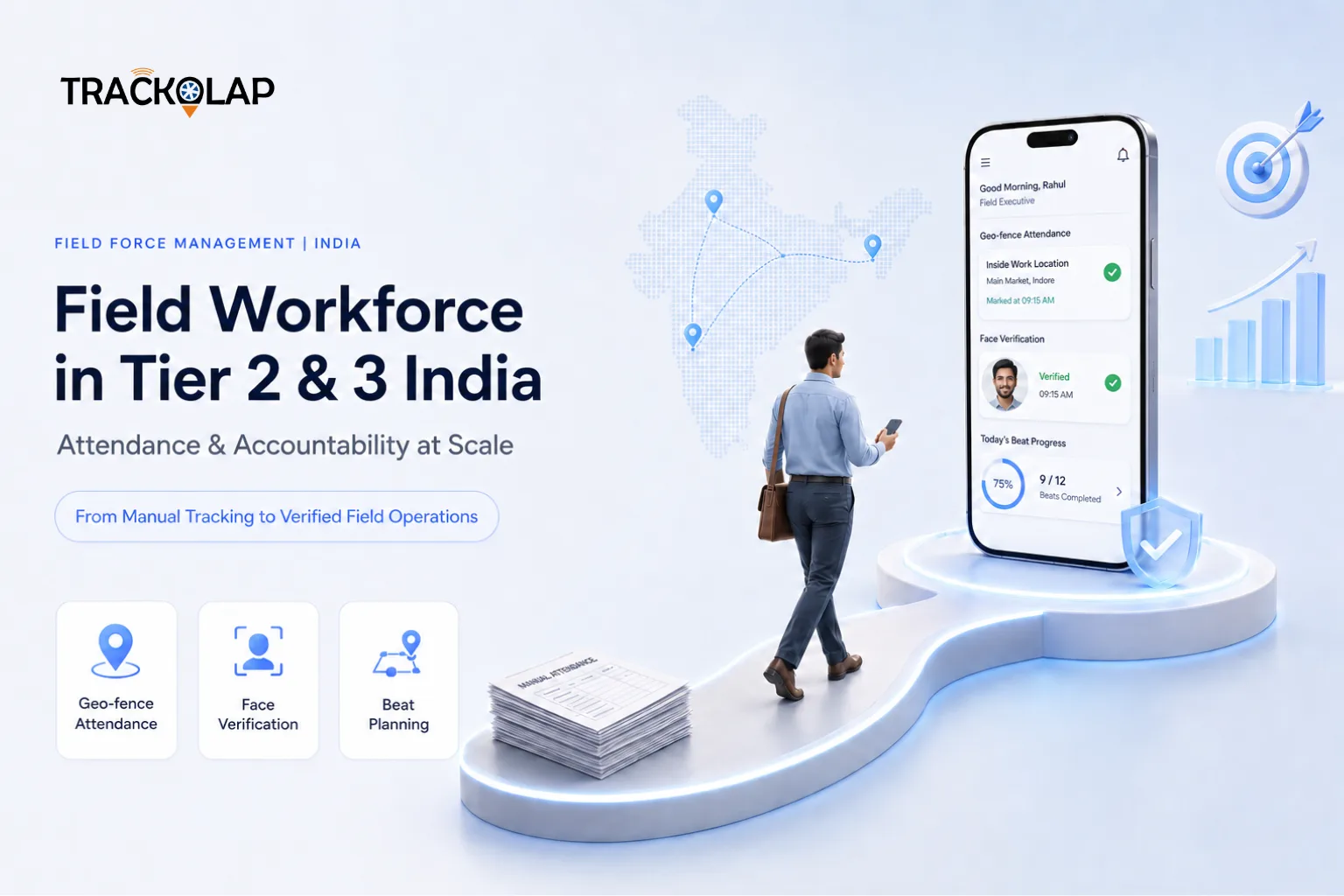
A Practical Roadmap: Implementing an Employee Tracking App for Workforce Verification
Technology works best when it is introduced with a clear plan. The following seven-step approach helps security agencies roll out verified attendance with minimal disruption.
- Audit the current roster. Reconcile payroll, deployment rosters and PSARA verification records. Remove names that cannot be matched to a verified, active guard. This step alone often exposes existing ghost employees.
- Map every site and post. Create geofences in the employee tracking app for each client location, with separate posts where a site has multiple gates or zones. Define patrol checkpoints for sites that require guard tours.
- Enrol guards with verified profiles. Register each guard with photo, ID details and PSARA verification status. Collect only the data required, explain its purpose, and obtain consent in line with the DPDP Act.
- Configure shifts, relievers and rules. Set shift timings, grace periods, overtime rules and escalation alerts for late or missing check-ins.
- Pilot at high-risk sites. Start with night-shift, remote or high-value client sites where ghost attendance risk is greatest. Use the pilot to refine geofence sizes and alert thresholds.
- Train guards and supervisors. Keep training simple and in the local language. Emphasise that verified attendance protects honest guards by ensuring every genuine shift is recorded and paid.
- Integrate with payroll and client reporting. Link verified attendance to payroll and billing, and share periodic proof-of-service reports with clients. Review dashboards weekly to act on absenteeism and coverage gaps.
Best practices for sustainable results
- Communicate transparently. Tell guards what is tracked, when, and why. Location tracking should be limited to duty hours.
- Combine technology with supervision. Use alerts to direct supervisors' surprise checks to the sites that need them most.
- Act on exceptions quickly. A flagged check-in that is ignored teaches staff that verification is optional.
- Reward reliability. Recognise guards with consistent, verified attendance records.
- Review data protection regularly. Restrict access to biometric and location data to authorised personnel.
Frequently asked questions
What is ghost attendance in security agencies?
Ghost attendance is the recording of attendance or wages for shifts that were never worked, or for guards who are not actually deployed. It includes ghost employees on payroll, unworked shifts marked as present, and inflated duty hours.
What is a proxy check-in or buddy punching?
A proxy check-in, or buddy punching, is when one person marks attendance on behalf of another, for example by signing a register, sharing an access card, or confirming presence over the phone.
How does TrackOlap prevent proxy attendance?
It requires each guard to check in through the attendance app for employees with a live selfie verified against the guard's registered profile, from inside the assigned site's geofence. Every entry is time-stamped and GPS-tagged, so attendance cannot be marked from elsewhere or by someone else.
Can employee tracking software verify that guards stay on post during the shift?
Yes. With duty-hour location tracking and geofence alerts, supervisors are notified if a guard leaves the post. Checkpoint-based guard tours also verify that patrols are completed as scheduled.
Does verified attendance help with PSARA compliance?
Verified attendance helps agencies show that only enrolled, verified guards were deployed and supports accurate record-keeping. Agencies should still meet all licensing, training and verification requirements under PSARA and the applicable state rules.
Is it legal to capture guards' selfies and location data?
Personal data must be handled in line with the Digital Personal Data Protection Act, 2023. Agencies should give clear notice, obtain consent where required, limit tracking to duty hours, and secure the data.
Does a mobile attendance app for employees work for remote or night-shift posts?
Yes. Because it runs on the guard's smartphone, the app does not depend on fixed hardware at the site, making it suitable for remote, outdoor and night-shift locations.
How quickly can an agency see results?
Many agencies see gaps surface within the first payroll cycle, as uncovered posts, late arrivals and unmatched roster names become visible on the dashboard.
Conclusion: From Claimed Presence to Proven Presence
In private security, presence is the service. Ghost attendance and proxy check-ins undermine that service at its core, draining payroll, inflating or weakening invoices, exposing agencies to PSARA and labour-law risk, and leaving client premises unprotected.
Paper registers and shared devices cannot solve this problem because they were never designed to prove identity, location and time together. A modern workforce verification platform can.
With geofenced attendance, live selfie and face verification, real-time guard tracking, checkpoint-based patrols and verified payroll data, TrackOlap gives security agencies the evidence they need to run leaner operations, bill with confidence and earn lasting client trust.
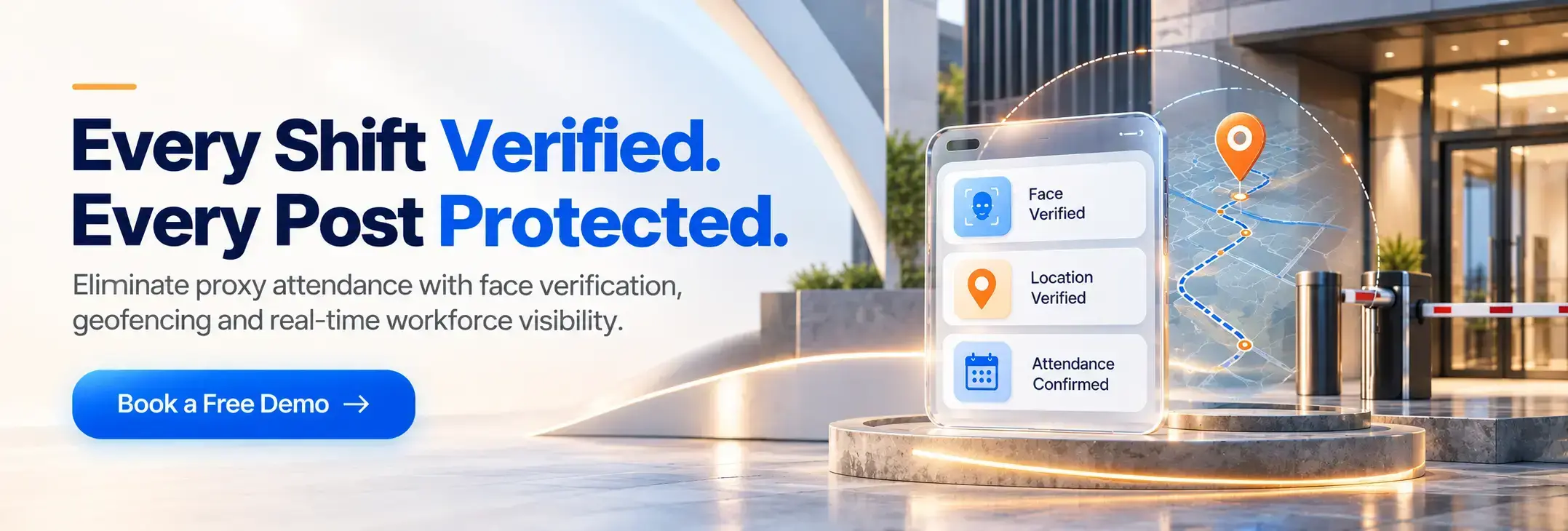
Ready to eliminate ghost attendance across your sites? Book a free demo of TrackOlap's security guard attendance and workforce management solution and see how verified attendance can protect your margins, your licence and your clients.



 D-5, Logix Infotech Park, Sector 59, Noida - 201301, Uttar Pradesh (India)
 contactus@trackolap.com
 7011494501





 Demo
at free of cost