












 Back to Blogs
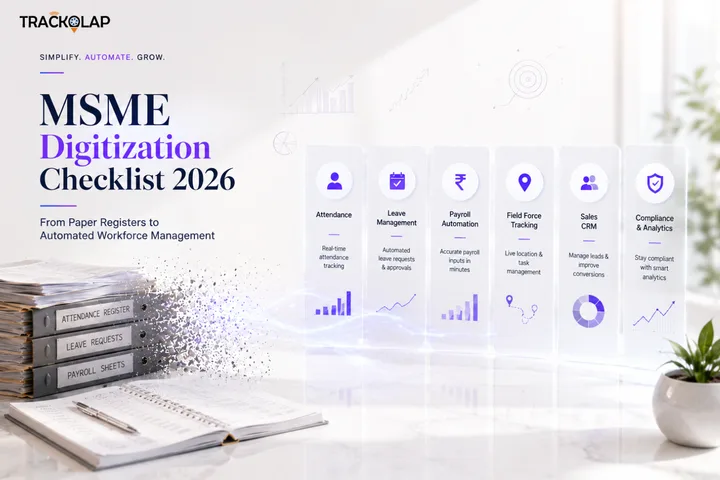
If your business still runs on a paper attendance register, a WhatsApp group for leave requests, and an Excel sheet that one person updates from memory, 2026 is the year that stops being “good enough.” It quietly becomes a liability.
Two forces have collided. India’s four new Labour Codes came into force on 21 November 2025, replacing 29 older labour laws with a single, stricter framework — and according to the Ministry of Labour & Employment, the codes make written appointment letters, statutory minimum wages, and social-security coverage mandatory for every worker, including gig and platform workers. At the same time, margins for most micro and small firms remain thin, audits are getting sharper, and a misplaced muster roll can now invite real penalties.
The result is a reversal of old logic. For decades, manual registers felt like the cheap option. In 2026, they are the expensive one. This MSME digitization checklist walks you through exactly how to move from paper to automated workforce management — step by step, in the order that actually makes sense for a small team.
Why MSMEs Must Digitize Now
The scale of India’s MSME sector makes this more than a niche concern. Press Information Bureau data published in March 2026 shows that over 7.83 crore enterprises have registered on the Udyam and Udyam Assist portals since July 2020 — up from 4.12 crore just two years earlier. Micro-enterprises alone make up roughly 97% of that base. These are precisely the businesses that historically relied on registers and spreadsheets, and precisely the ones now exposed to formalisation pressure.
Three shifts explain why digitization has moved from “nice to have” to “do it this year”:
1. Compliance is no longer optional paperwork: Under the Code on Wages and the Code on Social Security, employers must issue appointment letters to all workers, guarantee timely wage payment, and extend ESIC and social-security benefits more widely than before. These requirements are now concrete, not theoretical: the government notified the final Central Rules under all four codes on 8 May 2026, operationalising wage calculation, working hours, social security, and mandatory appointment letters (with several states still finalising their own State Rules). A handwritten register simply cannot produce the timestamped, exportable records an inspector or auditor will now ask for.
2. The digital tooling has become affordable: The reason metros once led digital adoption was cost. That gap has closed. India’s broader workforce formalisation reflects this momentum — social-security coverage rose from about 19% of the workforce in 2015 to more than 64% in 2025, per government figures. Cloud HR and workforce platforms now start at price points a five-person firm can absorb, and a 2024 NASSCOM survey found that over 65% of Indian SMEs planned to increase spending on digital tools. The wave has moved well beyond Bengaluru and Mumbai into Tier-2 and Tier-3 hubs.
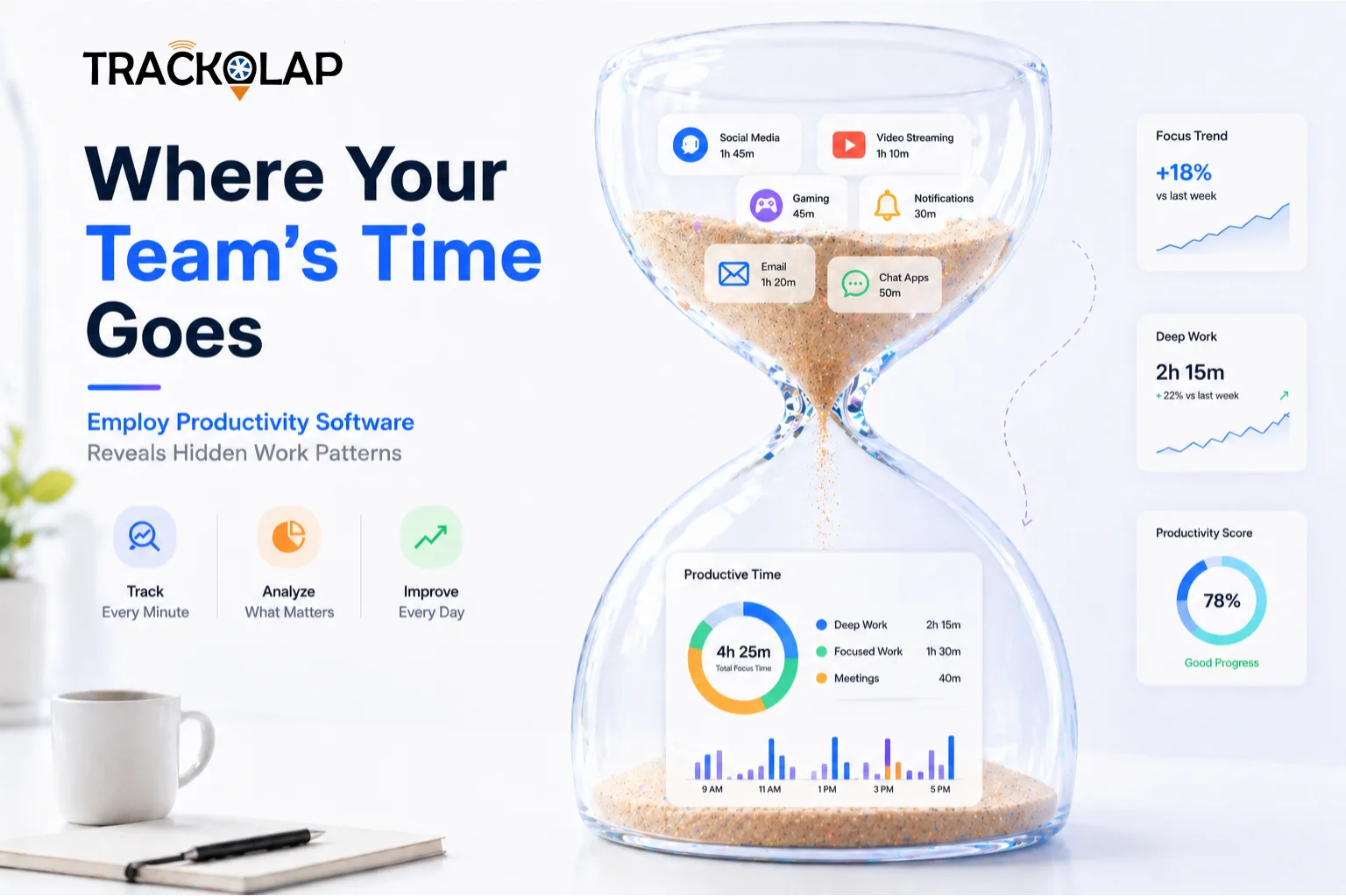
3. Manual processes cost more than they save: Every hour spent reconciling attendance against payroll, chasing leave approvals on chat, or rebuilding a field-staff report from scratch is an hour not spent on customers. The hidden costs — payroll errors, disputed overtime, lost expense bills, sales follow-ups that slipped — quietly outweigh any software subscription.
In short: digitization is now the compliance path and the efficiency path. The checklist below shows where to start.
The 10-Point MSME Digitization Checklist
You do not need to digitize everything at once. Work through these ten points roughly in order — each one builds on the last, and the early steps deliver the fastest payback. A single affordable platform like TrackOlap can cover most of these points from one dashboard, which is what keeps the cost (and the learning curve) realistic for a small team.
1. Digital Attendance
Start here, because attendance is the foundation everything else rests on. Replace the paper register with mobile or biometric check-in, GPS-stamped punches for field staff, and geofencing where it matters. The moment attendance becomes a clean digital record, payroll, overtime, and compliance logs all become reliable downstream. TrackOlap’s attendance module captures real-time punches and turns them directly into payroll-ready data.
2. Leave Management
Move leave requests off WhatsApp and email. A digital leave system gives employees a self-service balance view, routes approvals to the right manager, and updates entitlements automatically. No more reconciling who took what at month-end. Crucially, it creates the leave audit trail the new codes expect.
3. Payroll Inputs
You do not have to replace your accountant or payroll processor — you need to feed them clean inputs. Automating the bridge from attendance and leave into payroll inputs (LOP days, overtime, arrears, statutory deductions) eliminates the single most error-prone step in any small business. Get this right and salary disputes largely disappear.
4. Field Force Tracking
If you have sales reps, delivery staff, technicians, or merchandisers on the road, manual reporting is guesswork. Field employee tracking software replaces it with live location, route history, visit check-ins, and task completion — visibility without micromanaging. For field-heavy MSMEs in distribution, FMCG, and services, this is often where automation pays for itself within the first month.

5. Sales CRM
A spreadsheet of leads is a graveyard of follow-ups. A simple CRM captures every enquiry, assigns it, sets reminders, and shows you the pipeline at a glance — and for teams whose reps sell on the road, field sales management software ties that pipeline back to real visits. For a growing MSME, the difference between a 20% and a 30% conversion rate usually isn’t more leads — it’s never dropping the ones you already have.
6. Expense Management
Digitize expense claims so staff photograph a bill, submit from their phone, and managers approve in seconds. This kills the shoebox-of-receipts problem, speeds reimbursements, and — importantly — produces categorised, exportable expense records for your books and any audit.
7. Reporting and Analytics
Once attendance, leave, field staff location tracking, and sales live in one system, reporting stops being a monthly fire drill. Dashboards that update in real time let you see productivity, absenteeism, and pipeline health on demand. Decisions get faster because the numbers are already there.
8. Compliance and Statutory Logs
This is the point that ties directly to the Labour Codes. Maintain digital muster rolls, wage registers, and statutory logs that can be filtered, exported, and produced on request. Automated records with timestamps are exactly what the new compliance regime — and any inspector — will expect, and they are nearly impossible to assemble from paper after the fact.
9. Employee Records and Document Management
The codes now require appointment letters for all workers, so a central, digital employee record — contracts, IDs, salary structures, documents — is no longer optional housekeeping. Storing these in one searchable place means you can prove compliance instantly instead of digging through files.
10. Communication and Task Management
Finally, bring day-to-day coordination into the system: task assignment, deadlines, and team updates in one place rather than scattered across chats. This is the layer that turns a collection of tools into an actual operating rhythm for your team.

Budgeting for Cloud Tools
The most common objection — “we’re too small to afford software” — is now mostly outdated, but budgeting still matters. A few principles keep spending sane:
Pay per active user, not per seat. Most cloud workforce platforms price per employee per month. For a 15-person firm, a consolidated platform typically costs far less than a single part-time admin hour spent fixing manual errors each day.
Consolidate instead of stacking. Buying separate tools for attendance, Sales CRM, expenses, and field tracking software adds up fast — in money and in the chaos of disconnected data. A single platform covering most of the ten points above is usually cheaper and far easier to run than four niche apps that don’t talk to each other. This is the core argument for a unified system like TrackOlap rather than a patchwork.
Budget for the rollout, not just the licence. Set aside a little time for data migration and a week or two of staff hand-holding. The software cost is small; adoption is where projects succeed or stall.
Treat it as compliance insurance. With the Labour Codes now live, a modest monthly subscription that produces clean statutory records is cheaper than a single penalty or a disputed wage claim.
Common Pitfalls to Avoid
Digitization projects rarely fail because of the technology. They fail because of how they’re rolled out. Watch for these:
• Boiling the ocean: Trying to digitize all ten points in week one overwhelms a small team. Start with attendance, prove the value, then expand.
• No single owner: If “everyone” is responsible for the new system, no one is. Name one person to drive adoption.
• Skipping clean data: Importing a messy employee list into a new tool just digitizes the mess. Spend a day cleaning records first.
• Choosing on price alone: The cheapest tool that nobody uses is the most expensive mistake. Pick something your least tech-savvy employee can actually operate from a phone.
• Ignoring mobile: For field staff and small teams, a desktop-only system is dead on arrival; a proper field employee tracking app on every phone is the bare minimum. Mobile-first is non-negotiable in 2026.
Conclusion
The shift from manual registers to automated workforce management is no longer a future ambition for India’s MSMEs — it’s a 2026 necessity driven by both compliance and economics. The Labour Codes have raised the bar on documentation, affordable cloud tools have lowered the barrier to clearing it, and the cost of staying on paper now outweighs the cost of going digital.
Work the checklist in order, start with attendance, and consolidate onto a single platform built for small teams rather than enterprises. Start your MSME’s digital shift — TrackOlap, built for small teams to handle attendance, leave, payroll inputs, field tracking, CRM, expenses, and compliance from one affordable dashboard.
Frequently asked questions
How can an MSME go digital?
Start small and in order. Digitize attendance first, then leave and payroll inputs, then layer on field tracking, CRM, expenses, reporting, and compliance logs. Pick one affordable, mobile-first cloud platform that covers most of these functions, assign a single owner to drive adoption, and clean your existing data before importing it.
What should MSMEs automate first?
Attendance. It is the foundation for payroll accuracy, overtime, and statutory records, and it delivers visible results within the first pay cycle. Once attendance is reliable, leave management and payroll inputs are the natural next steps.
Is workforce software affordable for small businesses?
Yes. Most cloud platforms charge a modest fee per employee per month, and a 2024 NASSCOM survey found over 65% of Indian SMEs were increasing their digital-tool spending. A consolidated platform typically costs less than the time and errors of running everything manually — and far less than a compliance penalty.
How does digitization help labour-code compliance?
India’s four Labour Codes, effective 21 November 2025 with final Central Rules notified in May 2026, require appointment letters for all workers, timely statutory wages, and wider social-security coverage. Digital systems produce timestamped attendance, wage registers, leave records, and document trails that can be exported on demand — exactly the evidence the new framework expects and that paper registers cannot reliably provide.
What tools do MSMEs need?
At minimum: digital attendance, leave management, a payroll-input bridge, and compliance logging. Field-based businesses should add field-force tracking, and sales-driven firms need a CRM or a dedicated sales tracking system. Rather than buying separate apps, most MSMEs are better served by one unified platform covering attendance, leave, field tracking, CRM, expenses, and reporting together.

 D-5, Logix Infotech Park, Sector 59, Noida - 201301, Uttar Pradesh (India)
 contactus@trackolap.com
 7011494501






 Demo
at free of cost
Demo
at free of cost