
















 Back to Blogs
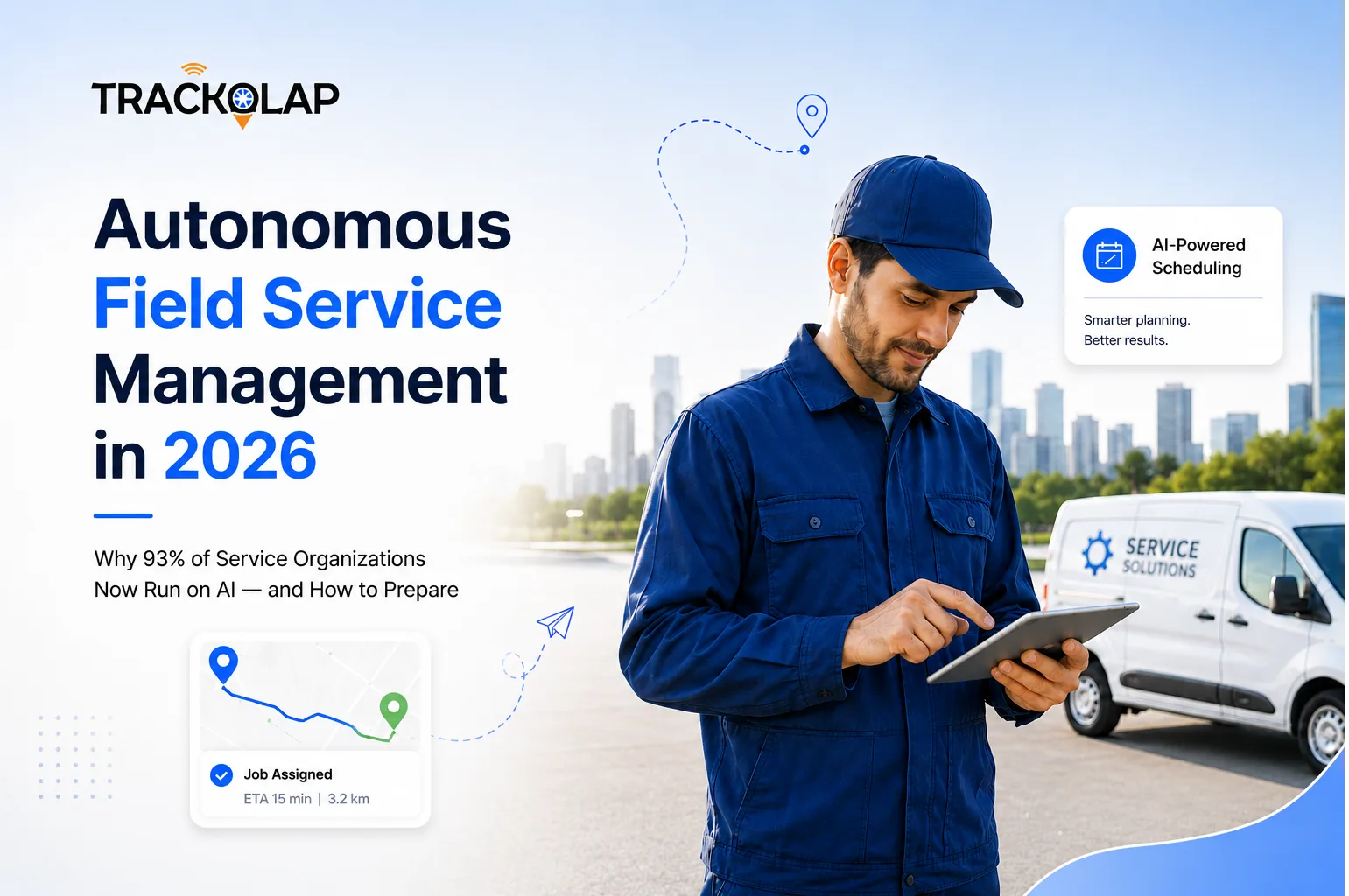
Field service management is no longer about assisting your team. In 2026, it is about running operations that increasingly manage themselves. The global field service management (FSM) market is valued at roughly $6.26 billion in 2026 and is projected to reach $9.68 billion by 2030, growing at a compound annual growth rate of about 11.5%. According to industry research, 93% of service organizations have now implemented artificial intelligence in some form, and enterprise data shows automation lifting dispatcher productivity by nearly 50% while reducing operational errors by around 8%.
For business owners, operations leaders, and field force managers, the message is unambiguous: the shift from AI-assisted to AI-autonomous field operations has arrived, and the organizations that adapt their scheduling, dispatch, and workforce management systems now will define the next decade of service delivery. This article explains what autonomous field service management means, what the latest data and government workforce statistics reveal, and how a purpose-built platform like TrackOlap helps growing companies make the transition with confidence.
What Is Autonomous Field Service Management? (A Clear Definition)
Autonomous field service management is the use of artificial intelligence, real-time location intelligence, and workflow automation to plan, assign, execute, and optimize field operations with minimal manual intervention. Where traditional FSM software simply records jobs and shows a technician’s location, autonomous FSM software actively decides: it generates work orders from incoming requests, assigns the right technician based on skills, availability, and proximity, optimizes travel routes, and updates schedules dynamically as conditions change.
In simple terms, the difference is this. AI-assisted systems suggest — they recommend a route or flag a delay for a human to approve. AI-autonomous systems act — they reassign a job, reschedule a visit, or dispatch the nearest available field executive without waiting for manual input. This is the single most important structural change in workforce management and field force automation in 2026, and it sits at the heart of why field service management software is being re-evaluated across manufacturing, utilities, telecom, facilities, healthcare, retail distribution, and financial field sales.
The 2026 Data: A Market Moving Fast Toward Automatio
The numbers behind this shift are worth stating plainly, because they anchor every business case for investing in modern field force automation.
The FSM market’s growth from $6.26 billion in 2026 to a projected $9.68 billion by 2030 reflects an 11.5% CAGR — faster than most enterprise software categories. That growth is driven less by new adopters and more by deeper adoption: with 93% of service organizations already using AI in some form, the competitive frontier has moved from “do you use AI?” to “how autonomous are your field operation.
Three capability areas are absorbing most of the investment. First, AI-powered scheduling and dispatch, where algorithms match technicians to jobs and continuously re-optimize as cancellations, traffic, and urgent tickets arrive. Second, route optimization and real-time location intelligence, where the system tracks field executives live and recalculates the most efficient routes and assignments as the day unfolds. Third, automated work-order generation, where a customer request becomes a fully specified, assigned, and routed job without a coordinator manually typing anything.
The productivity evidence is equally concrete. Enterprise field service data cited across the industry shows automation improving dispatcher productivity by approximately 50% and reducing errors by around 8% — gains that compound across hundreds of daily jobs. Mobile-first field operations report productivity improvements as high as 75%, and a large majority of service organizations report improved equipment uptime and customer experience after deploying AI. For a field-force-dependent business, those are not marginal improvements; they are the difference between shrinking margins and scalable growth.

Government and Official Data: The Workforce Reality Behind the Trend
Autonomous field service management is a response to measurable, government-documented pressures on the field workforce, and a few official facts make the case.
In the United States, the U.S. Bureau of Labor Statistics projects roughly 608,100 annual openings in installation, maintenance, and repair occupations over 2024–2034, with a median wage of $58,230 — confirming that field talent is in constant demand and costly, so every idle hour and avoidable truck roll matters. In the United Kingdom, the Office for National Statistics reports 29% of businesses using AI by 2026, rising to about 44% among large employers. In India, the government-backed IndiaAI Mission (MeitY), funded at over ₹10,300 crore, is actively accelerating AI infrastructure, skilling, and adoption for enterprises managing large distributed field teams.
From Assisted to Autonomous: What Actually Changes on the Ground
To understand why this matters for your business, consider a typical day in a field-force operation and how autonomy transforms it.
Scheduling and dispatch. In a manual model, a coordinator reviews the day’s jobs, checks who is free, guesses at travel times, and builds a schedule that is outdated by mid-morning. In an autonomous model, the system continuously assigns and re-sequences jobs based on real-time location, technician skills, service-level commitments, and traffic — absorbing last-minute cancellations and emergencies without a human rebuilding the board.
Work-order generation. Instead of a back-office agent transcribing a customer call into a ticket, an autonomous system converts the request into a structured, prioritized, and routed work order automatically, reducing the roughly 8% error rate that manual entry introduces.
Field execution and verification. Field executives receive optimized routes, digital checklists, and customer context on a mobile app. Their location, task status, and time on site are captured automatically, giving managers a live, accurate operational picture rather than end-of-day guesswork.
Continuous optimization. The system learns. Every completed job improves future estimates for travel time, job duration, and technician-task fit — the compounding advantage that separates AI-native operations from those merely bolting AI onto legacy tools.
This is precisely where the ~50% dispatcher productivity gain comes from: the humans stop doing repetitive coordination and start managing exceptions, relationships, and growth.
Where TrackOlap Fits: Field Force Automation Built for Autonomous Operations
The strategic question for most companies is not whether to move toward autonomous field operations, but how to do it without ripping out their existing processes. This is where TrackOlap is designed to help.
TrackOlap is a field force automation and workforce productivity platform built for businesses that run distributed teams — field sales executives, service engineers, delivery agents, and on-ground staff. Rather than forcing a rip-and-replace, TrackOlap brings the core building blocks of autonomous field service management into one connected system:
• Employee location tracking software with real-time GPS intelligence — the foundation of any autonomous dispatch decision. You cannot optimize routing or assignment without knowing, accurately and in real time, where your field executives are.
• Field employee attendance app with geo-verified check-ins — replacing manual registers and disputes with location-stamped, tamper-resistant records that feed directly into productivity analytics and staff time management.
• Task and work-order management — assign, track, and verify field jobs end to end, with status updates flowing back automatically instead of via phone calls.
• A tracking app for sales teams and lead management (CRM) — for organizations whose “field service” is field sales, TrackOlap manages leads, follow-ups, and pipeline so that the right executive reaches the right prospect at the right time.
• Remote employee monitoring software and productivity analytics — turning raw field activity into the insight managers need to reduce idle time, spot bottlenecks, and coach performance across distributed teams.
• Staff time management, expense, and leave management — closing the loop on the full field-operations lifecycle so administration stops consuming manager time.
In the language of this article, TrackOlap gives growing businesses the data backbone and automation layer that autonomous field service management depends on. Accurate location, verified attendance, structured tasks, and clean productivity data are the raw materials that AI-driven scheduling and dispatch require. Without that foundation, “autonomous FSM” is just a slogan; with it, it becomes an operational reality that scales.
For Indian SMEs and enterprises in particular — operating amid the government’s IndiaAI push and managing large, distributed, cost-sensitive field teams — TrackOlap offers a practical, affordable on-ramp to the same productivity gains that global enterprises are reporting.
A Practical Roadmap to Autonomous Field Operations
Moving toward autonomy is a journey, not a switch. Based on how leading service organizations are sequencing the transition, a pragmatic roadmap looks like this.
Stage 1 — Digitize and capture. Replace paper, spreadsheets, and phone-based coordination with a single system of record. Deploy field force tracking, geo-verified attendance, and digital task management. The goal is clean, real-time data — the non-negotiable prerequisite for any automation. TrackOlap is purpose-built for this stage.
Stage 2 — Automate the routine. Introduce automated work-order creation, rule-based assignment, and productivity dashboards. Free your coordinators from repetitive scheduling so they focus on exceptions. Expect early, visible wins in reduced errors and faster response times.
Stage 3 — Optimize with intelligence. Layer AI-driven scheduling, route optimization, and predictive insights on top of your now-reliable data. This is where the documented ~50% dispatcher productivity and ~8% error-reduction gains are realized.

Stage 4 — Move toward autonomy. Allow the system to make and execute low-risk decisions — reassignments, re-sequencing, routine dispatch — while humans supervise and handle judgment-heavy exceptions. Governance, transparency, and clear escalation paths matter here, especially as data-protection and workforce regulations tighten globally.
Attempting Stage 4 before completing Stage 1 is the most common and expensive mistake in field operations. Autonomy is only as good as the data underneath it.
The Business Case: Why This Is Worth Doing No
The return on autonomous field service management is measurable across four dimensions.
Cost efficiency: With field labour commanding a median wage above $58,000 in the US and comparable pressures worldwide, reducing idle time, misrouting, and unnecessary truck rolls directly protects margin. Even single-digit percentage gains in technician utilization translate to significant annual savings.
Productivity: The evidence — up to ~50% improvement in dispatcher productivity and as much as 75% in mobile-first operations — means more jobs completed per day with the same headcount, a decisive advantage in a talent-constrained market.
Customer experience: Faster response, accurate arrival windows, and first-time-fix improvements drive retention and referrals. With the majority of AI-adopting service organizations reporting better uptime and customer experience, this is now table stakes rather than a differentiator.
Scalability: Autonomous systems absorb volume growth without a linear increase in coordination headcount, letting you expand territories and teams without proportionally expanding back-office cost.
For a founder or operations leader, the strategic risk is no longer moving too early — it is moving too late while competitors compound their data and efficiency advantages.
Challenges to Manage Honestly
A formal assessment must acknowledge the obstacles. Data quality is the first: autonomous decisions built on inaccurate location or attendance data will fail visibly. Change management is the second: field teams adopt tools they trust and abandon tools that feel like surveillance, so transparency and clear value to the worker are essential. Integration with existing CRM, ERP, and billing systems requires planning. And governance and compliance — data protection, worker consent, and fair-scheduling expectations — must be addressed proactively, particularly as regulators across the UK, EU, and India sharpen their focus on workplace AI. Choosing a platform like TrackOlap that captures reliable data and presents it transparently to both managers and field staff materially reduces these risks.
Frequently asked questions
What is autonomous field service management in simple terms?
It is field operations software that uses AI and real-time location data to schedule, dispatch, and manage field jobs with minimal manual input — the system decides and acts, rather than only suggesting to a human coordinator.
How much can automation improve field service productivity?
Enterprise field service data shows automation improving dispatcher productivity by approximately 50% and reducing errors by around 8%, while mobile-first field operations report productivity gains up to 75%. Is AI adoption in field and workforce management actually mainstream in 2026? Yes. Roughly 93% of service organizations report using AI in some form, and official UK ONS data shows 29% of all businesses (about 44% of large businesses) using AI as of 2026.



 D-5, Logix Infotech Park, Sector 59, Noida - 201301, Uttar Pradesh (India)
 contactus@trackolap.com
 7011494501






 Demo
at free of cost
Demo
at free of cost