












 Back to Blogs
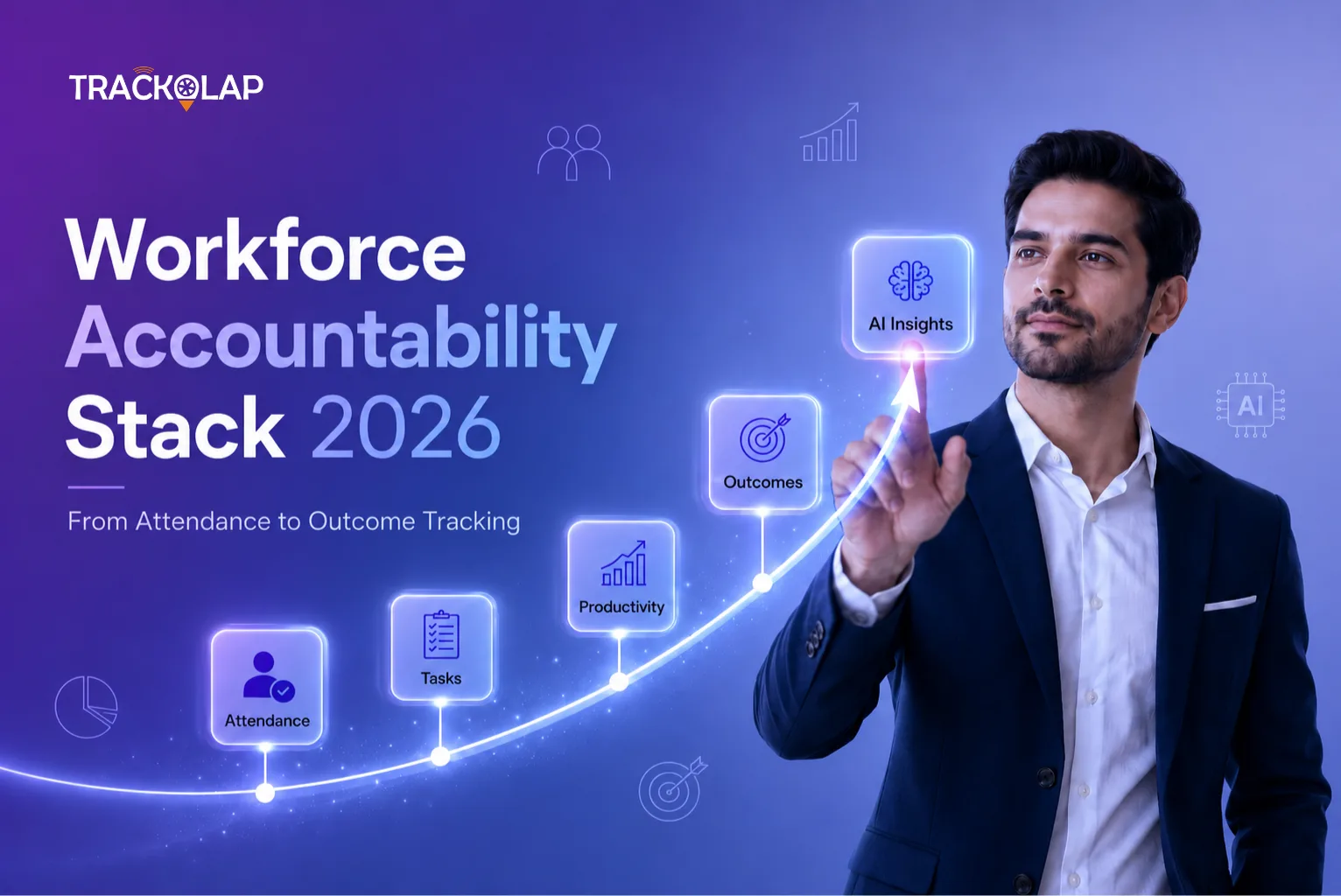
For two decades, workforce accountability in India began and ended with a single question: Who showed up today? Biometric punches, register entries, and swipe cards became the definition of a “present” employee. But in 2026, presence is the weakest signal of performance you can collect. A workforce accountability stack is the modern answer — a layered operating model that moves an organization from measuring attendance to measuring attention, activity, and ultimately outcomes. This guide lays out that stack, grounds it in India’s shifting labour landscape, and shows how a unified platform like TrackOlap becomes the connective layer that ties every layer together.
Why Attendance-Only Accountability Is Breaking in 2026
The Indian workforce is no longer a room full of desks that a supervisor can see. It is distributed, hybrid, field-based, and increasingly platform-driven. According to the Periodic Labour Force Survey (PLFS) 2024 released by the Ministry of Statistics and Programme Implementation (MoSPI), India’s all-India Labour Force Participation Rate stood at 59.6% with a Worker Population Ratio of 57.7% (usual status, persons aged 15 and above, January–December 2024). That is a vast, growing, and mobile workforce — and a punch-in timestamp tells you almost nothing about what any of it actually produced.
Three structural shifts have made attendance-only accountability obsolete:
The workforce has left the building
Sales teams, service technicians, delivery agents, merchandisers, and relationship managers now spend most of their day away from any fixed location. A biometric device at the head office cannot verify whether a field executive completed twelve client visits or two.
Work has become project
And outcome-shaped. Knowledge and services work is measured in deliverables, closures, and SLAs — not hours warmed in a chair. The COO who tracks only attendance is optimizing an input that has almost no correlation with revenue.
The gig and flexible economy is scaling fast
NITI Aayog’s report on India’s gig and platform economy projects the sector will grow from 7.7 million workers in 2020-21 to 23.5 million by 2029-30. Meanwhile, the government’s e-Shram portal has registered over 30 crore unorganised workers (Ministry of Labour & Employment). Accountability frameworks built for a fixed nine-to-five simply do not map onto this reality.
The conclusion is unavoidable: attendance is table stakes, not the scoreboard. To run a performant organization in 2026, leaders need a full workforce accountability stack — and they need the tooling to operate it.
What Is a Workforce Accountability Stack?
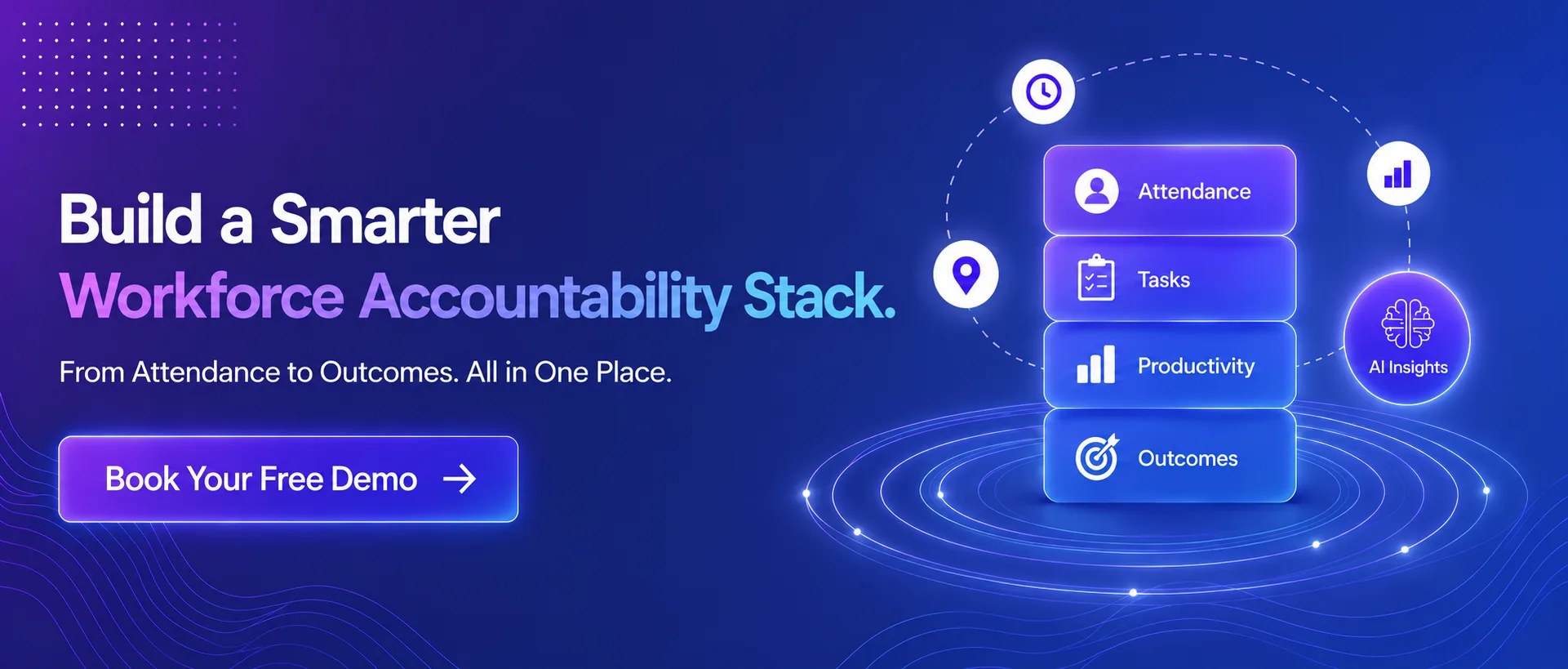
A workforce accountability stack is a layered model in which each layer captures a progressively more meaningful signal of performance, and each layer feeds data upward into the next. Think of it the way engineers think of a technology stack: no single layer is sufficient alone, but assembled correctly they produce something far greater than their parts.
The stack has four core layers plus a layer of connective intelligence:
1. Attendance & Presence — the foundation: is the person available and where they should be?
2. Task & Workflow — the assignment layer: is the right work assigned, in motion, and on time?
3. Productivity & Behaviour — the effort layer: how is working time actually being spent?
4. Outcomes & KPIs — the results layer: what business result did the work produce?
5. AI Insights — the connective layer that reads across all four and turns raw data into decisions.
Below, we break down each layer, the signals it captures, and how TrackOlap operationalizes it.
Layer 1 — Attendance & Presence: The Verified Foundation
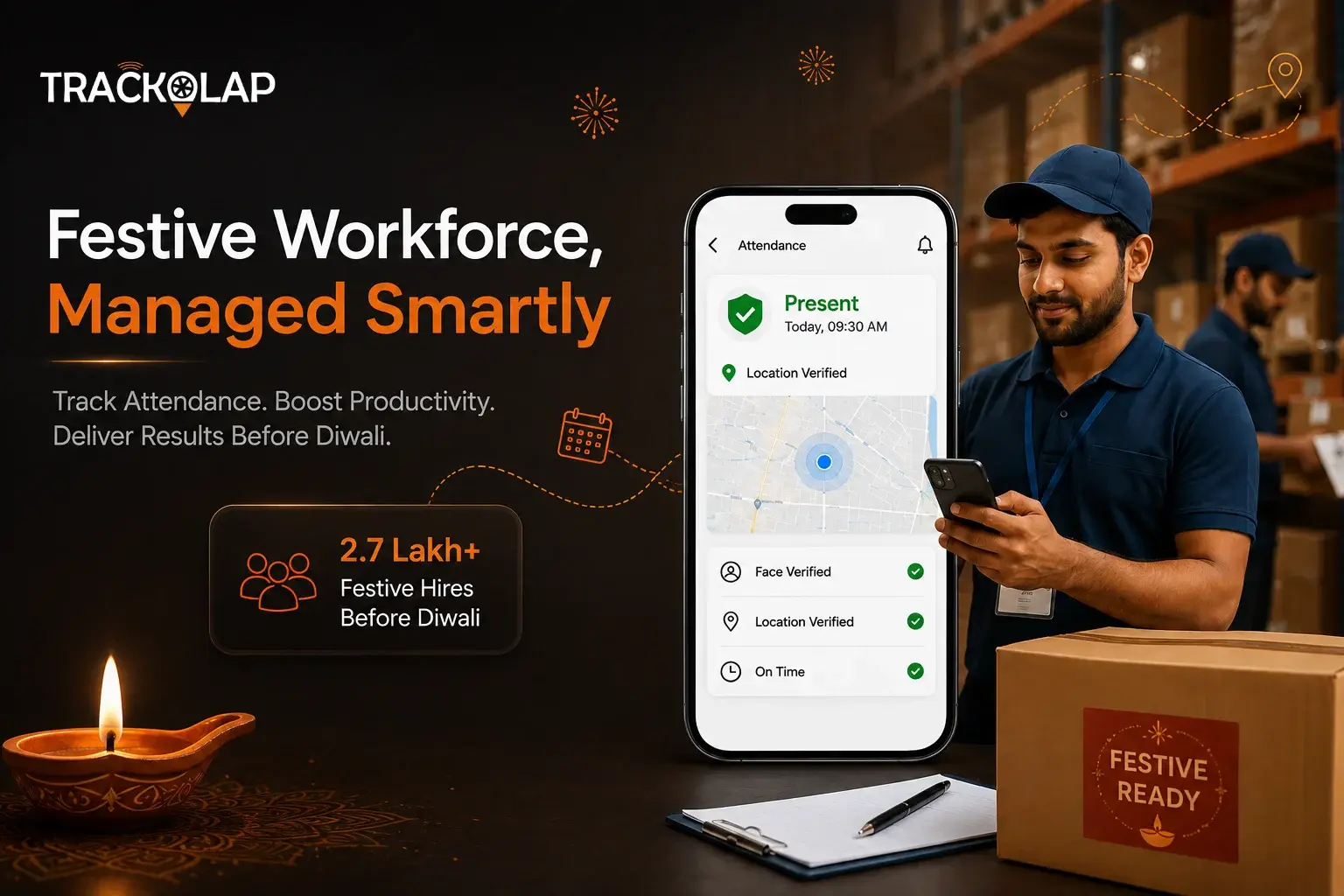
Attendance remains the base of the stack; the change in 2026 is how you verify it. Presence is no longer a binary punch — it is a geo-verified, timestamped, tamper-resistant signal.
TrackOlap’s attendance layer replaces the office biometric with GPS-based attendance, geo-fencing, and real-time employee tracking designed for a mobile workforce. A field executive marks attendance from an approved geo-fence; a remote employee checks in through a secure app; a distributed team is visible on a single live map. This real-time employee tracking capability means a manager always knows not just who is present, but where — the difference between a static register and a living view of the workforce. Selfie-based and geo-tagged check-ins eliminate proxy attendance, and automated timesheets remove the manual reconciliation that eats HR hours every month.
This layer is also where compliance starts. As India’s four new Labour Codes come into force, accurate, auditable records of working hours, overtime, and leave shift from nicety to statutory necessity — and a digital attendance system is the first line of defence for any compliance-conscious COO or HR head.
But presence only tells you the workforce is available. It does not tell you the work is happening. That is the next layer.
Layer 2 — Task & Workflow: Turning Presence Into Assigned Work
Once you know people are available, the accountability question becomes: is the right work assigned, understood, and progressing? This is the task and workflow layer, and it is where most attendance-first organizations have a complete blind spot.
TrackOlap’s task and workflow management converts availability into structured, trackable work. Managers assign tasks with deadlines, priorities, and checklists; employees update status in real time; and every task carries a clear owner and due date. For sales-driven organizations, the integrated Sales CRM and lead management layer means a lead is never lost between assignment and closure — each lead has a stage, an owner, a next action, and a timestamp.
For field teams, this layer becomes a beat plan and visit management engine — one of the most practical field service management tools in the stack: route assignment, client check-ins, order capture, and on-site proof of work. A regional manager can see, at a glance, which visits were planned, which were completed, and which slipped — an accountability signal that attendance data can never surface. Unlike standalone field service management tools bolted onto a separate CRM, this layer shares data with attendance and outcomes, so a completed visit ties directly back to who was present and what it produced.
The task layer answers is work in motion? But motion is not the same as productive effort. That distinction is the third layer.
Layer 3 — Productivity & Behaviour: Measuring How Time Is Spent
The productivity layer examines the quality and composition of working time. Two employees can both be “present” and both have “tasks assigned,” yet spend their day completely differently. This layer makes that difference visible.
For desk and hybrid teams, TrackOlap’s productivity monitoring works as a comprehensive employee work tracker — capturing application and website usage, active versus idle time, and automatic productivity classification, helping leaders distinguish deep work from digital distraction without resorting to surveillance-heavy micromanagement. A modern employee work tracker measures the composition of the working day, not just its length. For field teams, productivity is measured through visit frequency, distance travelled, time-on-site, and task-completion velocity.
The goal here is not to police keystrokes; it is to surface patterns. Which teams are overloaded? Where are the bottlenecks? Which high performers have habits worth replicating? A well-designed productivity layer, deployed transparently and with employee awareness, builds a culture of ownership rather than suspicion. Handled poorly, monitoring erodes trust; handled well — with clear policies and shared dashboards — it becomes a coaching tool.
Still, productivity measures effort. The stack is not complete until effort is tied to results.
Layer 4 — Outcomes & KPIs: The Layer That Actually Matters
This is the apex of the stack and the reason it exists. Outcome tracking asks the only question that ultimately matters to a business: what result did the work produce? Deals closed. Tickets resolved. Revenue booked. Orders delivered. Targets hit.
TrackOlap’s KPI and performance dashboards connect every lower layer to measurable business outcomes. A sales rep’s attendance, visits, and pipeline activity roll up into revenue closed against target. A support agent’s logged hours and task throughput roll up into resolution rates and customer satisfaction. Goal-setting, target tracking, and incentive and performance management modules close the loop — so recognition and reward attach to outcomes, not merely to hours logged.
This is the philosophical shift the entire article is built around: you stop paying for presence and start rewarding contribution. When outcomes sit at the top of a stack that is fully instrumented from attendance upward, every result is traceable — you can see not just that a target was hit, but the chain of attendance, tasks, and effort that produced it.
The Connective Layer — AI Insights
Four layers of data are only as valuable as your ability to interpret them. This is where AI insights transform the stack from a reporting system into a decision engine.
TrackOlap’s AI layer reads across attendance, tasks, productivity, and outcomes to detect what humans miss: the rep whose declining visit frequency predicts a missed quarter, the team whose idle-time pattern signals burnout, the workflow stage where deals consistently stall. Instead of forcing a COO to stitch together five reports, AI-driven analytics surface anomalies, trends, and recommendations automatically — early-warning signals for attrition risk, productivity dips, and pipeline leakage.
This is also what makes the stack future-proof. As India’s digital economy expands toward nearly one-fifth of national income by 2029-30 (Ministry of Electronics and Information Technology estimates it contributed 11.74% of national income in 2022-23), the organizations that win will be those that convert operational data into faster, sharper decisions. AI insights are the connective tissue that makes the whole stack intelligent rather than merely instrumented.
How to Build Your Workforce Accountability Stack: A 2026 Roadmap
Assembling the stack is a sequence, not a switch. Leaders who try to jump straight to outcome dashboards without the foundational layers end up with numbers they cannot trust. Here is a pragmatic path.
Start with a verified attendance foundation. Replace legacy biometric-only systems with geo-verified, app-based attendance that works for office, hybrid, and field staff alike. Ensure records are auditable and aligned with the working-hours and leave requirements introduced under the Labour Codes.
Layer in structured task and workflow management. Move work out of WhatsApp threads and spreadsheets into a single system where every task and lead has an owner, a deadline, and a status. This is where availability becomes accountable action.
Add productivity visibility — transparently. Introduce productivity and behaviour analytics with clear communication to employees about what is measured and why. Frame it as coaching and capacity planning, not surveillance. Transparency is what converts monitoring into trust.
Instrument outcomes and KPIs. Define the two or three outcomes that matter per role, connect them to the lower layers, and build dashboards that roll individual activity up into business results. Attach incentives to outcomes.
Turn on AI insights. Once data flows through all four layers, activate analytics that surface anomalies and recommendations — so managers spend time acting on signals rather than assembling reports.
Each step compounds. By the time you reach the top, you are no longer guessing whether your workforce is accountable — you can see the full chain from presence to profit.
Compliance and Trust: The 2026 Guardrails
A word of caution: an accountability stack must be built on a foundation of legality and trust. India’s evolving labour framework makes accurate, auditable workforce records increasingly important, and the four Labour Codes consolidate 29 central labour laws into a modernized structure covering wages, social security, industrial relations, and workplace safety (Ministry of Labour & Employment).
At the same time, monitoring must respect employee dignity and data privacy. The strongest accountability cultures are transparent: employees know what is tracked, understand how it is used, and see the same dashboards their managers do. A stack that is imposed in secret breeds resentment; a stack that is shared openly builds a genuine culture of ownership. TrackOlap is designed to be deployed in this transparent, consent-aware way — accountability with employees, not against them.
Why TrackOlap Is the Connective Layer
Most organizations already own point tools: a biometric device here, a CRM there, a spreadsheet for KPIs, a separate app for field tracking. The problem is that a stack assembled from disconnected tools does not actually stack — the data never flows upward, and no one sees the full chain from attendance to outcome.
TrackOlap’s advantage is that it is the connective layer. Attendance, task and workflow management, sales CRM, field-force tracking, productivity monitoring, KPI dashboards, incentive management, and AI insights live in a single, integrated employee productivity and monitoring platform. Because every layer sits on one data model, an outcome on the top dashboard can be traced all the way down to the attendance record that started the day. That end-to-end traceability is precisely what a workforce accountability stack is supposed to deliver — and it is nearly impossible to achieve by bolting together standalone apps.
For COOs and HR heads building for 2026, the strategic move is not to buy five more tools. It is to consolidate onto a platform that already speaks every layer of the stack. That is the role TrackOlap is built to play.
Frequently asked questions
What is a workforce accountability stack?
A workforce accountability stack is a layered model for measuring workforce performance that progresses from attendance and presence, to task and workflow, to productivity and behaviour, to business outcomes and KPIs — unified by AI insights. Each layer captures a more meaningful signal than the last, and all layers feed a single view so leaders can trace results back to the activity that produced them.
How is outcome tracking different from attendance tracking?
Attendance tracking records whether and when an employee was present. Outcome tracking measures what that presence actually produced — deals closed, tickets resolved, targets hit. Attendance is an input signal; outcomes are the business result. In 2026, presence has little correlation with performance, which is why leading Indian organizations are moving up the stack toward outcome tracking.
Why do Indian companies need this in 2026?
India’s workforce is increasingly mobile, hybrid, and platform-driven — NITI Aayog projects 23.5 million gig workers by 2029-30, and the digital economy is heading toward nearly one-fifth of national income. Attendance-only systems cannot measure a distributed, outcome-shaped workforce, and new Labour Code compliance requirements demand accurate, auditable records. An accountability stack meets both needs.
Does workforce monitoring hurt employee trust?
It depends entirely on how it is deployed. Secretive, surveillance-heavy monitoring erodes trust. Transparent monitoring — where employees know what is measured, understand why, and see the same dashboards — builds a culture of ownership. TrackOlap is designed for this transparent, consent-aware model of accountability.
How does TrackOlap fit into the accountability stack?
TrackOlap is the connective layer that runs every level of the stack — geo-attendance, task and workflow management, sales CRM, field-force tracking, productivity analytics, KPI and incentive dashboards, and AI insights — on a single integrated platform. Because all layers share one data model, outcomes can be traced end-to-end back to the underlying activity, which disconnected point tools cannot do. From Presence to Performance: The 2026 Mandate The organizations that will out-execute their competition in 2026 are not the ones with the strictest punch-in policies. They are the ones that have climbed the full accountability stack — verifying presence, structuring work, understanding effort, measuring outcomes, and letting AI turn all of it into faster decisions. Attendance tells you the day started. An accountability stack tells you what the day was worth. Building that stack from disconnected tools is slow, leaky, and unverifiable. Building it on a single connective platform is how modern Indian enterprises turn workforce data into a competitive advantage. Build your accountability stack on TrackOlap — talk to our team
 D-5, Logix Infotech Park, Sector 59, Noida - 201301, Uttar Pradesh (India)
 contactus@trackolap.com
 7011494501






 Demo
at free of cost
Demo
at free of cost