
















 Back to Blogs
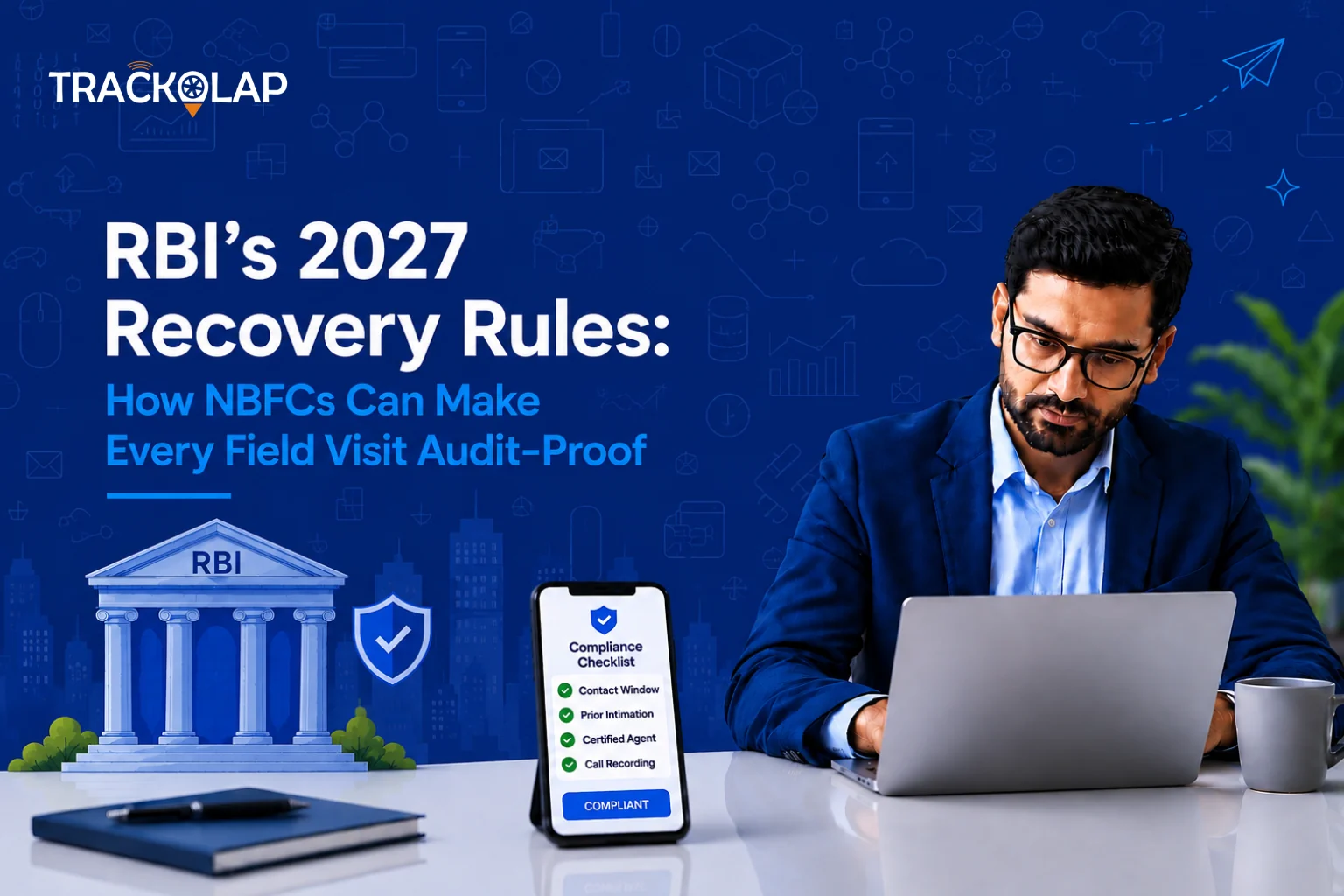
Quick answer: On 6 August 2026, the Reserve Bank of India issued the Reserve Bank of India (Non-Banking Financial Companies – Responsible Business Conduct) Third Amendment Directions, 2026. The Directions take effect on 1 January 2027, extended from the originally proposed 1 October 2026.
They restrict recovery-agent contact to 08:00–19:00 hours, mandate at least one day's prior intimation before a recovery agency's first in-person visit, require IIBF certification for every recovery agent, and oblige NBFCs to preserve recovery call records for six months.
For field collection teams, the practical burden is not the rules themselves—it is producing verifiable evidence that every one of them was followed.
The deadline moved. The work did not get smaller.
For most of 2026, NBFC collection heads were planning against a 1 October deadline. That date has changed.
Responding to industry representations that lenders needed additional time for technical and operational changes and agent training, the Reserve Bank deferred the revised recovery conduct framework to 1 January 2027. The amendment modifies the existing NBFC Responsible Business Conduct Directions and was notified through parallel circulars covering NBFCs, commercial banks and housing finance companies.
It would be a mistake to read the extension as a reprieve. The Reserve Bank granted more implementation time while refusing to dilute the substance. When asked whether newly engaged recovery agents could be certified after they began contacting borrowers, the regulator declined because that relaxation would expose borrowers to conduct risk.
The extension gives an NBFC roughly four and a half months to convert written policies into an operating system that generates proof automatically. A policy note and training deck are not enough. The field process for assigning, notifying, executing and recording visits must be rebuilt.
Why the Reserve Bank is tightening recovery conduct now
Recovery conduct has been under regulatory pressure for several years, and the supporting data explains the urgency.
The Reserve Bank's Annual Report of the Ombudsman Scheme, 2024–25 records 13,34,244 complaints, up 13.55% from the previous year's 11,75,075. Loans and advances were the largest complaint category at 29.25%, ahead of credit cards at 20.04%. NBFCs accounted for 14.80% of complaints received—a disproportionate share relative to the sector's size.
At the same time, the RBI's Report on Trend and Progress of Banking in India, 2024–25 records NBFC credit growth of roughly 19.4%, with the sector holding capital buffers well above the requirement at a CRAR of about 25.9%. NBFCs now account for close to a quarter of scheduled commercial bank credit.
The regulatory logic follows directly: a rapidly expanding lending channel, delivered substantially through outsourced field agents, is generating a significant share of consumer grievances. The Responsible Business Conduct framework is the Reserve Bank's structural answer.
The seven provisions that reshape NBFC field collections
The Directions are broad, but seven provisions carry most of the operational weight for a field collection function.
| # | Provision | What the Directions require | Operational consequence |
|---|---|---|---|
| 1 | Contact window | Contact or visit a borrower or guarantor only between 08:00 and 19:00 hours | Every call and visit needs a defensible timestamp |
| 2 | Prior intimation | Intimate recovery-agency details at least one day before the first visit | A dated, retrievable notification trail per account |
| 3 | Agent certification | IIBF certificate after the Debt Recovery Agents training programme | An onboarding gate, with a one-year window for existing agents |
| 4 | Agency disclosure | Maintain an up-to-date website list of empanelled recovery agencies and update it within seven calendar days | Live roster hygiene, not an annual refresh |
| 5 | Call records | Preserve recovery call records for six months, or until disposal where matters are sub judice | A retention policy with retrieval on demand |
| 6 | Board-approved policy | Cover recovery triggers, escalation matrices and structured handling of financial distress | Documented decision logic, consistently applied |
| 7 | Grievance redressal | Provide a dedicated recovery-grievance mechanism and officer contact details | Named accountability in every communication |
The Directions also codify prohibited practices. Recovery communication must be directed only to borrowers and guarantors—not to relatives, neighbours or colleagues as social leverage. Contact during bereavement, medical emergencies or family functions is barred. Minatory or abusive language, threatening or anonymous calls, and posting recordings on social media are expressly treated as harsh methods. Incentives must not reward aggressive behaviour, and agents may not access personal data such as contacts, SMS messages or call logs on a borrower's device.
For loans that finance a mobile device, technology-based restrictions are permitted only in narrow circumstances tied to defined past-due thresholds. Essential functions must remain available, restoration must occur within one hour after the default is cured, and wrongful restriction can trigger compensation.

The real problem is not compliance. It is evidence.
Almost none of these provisions can be satisfied by a policy document alone. Each creates a proof burden: an obligation to demonstrate to a supervisor or Ombudsman that a specific action was or was not taken at a specific time.
Consider a borrower who alleges that an agent arrived unannounced at 8:30 in the evening. A policy statement and the agent's denial do not establish what happened. Under the new framework, the lender needs the visit record. If it does not exist—or exists only as a handwritten entry in a daily report—the lender has no defensible evidence, irrespective of whether the visit actually complied.
The same asymmetry applies across the framework:
- The 08:00–19:00 window is proven by system-captured timestamps on calls and geo-tagged visits, not by a policy circular.
- One day's prior intimation is proven by a dated notification linked to the borrower record and sent before the visit, not by an agent's assurance.
- Agent certification is proven by an onboarding control that prevents an uncertified agent from receiving an account, not by a quarterly HR spreadsheet.
- The seven-day roster update is proven by change logs on the empanelment list, not by intent.
The Directions have effectively converted field collections from a performance-managed function into an audited one. Targets still matter, but so does the audit trail beneath every rupee recovered.
The evidence a supervisor will ask for is exactly what an employee location tracking system produces during normal operation. Agent-entered reports are assertions. System-captured location and time data provide corroboration—and corroboration is what survives a grievance.
What supervisory scrutiny will actually look for
Based on the structure of the Directions and the Reserve Bank's established supervisory approach, an NBFC should expect examination along four lines.
Reconstruct a single account
Given one loan account number, can the lender produce every call with timestamp and outcome, every visit with time, location and agent identity, the prior intimation sent before the first visit, and the identity and certification status of every agent who touched the account? If reconstruction takes days of manual collation, the control is inadequate.
Test the boundary
Can the lender show how many contact attempts fell outside 08:00–19:00 in the last quarter and what happened as a consequence? A system that cannot report its own exceptions cannot demonstrate that it manages them.
Trace the agent
For every active field agent, does the lender hold a valid IIBF certificate, a documented empanelment date and evidence that the agent appeared on the published list within seven days of engagement?
Close the loop
Where a recovery grievance was raised, can the lender show that the case was not reassigned while the grievance remained unresolved and that a named officer handled it?
None of these questions is answerable from memory. All are answerable from a properly instrumented field system.
A four-month readiness roadmap
With commencement set for 1 January 2027, the realistic planning horizon is short. The following sequence front-loads the items with the longest lead times.
| Period | Priority | Why now |
|---|---|---|
| Aug–Sep 2026 | Begin IIBF certification enrolment for existing agents | Training and examination make this a multi-month programme, not a weekend exercise |
| Sep–Oct 2026 | Secure board approval of the recovery policy and appoint the recovery-grievance officer | Board calendars are the binding constraint, so drafting must begin early |
| Oct–Nov 2026 | Instrument timestamped calls, geo-tagged visits, automated prior intimation and agent-account controls | This systems work requires user-acceptance testing and cannot be compressed into December |
| Nov–Dec 2026 | Publish and version-control the empanelled-agency list, with a seven-day update workflow | The control is public-facing and easily verified by a supervisor |
| Dec 2026 | Dry run: reconstruct ten randomly selected closed accounts | Find failures while there is still time to correct them |
| From 1 Jan 2027 | Operate live and report exceptions monthly to the audit committee | Demonstrate ongoing oversight, not a one-time certification |
Existing agents have one year from the effective date to obtain the IIBF certificate. Newly engaged agents do not: they must be certified before engaging with borrowers. Any NBFC planning to expand its field footprint in 2027 should build certification into its hiring pipeline immediately or accept much longer recruitment lead times.
Where field force technology closes the gap
Most NBFCs already have a collections management system that tracks allocation, dues and recovery. Few have a system that captures what actually happened in the field—and that is where the new evidentiary burden falls.
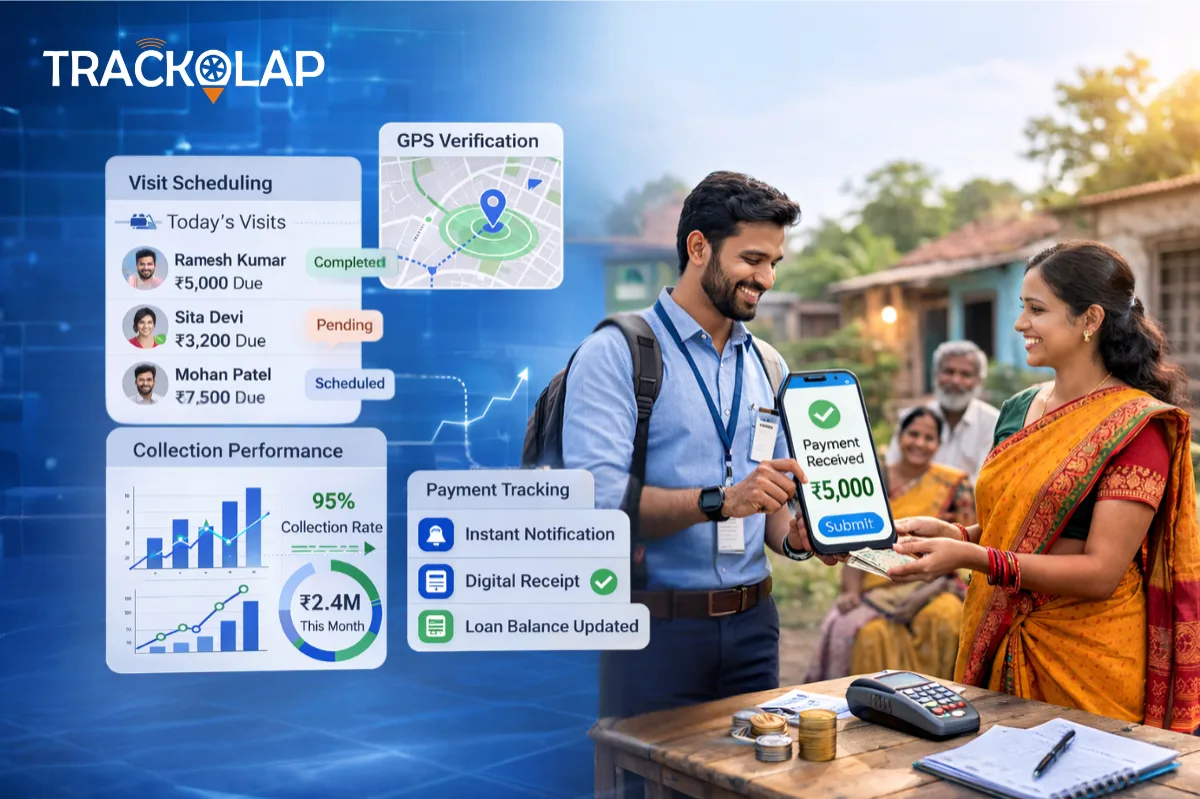
This is the gap TrackOlap's field sales automation software is built to close. A recovery agent on a collection beat is a field employee whose work happens away from a desk. The relevant capabilities map almost one-to-one onto the Directions.
| RBI requirement | Capability that evidences it |
|---|---|
| Contact only between 08:00 and 19:00 | Employee location tracking with timestamped, geo-tagged visit capture |
| One day's prior intimation before the first visit | Scheduled visit planning with automated borrower notification |
| Use IIBF-certified agents only | Agent master with certification status gating account allocation |
| Reconstruct what an agent did and where | Route mapping and travel history for every field day |
| Report exceptions to the audit committee | Structured task records with filterable exception reporting |
| Corroborate agent presence and duty status | Attendance, expense and productivity records |
Employee location tracking and face-captured geo-tagged visits
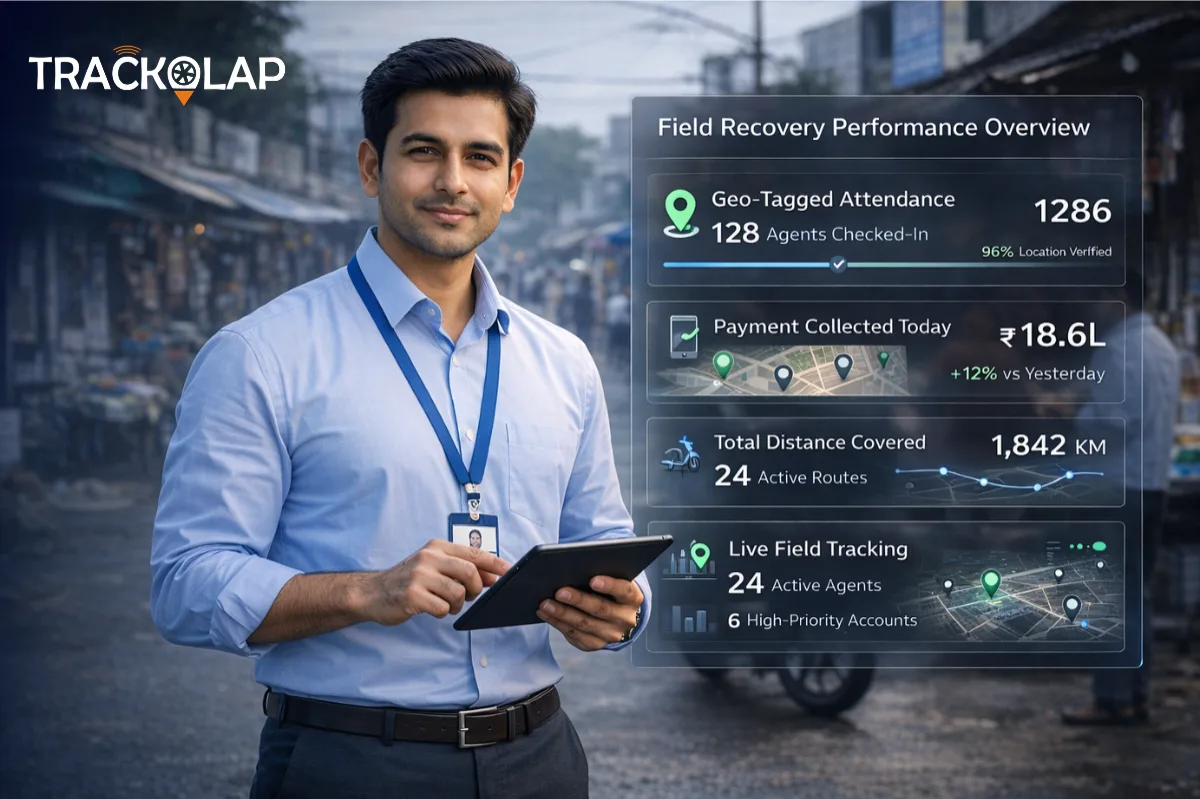
Every visit is captured with a timestamp and location stamp generated by the system rather than entered later by the agent. When a borrower disputes the timing of a visit, the record already exists. This is the strongest operational control against 08:00–19:00 exposure.
Route mapping and travel history
A location stamp answers where an agent was at one moment. Travel history answers what the agent did across the working day, in what sequence and against which planned beat. It also surfaces unplanned detours, accounts visited without allocation and activity near the edges of the permitted contact window.
Visit scheduling and automated borrower intimation
Because a visit is planned before execution, one-day prior intimation can be triggered automatically with agency details and logged against the borrower record. Manual notification processes fail at scale; scheduled workflows create a dated trail.
Agent master and allocation control
Certification status, empanelment date and territory can be held against each agent record. Allocation logic can exclude an agent whose certification is absent or lapsed, placing the control at assignment rather than audit.
Beat planning and route discipline
Planned beats keep field activity inside permitted hours by design and reduce ad hoc, unlogged visits. Read against actual travel history, a planned beat becomes a variance report rather than an intention.
Task management and exception reporting
Every contact attempt becomes a structured, queryable record. A quarterly exception report on out-of-window activity becomes a filter instead of a manual project.
Attendance, expense and productivity records
These records corroborate that an agent was on duty and in the assigned territory at the claimed time, supporting both supervisory responses and internal disciplinary processes.
The commercial argument matters too. Route mapping can raise visits per agent per day by reducing unproductive travel, live field visibility shortens the feedback loop on non-performing beats, and structured records make promise-to-pay follow-up systematic. The Directions make the same investment a compliance priority as well as an operational one.
Four mistakes to avoid before January
1. Treating the extension as slack
The three-month deferral was granted for technical and operational change. Consuming it on deliberation reproduces the original problem in December.
2. Certifying agents last
Certification has the longest and least controllable lead time because it depends on a third-party examination calendar. It should be first.
3. Instrumenting only in-house staff
The Directions define recovery agencies expansively. External entities assisting with collection remain within the NBFC's accountability. Outsourced agents must sit inside the same evidence system as employees.
4. Building the policy without building the record
A board-approved policy that the operating system cannot evidence establishes a documented standard against which the lender's own records may show non-adherence.
Frequently asked questions
When do RBI's new recovery rules come into effect?
The new recovery rules come into effect on 1 January 2027. The Reserve Bank notified the amendment on 6 August 2026, deferring commencement from the originally proposed 1 October 2026.
What are the permitted hours for recovery-agent contact?
An employee or recovery agent may contact or visit a borrower or guarantor only between 08:00 and 19:00 hours, unless the borrower or guarantor has expressly requested or authorised otherwise.
How much notice is required before a recovery agency's first visit?
The NBFC must intimate the details of the recovery agency to the borrower or guarantor at least one day before the agency's first visit.
Do all recovery agents need IIBF certification?
Yes. Recovery agents must hold an IIBF certificate after completing the Debt Recovery Agents training programme. Existing agents have one year from the effective date; newly engaged agents must be certified before engaging with borrowers.
How long must recovery call records be preserved?
Recovery call records must be preserved for six months from the call date, or until disposal in matters that are sub judice.
Do the recovery rules apply to NBFCs, banks and housing finance companies?
Yes. The Reserve Bank issued parallel circulars on 6 August 2026 covering commercial banks, NBFCs and housing finance companies, applying a substantially common recovery-conduct standard across regulated lenders.
What software do NBFCs need for the new RBI recovery rules?
No specific software is mandated. In practice, NBFCs need reliable evidence of compliant activity. Field sales automation can combine employee location tracking, geo-tagged visits, scheduled borrower intimation, route history and an agent master that records IIBF certification status.
How does employee location tracking support the 08:00–19:00 rule?
An employee location tracking system timestamps visits as they happen instead of relying on an end-of-day report. This turns the permitted contact window into a measurable control and makes out-of-window exceptions reportable.
Where can a borrower complain about recovery-agent conduct?
A borrower should first use the NBFC's dedicated recovery-grievance mechanism. The borrower may then use the Reserve Bank's Complaint Management System under the Integrated Ombudsman Scheme. The RBI Sachet portal also accepts and tracks complaints against unauthorised entities.
The bottom line
The Reserve Bank has not asked NBFCs to collect less. It has asked them to prove how they collected. That distinction determines what an NBFC should build before 1 January 2027.
A policy circular does not survive contact with a grievance. A timestamped, geo-tagged, system-generated record does. The NBFCs that come out ahead will be those that stop treating field collections only as an activity to manage and start treating them as an activity to evidence.
Next step: TrackOlap works with lending and financial-services teams to instrument exactly that. Request a demonstration to see how employee location tracking, geo-tagged visit capture, route mapping, automated borrower intimation and agent-level compliance controls fit onto your existing collections stack.
References and official sources
- Reserve Bank of India (Non-Banking Financial Companies – Responsible Business Conduct) Third Amendment Directions, 2026, RBI/2026-27/230, 6 August 2026
- Reserve Bank of India (Commercial Banks – Responsible Business Conduct) Fourth Amendment Directions, 2026, 6 August 2026
- Reserve Bank of India (Housing Finance Companies) Third Amendment Directions, 2026, 6 August 2026
- Indian Institute of Banking & Finance Certificate Examination for Debt Recovery Agents: Rules & Syllabus
- Reserve Bank of India Complaint Management System
- Reserve Bank of India Sachet portal
This article is provided for general information and does not constitute legal or compliance advice. NBFCs should refer to the full text of the applicable Directions on the Reserve Bank of India website and consult their compliance and legal advisers before finalising implementation plans.



 D-5, Logix Infotech Park, Sector 59, Noida - 201301, Uttar Pradesh (India)
 contactus@trackolap.com
 7011494501






 Demo
at free of cost
Demo
at free of cost