












 Back to Blogs

India’s pharmaceutical sector is entering FY27 with significant opportunities and equally significant execution challenges.
According to the Government of India’s Press Information Bureau, India’s pharmaceutical industry ranks third globally by volume. The sector recorded annual turnover of approximately ₹4.72 lakh crore in FY25. Pharmaceutical exports reached around US$30.5 billion, while India’s domestic pharmaceutical market—estimated at approximately US$60 billion—is projected to reach US$130 billion by 2030.
These numbers demonstrate the size of the opportunity. However, market growth alone does not guarantee growth for every pharmaceutical company.
Companies must operate amid intense competition, changing regulatory expectations, pressure on generic-drug prices and increasingly complex product portfolios. International markets remain important, but stronger execution in India is becoming a critical and comparatively controllable growth lever.
In the domestic market, execution frequently depends on the medical representative, or MR. Medical representatives connect pharmaceutical companies with doctors, hospitals, clinics, pharmacies and stockists. They communicate approved product information, manage scheduled interactions, collect market observations and complete essential follow-up activities.
The effectiveness of this workforce can influence territory coverage, sales execution and a company’s ability to translate strategy into measurable action.
Yet many pharmaceutical businesses still manage field operations through disconnected systems.
Attendance may be reported over the phone, doctor visits recorded in spreadsheets, expenses submitted on paper and performance discussed only at the end of the month.
A modern pharma field force management software platform can replace this fragmented process with structured, timely and actionable field information.
What is pharma field force automation?
Pharma field force automation is the use of mobile and cloud-based technology to plan, manage, record and analyse the activities of pharmaceutical field teams.
A comprehensive system may include:
- Medical representative attendance
- Doctor and hospital visit scheduling
- Geo-verified field check-ins
- Beat and territory planning
- Task and follow-up management
- Working-time records
- Travel and expense management
- Target monitoring
- Field activity reports
- Managerial dashboards
Unlike a conventional CRM that primarily manages customer relationships and sales pipelines, field force automation focuses on the operational activities behind those outcomes: where representatives work, which visits they complete, how they use their time and whether assigned actions are closed.
TrackOlap combines these capabilities to provide pharmaceutical companies with a connected view of field execution.
Why will MR effectiveness matter in FY27?
A February 2026 Press Information Bureau report stated that India exports pharmaceutical products to more than 200 markets. The United States accounts for approximately 34% of India’s pharmaceutical exports, while Europe represents about 19%.
This international presence is a major industry strength. It also exposes companies to pricing pressure, regulatory scrutiny, geopolitical uncertainty and competition in mature generic markets.
Domestic growth can provide greater balance—but capturing it requires consistent local execution. India is not one uniform pharmaceutical market. Territory potential differs by therapy, prescriber profile, patient demographics, healthcare infrastructure and location. A field strategy that works in a metropolitan territory may not suit a geographically dispersed tier-two or tier-three market.
More MR activity does not automatically produce better execution. Companies need to know whether their representatives are:
- Covering the appropriate doctors and institutions
- Meeting priority accounts at the planned frequency
- Following practical and efficient routes
- Completing required follow-ups
- Using field time productively
- Reporting activities accurately
- Working within approved company processes
- Generating relevant territory outcomes
Answering these questions requires more than a monthly call average. It requires dependable field intelligence.

What does medical representative effectiveness mean?
Medical representative effectiveness is the ability to convert planned field activity into appropriate account coverage, timely follow-ups, productive territory execution and measurable business outcomes.
It includes several dimensions.
Coverage quality
Coverage measures whether the MR reaches the appropriate doctors, clinics, hospitals, pharmacies and stockists within the assigned territory.
The number of calls alone can be misleading. Ten visits to lower-priority accounts may be less valuable than six well-planned visits aligned with territory priorities.
Visit frequency
Different accounts may require different visit frequencies. A structured plan helps prevent important accounts from being overlooked or a small group of convenient locations from receiving excessive attention.
Time productivity
MRs divide their working day among travel, waiting, meetings, reporting and follow-ups. Staff time management software helps managers understand this distribution and identify avoidable operational inefficiencies.
Follow-up discipline
A productive interaction often creates a next action. It may involve arranging another appointment, providing approved information, meeting a stockist or escalating an issue internally.
MR effectiveness depends partly on whether these actions are recorded, assigned and completed.
Territory efficiency
A well-designed territory balances business potential, travel distance, account density and available working time. Poor territory planning can create high travel costs and weak coverage even when representatives work diligently.
Reporting quality
Managers need accurate and timely information to make decisions. Delayed or incomplete reports reduce the organisation’s ability to intervene during the sales cycle.
Cost efficiency
Field productivity must be evaluated alongside travel and operating expenses. Rising field costs without corresponding improvements in coverage or outcomes may indicate inefficient routes, weak planning or unsuitable territory design.
Why manual MR reporting is no longer enough
Manual MR reporting creates several operational limitations.
An MR may maintain a daily tour plan in one spreadsheet, report attendance through a messaging application, record doctor calls in another document and submit expenses at month-end. A first-line manager must collect, verify and consolidate this information before analysing performance.
This process creates administrative effort but still may not answer basic management questions reliably.
Common limitations include:
- Delayed activity reporting
- Inconsistent report formats
- Incomplete doctor-visit records
- Limited verification of completed visits
- Missed follow-ups
- Duplicate data entry
- Slow expense approvals
- Poor visibility across territories
- Difficulty comparing teams consistently
- Excessive dependence on manager follow-ups
Most manual systems are retrospective. Managers often discover an execution gap after the reporting period has ended.
MR reporting software changes this process by allowing representatives to submit activity information through a mobile system. Managers receive timely updates and can act before a missed visit, incomplete task or territory gap becomes a month-end problem.
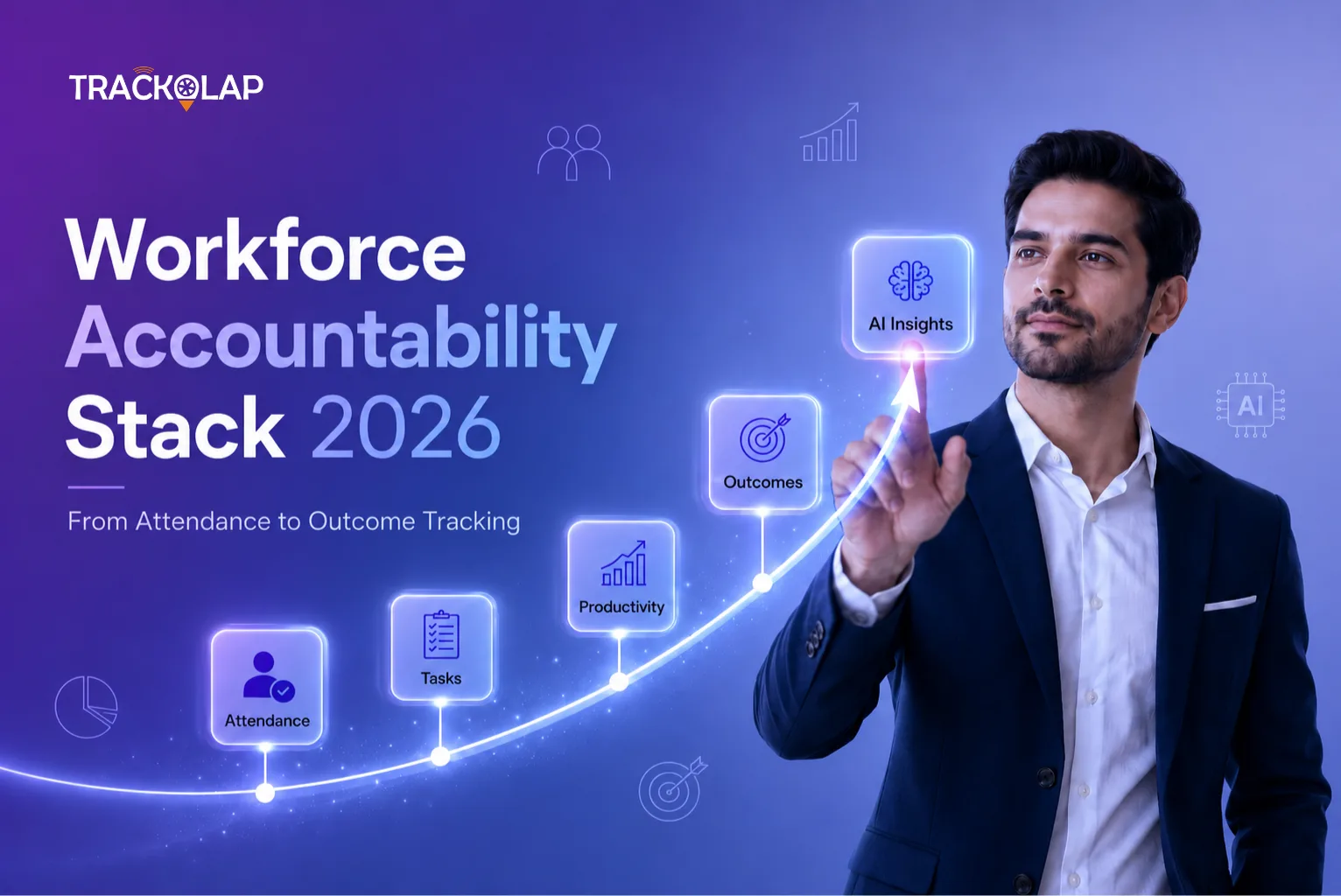
How TrackOlap helps improve MR effectiveness
TrackOlap provides field force automation, sales management and workforce-management capabilities for distributed teams.
For pharmaceutical companies, TrackOlap can bring attendance, location-supported activity, visits, routes, tasks, targets, time and expenses into one operational system.
1. Real-time employee tracking
Pharmaceutical managers may oversee teams operating across multiple cities, districts or states.
Depending on phone calls for updates makes coordination slow and provides little visibility into current field activity.
TrackOlap’s real-time employee tracking gives authorised managers a live view of field-team location and status. This can help them understand workforce availability, coordinate urgent tasks and respond to unexpected changes.
For example, if a scheduled activity is cancelled, a manager can assess field availability and reassign an appropriate task. If a representative encounters a route or territory issue, the manager has better operational context.
Real-time visibility should be used as an enablement tool, not as intrusive surveillance. Pharmaceutical companies should clearly define tracking hours, authorised users, data-retention practices and legitimate operational purposes.
2. Employee GPS tracking software
Medical representatives commonly begin their day in the field rather than at a branch office. Conventional attendance systems may therefore fail to reflect how pharmaceutical sales teams actually work.
TrackOlap’s employee GPS tracking software enables location-supported attendance and geo-verified check-ins. These records can help establish whether an authorised field activity occurred at the expected location and time.
GPS-supported field information can help pharma managers:
- Validate scheduled field visits
- Compare planned and actual movement
- Understand travel patterns
- Improve route planning
- Add context to expense claims
- Reduce attendance ambiguity
- Identify territory-level inefficiencies
Location data should not be treated as a complete performance measure. An employee’s presence at a location does not establish the quality or outcome of an interaction. GPS information becomes useful when evaluated alongside visit plans, assigned tasks, follow-ups, time utilisation and relevant business results.
3. Medical representative attendance software
Field employees require an attendance process suited to mobile work.
TrackOlap can function as medical representative attendance software, allowing MRs to record attendance from authorised field locations through a mobile application. This reduces the need to travel to an office solely to mark attendance.
Digital attendance records can also help HR and sales managers reduce manual reconciliation. When attendance, leave and field activity are available through connected workflows, teams spend less time checking separate registers and messages.
The result is a more practical attendance system for representatives and greater administrative consistency for the company.
4. Doctor visit tracking software
Doctor coverage is a central part of pharmaceutical field execution. However, a scheduled visit and a completed visit are not the same.
TrackOlap’s visit-management capabilities can be used as doctor visit tracking software to schedule, assign and record field interactions. Representatives can update visit status through the mobile application, while managers can compare planned visits with completed activity.
This helps answer questions such as:
- Which priority doctors were covered?
- Which scheduled visits were missed?
- Where are repeated cancellations occurring?
- Are some accounts receiving excessive attention?
- Are follow-ups being completed?
- Is the current visit plan realistic?
The purpose is not merely to increase call volume. Better doctor visit tracking helps companies improve the quality and consistency of account coverage.
Companies should collect only appropriate business information and configure their processes in line with applicable privacy, internal governance and pharmaceutical-marketing requirements.
5. Pharma beat planning software
Poor route planning can quietly reduce MR productivity.
A representative may complete a full working day but spend too much of it travelling between widely separated locations. Another may repeatedly visit nearby accounts while distant but strategically important accounts remain under-covered.
TrackOlap’s route and beat-planning capabilities make it suitable as pharma beat planning software. Managers can organise territories into logical visit sequences and compare planned routes with field activity.
Better beat planning can help:
- Reduce avoidable backtracking
- Improve daily coverage density
- Balance account frequency
- Lower unnecessary travel
- Identify unrealistic territory structures
- Use historical movement to improve future plans
This is particularly important in geographically dispersed markets where distance and accessibility can affect territory capacity more than the number of listed accounts.
6. Staff time management software
MR productivity depends not only on attendance but also on how working time is used.
TrackOlap’s staff time management software capabilities help companies record attendance, working hours, visit activity and task progress. Managers can use this information to understand how much time is spent on productive fieldwork, travel, waiting and administration.
Reliable time data can reveal process problems that are otherwise misinterpreted as individual performance issues.
For instance, low visit completion might result from an impractical route rather than insufficient effort. Excessive reporting time may point to duplicate internal processes. A consistently overloaded territory may require restructuring.
The objective is not to maximise every minute. It is to give representatives practical schedules and reduce work that does not contribute to meaningful execution.
7. Task and follow-up management
Important field actions can easily become lost in personal notebooks, spreadsheets or chat conversations.
TrackOlap allows managers to create, assign, prioritise and monitor tasks through a common system. Representatives can view pending work and update completion status from the field.
This enables structured management of activities such as:
- Follow-up visits
- Approved information requests
- Stockist coordination
- Internal escalations
- Manager-assigned actions
- Field surveys
- Administrative requirements
A central task record improves accountability while reducing the number of manual reminders required from first-line managers.
8. MR reporting software
Traditional daily call reports can consume valuable time and still produce inconsistent information.
TrackOlap can serve as MR reporting software by enabling mobile activity updates and centralised managerial reporting. Visit, attendance, task, route and expense information can be recorded in a structured format rather than assembled manually at month-end.
This gives managers faster access to plan-versus-actual activity and allows reports to be reviewed across representatives, territories and periods.
A well-designed digital reporting process benefits both sides. Managers gain greater visibility, while representatives spend less time reproducing the same information across multiple formats.
9. MR productivity software
Productivity cannot be measured accurately through location or attendance alone.
TrackOlap can support the role of MR productivity software by connecting several operational dimensions:
- Attendance
- Visits
- Accounts covered
- Routes
- Working time
- Tasks
- Follow-ups
- Expenses
- Targets and outcomes, where appropriately configured
This connected information helps managers identify the causes behind performance differences.
High activity but limited progress may indicate poor account prioritisation or a need for coaching. Low visit completion may reveal unrealistic scheduling. High expenses with weak territory coverage may point to inefficient routing.
Productivity data should be used to support fair reviews, targeted coaching and better resource allocation—not simply to rank employees.
10. Pharma employee location tracking
Pharma employee location tracking provides operational context for companies managing widely distributed teams.
When combined with transparent policies and appropriate access controls, location information can help managers verify field deployment, coordinate teams and analyse territory movement. It can also help representatives establish a reliable record of completed travel and field attendance.
However, pharmaceutical companies should establish clear governance before implementation.
Employees should know:
- When location tracking is active
- What information is collected
- Why the information is required
- Who is authorised to access it
- How long records are retained
- How inaccurate data can be corrected
Trust is essential. Location tracking should support field execution and employee safety, not create a culture of continuous suspicion.
11. Pharmaceutical sales team tracking
At a broader level, pharmaceutical sales team tracking helps regional and national managers understand how field strategy is being executed across multiple territories.
A central TrackOlap dashboard can consolidate relevant attendance, activity, route, task and expense information. This reduces the need to collect numerous spreadsheets before every review.
Managers can examine patterns across:
- Representatives
- Teams
- Regions
- Territory types
- Reporting periods
- Planned and completed activities
The benefit is not merely having more data. It is having comparable information that can guide decisions about coverage, workloads, coaching and territory design.
12. Field service management solutions
Pharmaceutical sales and field service are not identical functions, but they share important operational requirements: scheduling, route planning, location visibility, task allocation, documentation, expense control and performance monitoring.
TrackOlap’s field service management solutions can support pharmaceutical companies that manage MRs, field supervisors, service personnel and other distributed employees.
Bringing these workflows into a common platform can reduce operational silos. Managers gain a clearer view of field capacity, while employees receive structured assignments and simpler reporting channels.
13. Pharma sales force automation
Pharma sales force automation connects everyday field activities with broader commercial execution.
Instead of viewing doctor visits, attendance, tasks, expenses and targets as separate processes, TrackOlap brings them into a connected workflow. This allows managers to understand what activity occurred, what remains pending and where intervention may be required.
Automation does not replace the professional judgement of medical representatives or managers. It reduces administrative friction and helps those teams make decisions using more reliable information.
Field automation and pharmaceutical marketing compliance
Pharmaceutical field activity must remain consistent with applicable laws, codes, company policies and ethical marketing standards.
The Department of Pharmaceuticals issued the Uniform Code for Pharmaceutical Marketing Practices 2024 for strict compliance. The code addresses pharmaceutical promotion and interactions with healthcare professionals.
The Department’s official UCPMP guidance states that companies should maintain accurate records, conduct internal audits and train employees. Its disclosure framework also covers areas such as free samples and expenditure on continuing medical education or professional-development programmes.
Field force automation does not automatically guarantee compliance with UCPMP 2024 or other applicable requirements. However, structured workflows and consistent activity records can support internal governance.
Pharma companies should configure TrackOlap according to their approved processes and establish suitable controls for:
- User access
- Data collection
- Record retention
- Promotional activity reporting
- Expense approvals
- Information security
- Internal reviews
- Employee training
Technology should support—not replace—a properly designed compliance programme.
Which MR effectiveness KPIs should pharma companies track?
Pharmaceutical companies should choose KPIs that lead to useful managerial decisions.
Relevant indicators may include:
- Planned-versus-completed visit rate
- Priority-account coverage
- Unique accounts covered
- Visit frequency by account category
- Follow-up completion rate
- Task closure rate
- Productive field time
- Average travel time
- Territory coverage consistency
- Expense per completed visit
- Report-submission timeliness
- Attendance regularity
- Manager coaching frequency
- Relevant sales outcomes, where appropriately integrated
No single KPI should define an MR’s performance. A high visit count may conceal weak targeting, while low activity in a geographically difficult territory may require contextual interpretation.
TrackOlap’s reporting capabilities can help managers consider these measures together instead of making decisions from one isolated number.
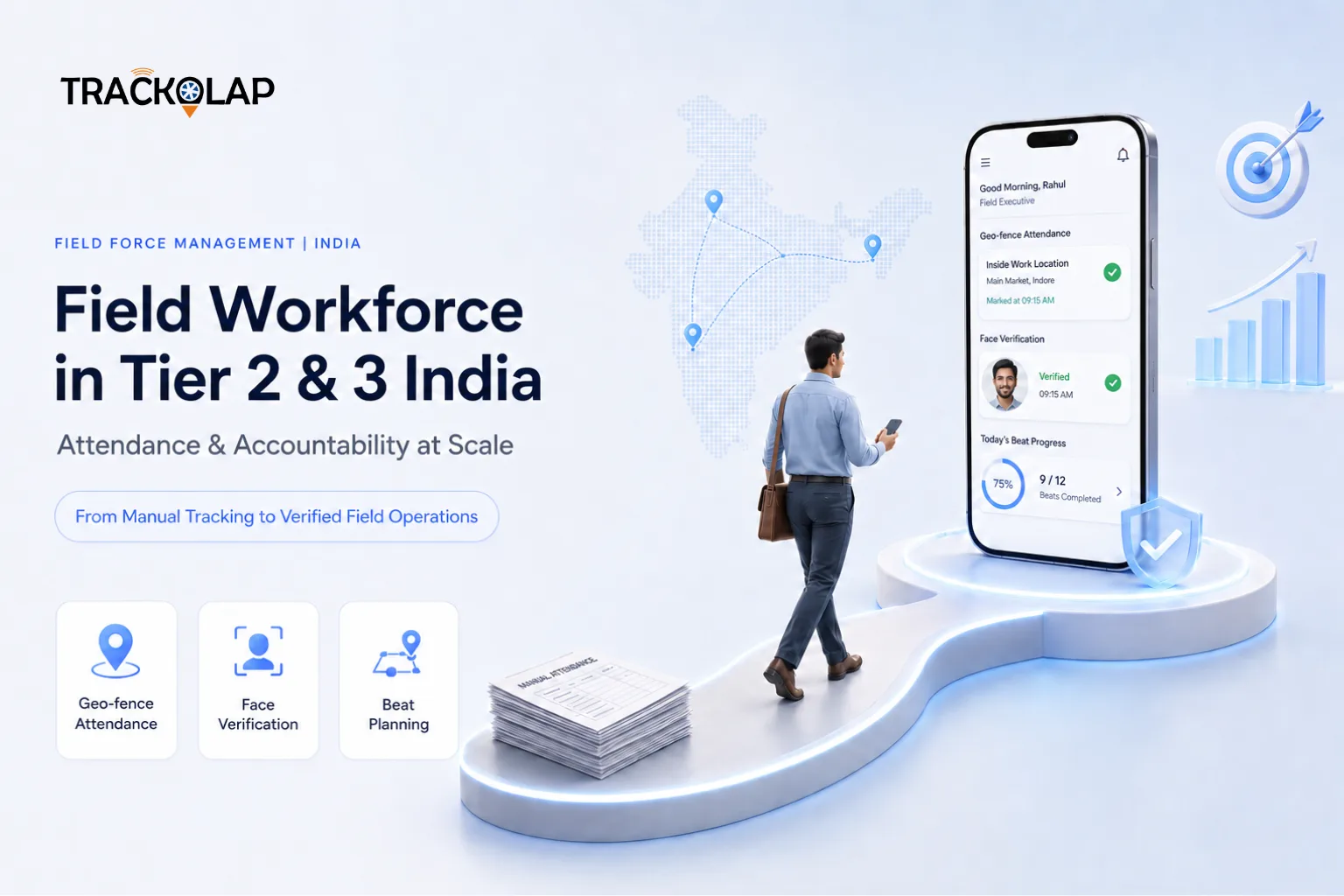
Choosing a Field Force Automation Platform: An Evaluation Checklist
Pharmaceutical decision-makers evaluating MR reporting software or field force management software in India should test any shortlisted platform against the following:
- Does it geo-verify calls, or merely record typed entries?
- Can beat plans be configured by prescriber class and monitored for frequency compliance?
- Are call report forms genuinely configurable by division and therapy, including conditional logic?
- Does expense management reconcile against recorded distance?
- Is the analytics layer available to First Line Managers in real time, or only to headquarters at month-end?
- Does it operate reliably on mid-range Android devices in low-connectivity territories?
- Can attendance, leave, targets and productivity data be governed on a single platform rather than stitched across three vendors?
TrackOlap is architected to answer each of these affirmatively, spanning field sales automation, beat planning, live tracking, attendance and leave management, expense management and productivity analytics within one system.
Frequently asked questions
What is medical representative tracking software?
Medical representative tracking software helps pharmaceutical companies plan and record MR attendance, field visits, routes, tasks, follow-ups, time and expenses. It provides managers with structured visibility into field execution.
Can TrackOlap monitor doctor visits?
TrackOlap supports field-visit scheduling, mobile activity updates and location-supported check-ins. Pharma companies can configure these capabilities to record planned and completed doctor visits while applying appropriate data and compliance policies.
How does employee GPS tracking software help pharma companies?
Employee GPS tracking software can support geo-verified attendance, visit validation, route analysis and field coordination. It is most effective when combined with tasks, visit plans, time, expenses and performance data.
What is the difference between MR reporting software and pharma CRM software?
MR reporting software focuses on field activity such as visits, attendance, routes and daily reports. A pharma CRM focuses more broadly on account relationships and commercial workflows. TrackOlap combines sales and field force management capabilities in a connected platform.
Can TrackOlap improve MR productivity?
TrackOlap can help managers identify coverage gaps, inefficient routes, delayed reports and incomplete tasks. These insights can support better planning and coaching, although results also depend on adoption, territory strategy and management practices.
Is MR tracking software only about monitoring employees?
No. Monitoring is a by-product; the objective is productivity and fairness. Verified data protects high-performing representatives from subjective assessment, accelerates expense reimbursement, reduces reporting workload and preserves territory knowledge when staff change roles.
How long does implementation take?
A structured rollout — configuration, single-division pilot, then scale — is typically achievable in about 90 days for a mid-sized division structure, provided the customer master and beat definitions are finalised early.
Conclusion
FY27 will not be decided solely by how many medical representatives a pharmaceutical company employs. It will be influenced by how effectively each representative, territory and field day is managed.
Manual reporting cannot provide the speed, consistency or visibility required by a growing pharmaceutical business. Companies need a connected approach to attendance, doctor visits, beats, routes, tasks, time, expenses and managerial reporting.
TrackOlap brings together real-time employee tracking, employee GPS tracking software, staff time management software, medical representative attendance software, doctor visit tracking software, pharma beat planning software and MR reporting software in a unified field-management environment.
Its capabilities support pharma sales force automation, pharmaceutical sales team tracking and broader field service management solutions. By connecting field presence with planned and completed work, TrackOlap helps managers identify execution gaps, simplify reporting and make better-informed decisions.
The goal is not simply to track medical representatives. It is to give representatives clearer plans, reduce avoidable administration and help managers build a more productive, accountable and responsive field organisation.
Improve MR effectiveness with connected field visibility. Explore TrackOlap’s field force automation software to manage attendance, doctor visits, routes, tasks, expenses and field performance from one platform.

 D-5, Logix Infotech Park, Sector 59, Noida - 201301, Uttar Pradesh (India)
 contactus@trackolap.com
 7011494501






 Demo
at free of cost
Demo
at free of cost