
















 Back to Blogs

Walk onto any large project site in Gurugram, Navi Mumbai or Hyderabad and you will find a striking asymmetry. The most closely monitored asset on that site is not a person — it is a machine. A modern excavator transmits engine hours, fuel consumption, idling duration, hydraulic load and GPS position to a fleet dashboard several times an hour. If it sits idle for forty minutes, someone in the head office knows. If it leaves the site boundary, an alert fires.
Fifty metres away, four hundred workers are being recorded in a paper muster roll by a site supervisor holding a ballpoint pen. Their reporting time is written from memory at the end of the shift. Their overtime is negotiated verbally. Their wage sheet will reach the accounts department eleven days later, transcribed twice, disputed once, and reconciled against nothing.
The industry has spent a decade digitising steel, concrete, drawings and machinery. It has left the largest, costliest and most legally exposed input — labour — exactly where it was in 1996. This is the single biggest unclaimed productivity opportunity in Indian construction, and construction workforce management software is how it gets claimed.
One in Eight Working Indians Is on a Construction Site
Ask a project manager how many workers were on site last Tuesday and you will usually get a confident answer. Ask how they know, and the answer turns out to be a supervisor’s memory, a sub-contractor’s claim, and a register that was filled in after everybody had gone home. All three are estimates wearing the clothes of a fact.
This matters more than it sounds, because construction is not a small corner of the Indian economy. The Ministry of Statistics and Programme Implementation reported in its Periodic Labour Force Survey 2025 that roughly 12% of everyone working in India works in construction. One in eight. That is a larger share of the country than manufacturing employs.
And most of those people do not work for the company whose name is on the hoarding. The Construction Skill Development Council of India estimates that around 85% of construction workers reach the site through a sub-contractor. So the firm that ultimately pays for the labour frequently has no independent record of who actually turned up. It has a sub-contractor’s word, and an invoice built on that word.
That is the whole problem in one sentence.
It is not only an Indian problem. McKinsey has tracked construction productivity worldwide for years and keeps placing the sector near the very bottom of its digitisation rankings — second-to-last in the United States, last in Europe. Everybody digitised the drawings and the machines. Almost nobody digitised the people.
You cannot improve what you never wrote down. Indian construction measures its machines beautifully and its people barely at all.
Where a Paper Workforce Leaks Money
Contractors rarely lose money in one dramatic event. They lose it in five quiet, recurring places — every one of which is a data problem before it is a management problem.
- Unverified attendance. Ghost workers on sub-contractor rolls are common wherever attendance is written down by an interested party. Even 3% inflation on a 400-person site is twelve fully paid phantom workers, every day of the project.
- Overtime without evidence. When shift timings are recalled rather than recorded, overtime becomes a negotiation, and the contractor pays for the version they cannot disprove.
- Invisible idle time. Telematics report machine idling in minutes. Labour idling — waiting for material, for a crane, for instruction — is never captured, so it is never designed out of the schedule.
- Reconciliation lag. Seven sites send seven differently formatted summaries at seven different times. By the time labour cost per square foot is known, the pour is done.
- Unauditable billing. Sub-contractor invoices are checked against the sub-contractor’s own attendance record. That is not verification; it is transcription.
Each of these is solved by the same intervention: a single, timestamped, location-verified record of who worked where, for how long, on what — captured at the moment it happens, not reconstructed afterwards.
The Telematics Precedent: The Industry Has Already Proved This Works
Construction leaders sometimes treat workforce digitisation as an unproven experiment. It is not. It is the same intervention the industry already ran on its equipment fleet, with results nobody now disputes.
Before telematics, machine utilisation was estimated from operator logbooks. Fuel theft was suspected but not provable. Idling was invisible. Then the industry attached a sensor and a GPS module to each asset, and within two quarters utilisation and fuel cost moved measurably — not because the machines changed, but because the decisions around them finally had evidence.
The workforce is still in the pre-telematics era. Utilisation is estimated from supervisor logbooks, attendance inflation is suspected but not provable, and idle time is invisible. The fix is identical in structure and considerably cheaper, because the sensor already exists in every worker’s pocket. A contractor who accepts telematics for a hired excavator but rejects verified attendance for four hundred workers is not being cautious — only inconsistent about where evidence matters.
The Government Went Digital. Most Contractors Did Not.
Here is a risk most site teams have not thought about. The government’s record of your workers is now digital. Yours probably is not.
Consider e-Shram, the national database of unorganised workers run by the Ministry of Labour & Employment. More than 31 crore workers are registered on it, and a Press Information Bureau release confirms that the details of construction workers who register are shared with the relevant Building and Other Construction Workers Welfare Boards. Your labour is already sitting in a searchable, Aadhaar-linked database maintained by the state. Your muster roll is sitting in a drawer.
The law itself has not changed much. The Building and Other Construction Workers Act, 1996 has always required you to register your establishment and your workers, keep proper registers, and pay a welfare cess of 1% on the cost of construction — the text is on the India Code repository and the Chief Labour Commissioner’s portal, and the Ministry runs a dedicated BOCW and inter-state migrant worker portal.
What did change is the date. On 21 November 2025, India’s four labour codes came into force, as announced by the Press Information Bureau. The Occupational Safety, Health and Working Conditions Code, 2020 brought in three obligations that quietly assume a digital employer:
- An appointment letter for every worker, stating designation, wages and social security details.
- Portability of welfare-fund benefits for migrant construction workers who move between states.
- Safety committees with worker representation at sites with 250 or more construction workers.
Read those three again and ask yourself a simple question. If an inspector walked onto your site tomorrow and asked for a verified list of everyone who worked there last Tuesday, how long would it take you to produce it?
A register in a site office cannot answer that. Software answers it before the inspector has finished the sentence. And none of this is about catching workers out — it is about being able to prove, calmly and quickly, something you already believe to be true.
Why Biometric Punch Machines Did Not Solve This
Many contractors did attempt digitisation — usually by installing a fingerprint terminal at the site gate. It rarely survived contact with reality, for reasons specific to construction:
- Sites have no meaningful perimeter. Workers enter from wherever the boundary is open, not through a single gate.
- Manual labour destroys fingerprints. Workers handling cement, aggregate and steel have abraded ridges; failure-to-enrol rates on construction sites are far higher than in offices.
- Dust, heat and power cuts disable fixed hardware.
- Work happens across blocks, floors and basements, not at the gate. Gate-in tells you someone arrived; it tells you nothing about where they spent the day.
- A firm runs many sites at once, and hardware does not consolidate across them.
- Sub-contracted crews rotate constantly, making enrolment an unending administrative burden.
The correct architecture for construction is not fixed hardware. It is mobile-first, GPS-verified, geofenced, image-authenticated and offline-tolerant — in other words, an attendance tracker for employees that travels with the worker instead of waiting for them at a turnstile.
What a Digitized Construction Workforce Actually Looks Like
TrackOlap is a workforce and field operations platform that gives construction companies the same real-time visibility over their people that telematics already gives them over their machines. It runs on Android, iOS, Windows, Mac, Linux and Chromebook, and requires no site hardware installation.
In practice, three things a contractor normally buys separately — an attendance tracker for employees, GPS attendance software and employee location tracking software — sit inside one system here, drawing on the same record. Here is how that maps onto the specific failures described above.

Geo-Attendance: GPS Attendance Software Built for Sites Without a Gate
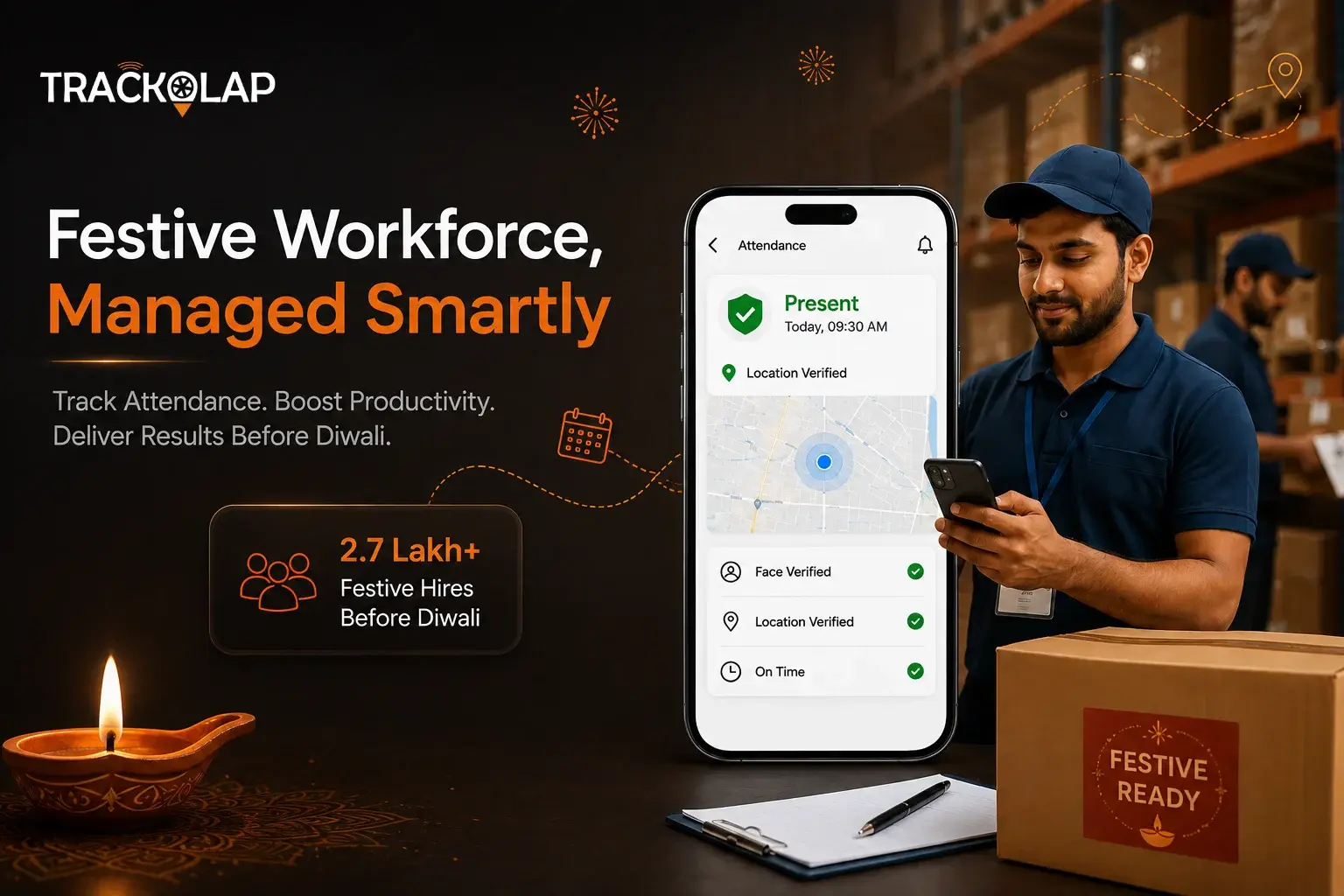
TrackOlap’s construction employee attendance app captures attendance through geotagged selfie punch-in, binding three facts together at the moment of marking: who (face image), where (GPS coordinates) and when (server timestamp). This is what separates real GPS attendance software from a digitised register — the location is part of the record, not a note beside it. Proxy attendance stops being possible, because a photograph taken at a specific latitude and longitude cannot be recreated from a supervisor’s memory at 7 p.m.
Geofencing with Deviation Rules
Every site, block or zone is drawn as a geofence with configurable deviation tolerance. Attendance registers only inside the boundary. Movement outside it during shift hours triggers an exception, not a dispute. And in safety-critical zones, geofencing answers the question that matters most in an emergency and is almost never answerable today: who is inside, right now.
Employee Location Tracking Software for Staff Who Move Between Sites
Not everyone stands in one place all day. Supervisors, engineers, safety officers, surveyors and material coordinators move constantly, and for them employee location tracking software replaces the phone call that asks where someone is. Route history converts travel-time claims into travel-time records, and a day spent between three sites is visible as exactly that.
Multi-Site Shift Scheduling
Shifts are assigned by site, zone and time slot from a single console. A planner allocating 900 workers across five sites sees the whole board at once, and a change made at head office reaches the worker’s phone immediately.
Task Management and Productivity Analytics
Work is issued as tasks against locations and deadlines. Completion is timestamped and location-stamped. Over a quarter, this produces something Indian construction has almost never had: a defensible measure of output per worker-hour, by trade, by site and by sub-contractor.
Payroll, Leave and Overtime Automation
The payroll management module calculates wages directly from verified hours worked, overtime, task completion and leave, with tax and deduction handling, and pushes timesheets through an approval workflow before payment. Leave management covers casual, sick, paid and unpaid categories with structured approvals. Wage disputes shrink because the wage sheet and the attendance record are the same record.
Expense, Fleet and Asset Control
Expense management brings site conveyance, material-run and incidental claims into a policy-checked digital workflow. Fleet management and asset management extend the same discipline to vehicles, tools and equipment — closing the loop between the machines that were already digitised and the people operating them.
Dashboards, Reports and the Audit Trail
A real-time dashboard shows every worker as on-duty, off-duty, on-leave or unreachable across all sites. Monthly reports consolidate attendance patterns and location analytics. Employee onboarding and a Policy Centre hold appointment terms and policy acknowledgements in one place — directly supporting the appointment-letter obligation introduced under the new labour codes.
Paper Site Versus Connected Site
| Dimension | Paper-Based Site | Site Running TrackOlap |
|---|---|---|
| Attendance capture | Manual register, end of shift | Geotagged selfie, real time |
| Attendance integrity | Supervisor's word | GPS + image + timestamp |
| Multi-site view | Seven separate summaries | One live dashboard |
| Overtime | Negotiated | Calculated from record |
| Payroll cycle | 8–12 days, manual | Auto-computed from timesheets |
| Labour cost per unit | Known after the fact | Known during the pour |
| Statutory records | Reconstructed on notice | Exportable on demand |
| Safety zone visibility | None | Live geofence roster |


A Ninety-Day Rollout That Site Teams Will Actually Accept
Technology fails on construction sites for cultural reasons more often than technical ones. A phased rollout works.
| Phase | Focus | Outcome |
|---|---|---|
| Phase 1 — Prove · Days 1–30 | One site. Geo-attendance and geofencing only. Paper register kept in parallel. | A measured variance between paper and verified headcount. This number funds the rest of the programme. |
| Phase 2 — Extend · Days 31–60 | Add shift scheduling, leave, task management and expense. Retire the paper register on the pilot site. | Supervisors stop transcribing and start reviewing exceptions. |
| Phase 3 — Scale · Days 61–90 | Roll to all sites; connect payroll; onboard sub-contractor crews; enable compliance exports. | One consolidated labour record across the portfolio. |
Two things decide whether it sticks. Enrol sub-contractor crews from day one, because that is where 85% of the workforce sits. And give supervisors a visible win early — usually the end of manual wage-sheet preparation — so the system feels like help rather than surveillance.
What Changes by the End of the First Quarter
Contractors who finish this transition tend to report the same short list. Headcount inflation disappears, because attendance is location- and image-verified. Payroll preparation drops from days to hours. Wage disputes fall away, because the evidence is timestamped. Labour cost becomes visible during execution rather than after handover. And statutory registers become an export rather than a fire drill.
None of this needs new hardware or a change to how work is physically done. It only needs the workforce to be taken as seriously, informationally, as a hired excavator already is.
Frequently asked questions
What is construction workforce management software?
Construction workforce management software is a digital platform that records attendance, location, shifts, tasks, leave, expenses and payroll for construction workers across one or many sites, replacing paper muster rolls with a verified, timestamped and exportable record.
How does GPS attendance work on a construction site?
The worker marks attendance from a mobile app. The system captures a selfie, the device’s GPS coordinates and a server timestamp, and validates that the location falls inside the site’s geofence. Attendance outside the boundary is flagged as an exception rather than silently recorded.
What makes a good attendance tracker for employees on a construction site?
A construction-ready attendance tracker for employees must work without fixed hardware, verify identity and location together, function across several sites at once, and feed payroll directly. Office attendance systems built around a single door and a fingerprint reader fail on all four counts.
What is the difference between GPS attendance software and employee location tracking software?
GPS attendance software records a single verified event — the worker marking in or out at a specific location and time. Employee location tracking software records movement through the day, which matters for supervisors, engineers and material coordinators who travel between sites. A well-built platform provides both from the same record, so attendance and movement never have to be reconciled against each other.
Can workers be tracked across multiple construction sites at once?
Yes. TrackOlap consolidates attendance, shifts and productivity across all sites into a single live dashboard, with each site configured as its own geofence and shift calendar.
Does workforce software help with BOCW and labour code compliance?
It does not file statutory returns for you, but it produces the underlying evidence those obligations depend on — verified attendance, worker-wise hours, appointment and policy records, and site-wise headcounts — in exportable form. Statutory filing and cess payment continue to be made to the relevant state welfare board.
Is biometric hardware required?
No. TrackOlap uses the worker’s mobile device with GPS and selfie verification, which avoids the fingerprint failure, dust, power and single-gate limitations that make fixed biometric terminals unreliable on construction sites.
Can sub-contractor crews be tracked?
Yes, and they should be, because roughly 85% of India’s construction workforce is engaged through sub-contracting. Sub-contractor crews can be onboarded as distinct groups so their attendance and output are verified independently of the sub-contractor’s own records.
How long does implementation take?
A single-site pilot typically runs in the first thirty days, with full portfolio rollout and payroll integration completed inside ninety days.
The Last Analogue System on Site
Construction did not resist digital transformation. It digitised drawings, materials, procurement, project scheduling and machinery — and then stopped one step short of the input that represents the largest share of cost, the greatest share of risk and the entirety of its statutory exposure.
The workforce is the last analogue system on an otherwise connected site. Closing that gap does not need a cultural revolution; it needs a phone, a geofence and a decision.
Digitise your workforce the way you already digitised your machines. Book a TrackOlap demo and see your first site running on verified attendance within thirty days.



 D-5, Logix Infotech Park, Sector 59, Noida - 201301, Uttar Pradesh (India)
 contactus@trackolap.com
 7011494501






 Demo
at free of cost
Demo
at free of cost