
















 Back to Blogs

After a long stretch of contraction and cautious lending, India's microfinance industry is growing again. Portfolio at Risk in the 31–180 day bucket has fallen to roughly 2% as on March 2026, down from about 6.3% a year earlier, and the industry's loan book expanded for the first time in seven quarters. The Reserve Bank of India's own assessment in its Financial Stability Report, June 2026 points to a gradual, broad-based improvement in asset quality.
That is the good news, and it deserves to be said plainly.
The harder truth is that microfinance recoveries have never been secured in a credit committee. They are secured — or quietly lost — in the two hours between a field officer leaving the branch and reaching the first centre meeting of the day. The last downturn was not triggered by one dramatic event. It accumulated: officers arriving late and compressing the collection window, delinquency follow-ups slipping by days, centre meetings drifting away from their designated locations, and branch managers working from month-end reports rather than this morning's reality.
The borrower base is smaller now and average ticket sizes are larger, which means every field officer carries more rupee exposure per relationship than they did two years ago. A single missed collection cycle costs more than it used to.
Put simply: the recovery will hold or break on field-collection efficiency — on whether the right officer reaches the right centre, at the right hour, with the right list, and whether the institution can see it happening and prove it afterwards.
That is an operations problem, not a lending problem. And it is exactly the layer TrackOlap was built to run.
Why the Last Mile Is So Hard to Manage Without Software
Microfinance collection is unlike almost any other repayment process in financial services, and the differences are all operational.
It is physical. A large share of joint-liability group collection still happens face to face, at a scheduled centre meeting, with an officer present.
It is time-bound. A centre meeting has an hour. Missing it does not delay collection by sixty minutes — it typically pushes the instalment into the next cycle.
It is dispersed. A single branch may run dozens of centres across villages and urban clusters. No manager can observe more than a fraction of them in a week.
It is relationship-dependent. Group cohesion and officer continuity influence repayment as strongly as household cash flow does, which makes field-staff attrition unusually expensive.
It is regulated. Recovery conduct is prescribed, and the evidence of compliance matters as much as the compliance itself.
Every one of those characteristics points to the same conclusion. What lenders need is not more reporting — it is real-time visibility of a mobile workforce. That is the category employee location tracking software and field service management solutions exist to serve, and microfinance is close to the purest use case there is.
Compliance Is Now a Design Constraint, Not a Footnote
The RBI's Regulatory Framework for Microfinance Loans, 2022 shapes how field collection must be structured. Its provisions read like regulation, but they behave like operating instructions:
- Lenders must not contact borrowers for recovery before 9:00 a.m. or after 6:00 p.m. — a scheduling constraint.
- Recovery should ordinarily be made at a designated or central designated place, with visits to a borrower's residence or workplace only after the borrower fails to appear on two or more successive occasions — a location constraint and an audit-trail requirement.
- Harsh recovery practices are prohibited, and regulated entities must operate board-approved policies on fair practices and grievance redress — which implies evidence that policy is actually followed in the field.
An institution that cannot produce a time-stamped, location-verified record of where its officers were and what they did is not just inefficient. It is unable to demonstrate compliance when a supervisor, an internal auditor or a rating agency asks.
This is why employee GPS tracking software has moved from a productivity tool to a governance tool in lending operations. The same timestamp that tells a branch manager an officer reached the centre at 9:40 a.m. is the record that proves contact occurred within permitted hours, at the designated place.

Eight Quiet Leaks in a Typical Field Collection Day
Across field-heavy lending operations, the same failure patterns repeat — and none of them appear in a credit policy document:
- Unverified start times. An officer is marked present at the branch but reaches the first centre late, losing the most productive hour of the day.
- Routing by memory. Centres are visited in the order the officer recalls rather than the order that minimises travel, cutting daily coverage.
- Slow delinquency response. Overdue accounts surface in a monthly MIS instead of a same-day task queue, letting early-bucket cases age into harder ones.
- No proof of visit. A dispute over whether a borrower was contacted has no timestamp or location to settle it.
- Paper expense claims. Travel reimbursements consume supervisory bandwidth and invite leakage.
- Invisible effort. Managers cannot distinguish an officer covering fourteen centres from one covering seven, so coaching is guesswork.
- Incentives without evidence. Performance pay is calculated on collected value alone, ignoring coverage, punctuality and compliance quality.
- Cash in transit. Officers carry physical collections between centres and the branch, creating safety exposure, reconciliation delays and an unavoidable gap between money collected and money recorded.
None of these are credit failures. All of them eventually show up in PAR.
How TrackOlap Runs the Last Mile
TrackOlap is a business automation platform for organisations that operate distributed field teams. Its modules — field force automation, Sales CRM, HR and workforce productivity — map almost one-to-one onto the operating model of a lending branch. Here is what each does in practice.
Employee location tracking software that reflects reality, not paperwork
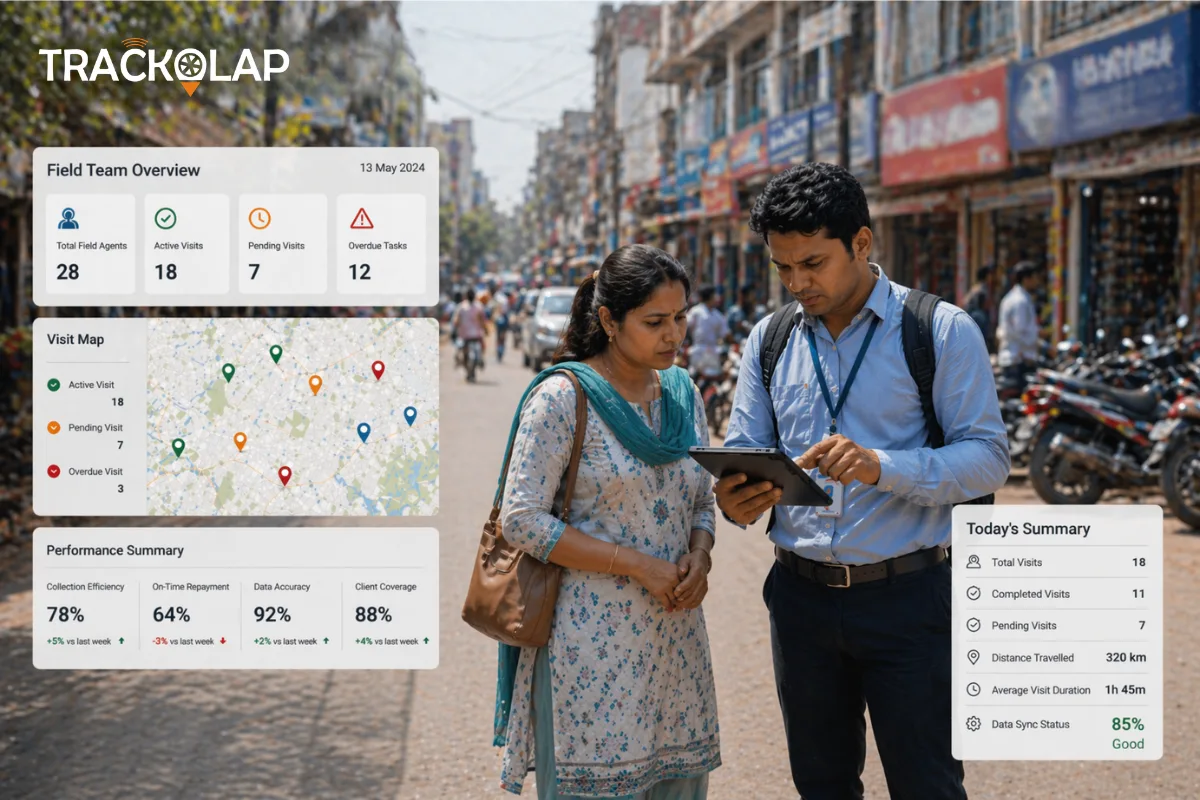
TrackOlap's real-time employee location tracking gives supervisors an accurate, live view of where field staff are through the working day, with an automatic visit history built from actual movement rather than end-of-day recall.
For a branch manager, this changes the nature of the job. Instead of discovering a shortfall at a centre the following morning, they can see coverage falling behind by mid-morning and redeploy an officer while the day is still recoverable. Instead of adjudicating a dispute about whether a visit happened, they open the trail.
Employee GPS tracking software with geofenced centre locations
Every centre-meeting point can be defined as a geofence. Attendance is captured on arrival at the location, not at a desk in the branch, which turns punctuality from an assumption into a measurement.
This matters more than it sounds. Arrival time at centre meetings is among the strongest behavioural predictors of on-time group repayment — groups take their cue from the officer. Employee GPS tracking software makes that behaviour visible, and visible behaviour is improvable behaviour. It also produces the location-verified record that supports designated-place recovery under the RBI framework.
A staff time management system that closes the loop from attendance to payroll
TrackOlap's staff time management system covers attendance, leave, shift and roster management, holiday policy and payroll in one connected flow. Field attendance captured on a mobile device feeds leave balances, and leave feeds payroll, without a spreadsheet in between.
Two benefits follow. First, HR and branch operations stop spending days each month reconciling registers. Second, incentives can finally be linked to verified activity — coverage, punctuality and task closure — rather than collected value alone. In a sector where field-officer attrition destroys hard-won group relationships, transparent and evidence-based performance management is a retention strategy, not just an administrative one.
Employee monitoring software built for coaching, not suspicion
The phrase employee monitoring software carries baggage, and it should be used carefully. Used badly, it produces surveillance and resentment. Used well, it produces fairness.
TrackOlap's productivity analytics give officer-level, branch-level and regional views of centres covered, visits completed, tasks closed and time spent in the field. The value is diagnostic. When a branch underperforms, management can see whether the cause is territory design, routing, workload or capability — four problems with four different remedies. Without that data, every underperformance conversation defaults to effort, which is usually the wrong diagnosis and always the most demoralising one.
The most effective deployments publish the metrics openly to the field team. Officers who can see their own coverage numbers tend to fix them without being asked.
Field service management solutions for beat planning and daily task flow
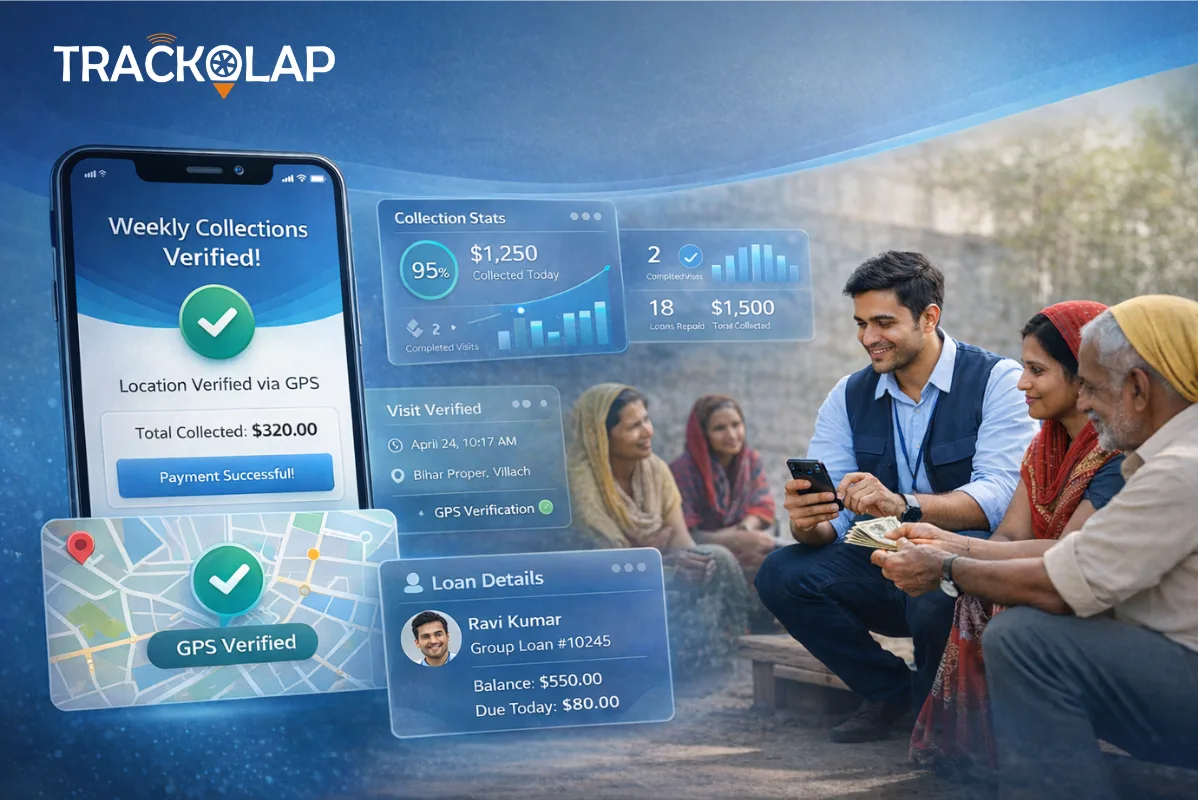
TrackOlap's field service management solutions cover the planning half of the equation. Branch managers build officer-wise, day-wise beat plans across assigned centres, sequenced by geography and meeting time rather than habit. Delinquency lists convert into assigned, dated tasks with named owners and closure status, so an account that ages into a follow-up bucket becomes a field action the same day rather than the following month.
This is where portfolio quality is actually defended. Early-bucket cases cure at far higher rates than aged ones, and the single highest-leverage change most lenders can make is shortening the gap between identifying an overdue account and physically knocking on the door.
UPI payment collection that closes the loop at the point of visit
Everything above improves how a field officer reaches the borrower. TrackOlap's QR-based UPI payment collection improves what happens once they are standing there.
Instead of accepting cash and reconciling it hours later at the branch, the officer generates a QR code carrying the exact amount due against that borrower's account. The customer scans it with any UPI application and pays in seconds, and the funds settle directly into the company's integrated bank account — no intermediary handling, no counting, no cash box.
Three things change immediately.
Cash risk disappears from the route. Physical money is the largest safety and shrinkage exposure in field collection. Removing it protects officers travelling between villages after dark and eliminates the discrepancies that arise whenever cash and paperwork travel separately.
Reconciliation becomes instant. Every transaction is captured automatically against the borrower's record with real-time confirmation. The branch does not wait for an end-of-day cash-up, and nobody re-keys a receipt book the next morning. Manual entry errors — the quiet source of most collection disputes — largely disappear.
The collection record becomes evidence. A digital, timestamped payment sits alongside the location-verified visit record, producing a complete and auditable account of when the officer arrived, where they were and what was collected. For a regulated lender, that combination is considerably stronger than a signed register.
There is a borrower-side benefit too. Digital repayment builds a verifiable transaction history for households that have historically had very little of it — which is precisely the kind of financial footprint that supports better credit assessment and deeper formal-sector inclusion over time.
Because payment collection sits inside the same platform as tracking, tasks and CRM, the officer's day reconciles end to end: the visit, the outcome and the money are one record rather than three systems that have to be matched later.
Expense management and the cost of collection
Automated expense capture with distance tracking removes the paper reimbursement cycle and reduces claim leakage. The strategic point is not the saving itself but the ratio: cost-to-collect is one of the metrics lenders and rating agencies scrutinise when funding lines come up for renewal. A recovery in portfolio quality that comes with a deteriorating cost ratio is only half a recovery.
CRM for the growth side of the recovery
Lending has to restart, carefully. TrackOlap's Sales CRM and lead management track prospective borrowers, KYC documentation status, application stages and follow-ups, with the same field visibility applied to acquisition that is applied to collection. WhatsApp CRM capabilities support low-friction borrower communication where it is permitted and appropriate.
With the borrower base having contracted, disciplined customer acquisition now carries as much weight as disciplined collection.
What a Sensible Rollout Looks Like
Institutions that get value from field workforce software treat it as an operating-model change, not an installation.
Weeks 1–4 — Baseline. Measure what you have: collection efficiency, PAR by bucket, centres covered per officer per day, average centre-meeting start delay, cost-to-collect and field-staff attrition. Pick three to five pilot branches across at least two states, including one high-PAR branch. Without a baseline, you will not be able to prove the return later.
Weeks 5–8 — Configure and pilot. Geofence centre locations, load beat plans, push delinquency data into daily task queues, and switch on attendance, location tracking, QR-based UPI collection and expense capture. Train supervisors before field staff — adoption in field operations is almost always top-down. Communicate clearly to officers what is being tracked and why; deployments framed as surveillance underperform deployments framed as workload fairness.
Weeks 9–12 — Measure, refine, scale. Compare pilot branches against control branches on the same metrics. Redesign territories using observed travel-time data instead of assumptions — this alone often releases meaningful capacity. Then sequence the rollout by performance gap, starting with the branches that stand to gain most.
Thereafter — Govern it. Bring field-compliance evidence into the board's periodic fair-practices review: contacts within permitted hours, designated-place recoveries, and the visit trail preceding any residence visit.
The Metrics That Prove It Worked
Keep the scorecard short and track it monthly:
- Collection efficiency, overall and by branch
- PAR movement, watching the early buckets first
- Centres covered per field officer per day
- Average centre-meeting start delay
- Hours from delinquency identification to first field action
- Share of collections received digitally versus in cash
- Time from collection to reconciliation
- Cost-to-collect per rupee recovered
- Field-officer attrition and average tenure
If the deployment is working, you will see early-bucket PAR improve first, coverage per officer rise next, and cost ratios follow.
Choosing a Platform: What Actually Matters
Field workforce platforms look similar in a demo. They diverge in the field. Four questions separate them:
Does it work on poor connectivity? Rural collection routes have dead zones. Offline capture with automatic sync is not a nice-to-have.
Is it one platform or four? Location tracking from one vendor, attendance from another, payments from a third and CRM from a fourth produces four sets of numbers and no single truth. TrackOlap's value is that field tracking, staff time management, task flow, UPI payment collection, expenses and CRM sit in one system, so an officer's day reconciles end to end.
Is it light enough for daily use? A field officer will not operate a system that adds fifteen minutes to their day. Adoption dies on friction.
Does it produce evidence, not just dashboards? For a regulated lender, exportable, time-stamped, location-verified records are the difference between a productivity tool and a compliance asset.
Efficiency Is the Recovery
The sector data confirms that Indian microfinance can recover. What no dataset can confirm is whether an individual lender has built the operating discipline to hold those gains through the next monsoon, the next local disruption or the next credit cycle.
That discipline is not built in a policy document. It is built at 9:15 in the morning, at a centre meeting in a village, by a field officer who arrived on time with the correct list — and by an institution that can see it, measure it and prove it.
TrackOlap gives lenders, NBFCs and field-driven organisations that visibility across every executive, every branch and every route. If your portfolio quality is improving but your cost-to-collect is not, or if your compliance evidence still lives in registers, the gap is operational — and operational gaps are the fixable kind.
See how TrackOlap's employee location tracking, staff time management, UPI payment collection and field service management solutions can be configured for your teams — request a demo.
Frequently asked questions
What is employee location tracking software?
Employee location tracking software uses GPS on a staff member's mobile device to record their work-related location and movement in real time, producing verified attendance, visit histories and route data. In lending operations it is used to confirm that field officers reached assigned centres on schedule.
How does employee GPS tracking software improve field collections?
It verifies arrival at centre meetings through geofencing, enables mid-day redeployment when coverage falls behind, produces time-stamped proof of visits for compliance and dispute resolution, and generates the coverage data managers need to diagnose underperformance accurately.
Is employee monitoring software legal and appropriate in India?
Workplace monitoring of work-related activity on company-provided systems and during working hours is generally permissible when employees are informed and the purpose is legitimate. Best practice is a clear, written, consent-based policy that limits tracking to working hours and work purposes, and communicates the rationale to staff.
What does a staff time management system do?
It automates attendance, leave, shifts and rosters, and connects them to payroll, replacing manual registers and spreadsheets. For distributed teams it captures attendance at the point of work rather than at an office, so payroll reflects actual field activity.
What are field service management solutions?
Field service management solutions plan, assign and track the work of teams operating outside a fixed workplace — covering route and beat planning, task assignment, real-time tracking, proof of visit, expense capture and productivity analytics.
How does UPI payment collection work in a field collection app?
The field executive generates a QR code carrying the exact amount due against a customer's account. The customer scans it using any UPI application and pays instantly, and the funds settle directly into the company's integrated bank account. The transaction is recorded automatically against the customer record in real time, so no cash is carried and no receipt has to be re-entered later.
Why should lenders move field collections from cash to UPI?
Digital collection removes cash-in-transit risk to field staff, eliminates counting and reconciliation delays at the branch, prevents manual entry errors and discrepancies, gives management same-day visibility of what was collected, and creates an auditable digital record of every repayment.
Which TrackOlap capabilities suit a microfinance or NBFC field team?
Real-time employee location tracking, GPS-based attendance with geofencing, beat planning and route optimisation, task management for follow-ups, QR-based UPI payment collection, expense management, workforce productivity analytics, Sales CRM with lead management, and HR with payroll.


 D-5, Logix Infotech Park, Sector 59, Noida - 201301, Uttar Pradesh (India)
 contactus@trackolap.com
 7011494501






 Demo
at free of cost
Demo
at free of cost