
















 Back to Blogs

India's gold-loan lenders are opening branches at a pace the industry has rarely seen. Non-banking financial companies have collectively signalled plans to add around 3,000 dedicated gold-loan branches inside a single year — and behind every one of those branches sits a set of people who do not work at a desk.
Loan officers who travel to meet borrowers. Valuers who assess ornaments. Sourcing agents who bring in leads from local markets. Collection executives who follow up on overdue accounts. Cluster managers who are meant to supervise all of them across districts they can visit only occasionally.
The commercial case for this expansion is clear enough. The harder question is operational: when a lender doubles its branch network in a year, does supervision scale with it — or does it quietly fall behind?
For most institutions, supervision falls behind first. This blog looks at why that happens, what regulators have already said about it, and what a field-operations system such as TrackOlap changes about the answer.
Quick Answer: Why the Branch Race Is Risky
Gold lending is one of the few remaining forms of retail credit that cannot be delivered digitally. Collateral is physical. Valuation is physical. Custody is physical. The borrower must be present. Every new branch therefore means new field staff, and new field staff mean new supervisory load.
The risk is not that lenders will open too many branches. It is that branch growth is easy to plan and field discipline is easy to lose — and the gap between the two only becomes visible during an audit, a customer complaint or a supervisory inspection, by which time it has usually been building for months.
Why This Boom Is Different From Previous Ones
Gold lending has grown before. What makes the current cycle distinctive is the combination of three forces arriving together.
Gold prices are high. A rising metal price expands the loan value available against the same ornament, which pulls in borrowers who never previously considered pledging jewellery.
Unsecured lending has tightened. Lenders and borrowers who would once have transacted through a personal loan are meeting instead through a gold loan. The customer profile is broadly the same; the product is secured.
The map is lopsided. The organised gold-loan market has historically been concentrated in South India — roughly four-fifths of outstanding loans by most estimates. North, East and Central India remain thinly served, and that is exactly where the current branch race is directed.
The result is expansion into markets where the lender has no existing branch, no local staff, no established referral network and no institutional knowledge of the territory. That is a very different proposition from adding a branch in a district where the brand has operated for twenty years.
The public infrastructure supports the move. Government data indicates that formal banking access now reaches within five kilometres of virtually every village in India, and the Reserve Bank's Financial Inclusion Index has risen steadily year on year. Customers are reachable. That was never the constraint.
The constraint is control.

Where Control Actually Breaks
Ask a regional head what goes wrong when a network expands quickly, and the answer is rarely about credit policy. It is about execution. Five failures recur.
Presence becomes unverifiable
At thirty branches, a cluster manager knows his people. At three hundred, he knows their names. Registers, WhatsApp check-ins and end-of-day phone calls cannot establish where a valuer or field officer actually was during business hours. In a business built on custody and dual control, that is more than a payroll question.
Field visits leave no evidence
A sourcing agent says he met the borrower. A collections executive says he visited the address twice. Without a geo-tagged, timestamped record, the institution has an assertion rather than proof. When a complaint or dispute arises months later, assertion is not much use.
Territory coverage becomes uneven
New geographies are unfamiliar geographies. Without structured beat planning, staff gravitate to the easy pockets, ignore the difficult ones, and report a full field day either way. Travel claims rise faster than business does.
Leads leak
Aggressive hiring produces a large cohort with no institutional habits. Enquiries get captured on personal phones and in personal notebooks. The branch cannot see them, the cluster cannot see them, and head office cannot tell whether a weak month reflects a weak market or weak follow-up.
Compliance evidence has to be reconstructed
This is the one that hurts. Regulatory obligations in gold lending are documentary and time-bound. If field activity is not captured as it happens, the record must be assembled afterwards from memory and paper — which is precisely the pattern supervisors look for.
The Regulator Has Already Named the Problem
Anyone planning a gold-loan expansion should read the Reserve Bank of India's supervisory commentary on this sector, because it reads less like a credit review and more like a field-operations audit.
In a circular issued in September 2024, following a review across supervised entities, the RBI flagged practices including:
- Gold being valued without the customer present
- Improper custody of pledged collateral
- Heavy reliance on third parties for sourcing, without adequate oversight of how they operated
- Weak monitoring of loan-to-value ratios
- Insufficient verification of how loan funds were actually used
- Cash disbursements beyond permitted limits
Lenders were asked to review their processes and report remedial action within three months.
The RBI subsequently issued the Reserve Bank of India (Lending Against Gold and Silver Collateral) Directions, 2025, harmonising the rules across banks, NBFCs and co-operative lenders, with compliance required from April 2026. The Directions tighten expectations on valuation, credit assessment, eligible collateral, custody and the return of pledged items after repayment.
The point worth absorbing is this: almost none of these obligations are discharged in a head-office system. They are discharged at a counter, by a field employee, in a branch the compliance team has never visited. That is why the compliance question and the field-force question are, in practice, the same question.
Official texts are available on the RBI Notifications portal.
Why the Usual Tools Stop Working
Most lenders enter an expansion phase supervising the field with three instruments: a spreadsheet, a WhatsApp group and a monthly review meeting. Each fails in a predictable way.
Spreadsheets record outcomes, not activity. They show that a branch disbursed forty loans. They cannot show whether the valuer was present, whether the borrower was met, or whether the officer covered his territory.
WhatsApp produces volume, not evidence. Photographs and messages scattered across group chats are not a structured, retrievable audit record. Two years later, they cannot be produced as a control.
Monthly reviews detect problems late. In a business where collateral is physically held and exposure moves with the metal price, a thirty-day detection lag is a real risk, not an administrative inconvenience.
At a modest branch count these tools are inadequate but survivable. At several hundred branches they simply stop working.
What a Field-Operations System Changes
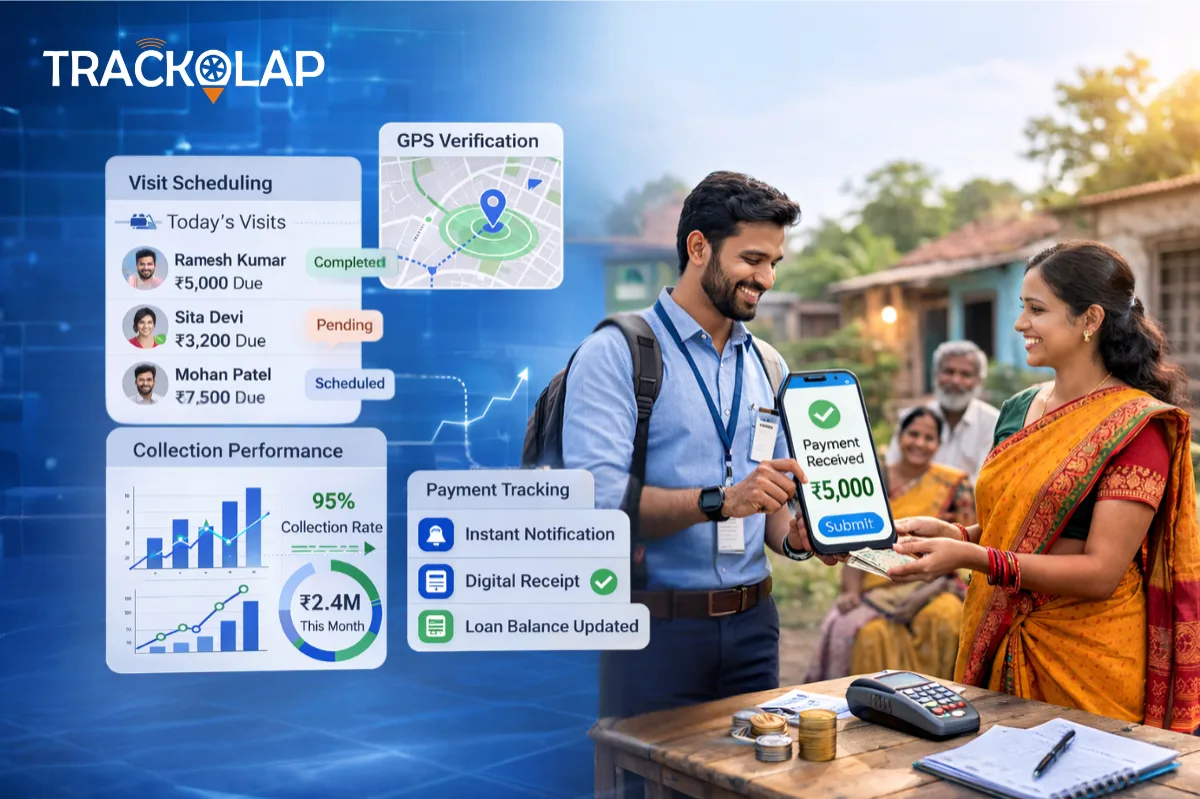
Lenders who scale well treat field operations as infrastructure rather than as a management style. The capabilities below — all part of the TrackOlap platform — form the practical control layer for a growing branch network.
Geo-based attendance. Field staff mark attendance only from designated locations, with geotagging and photo capture that make proxy check-ins substantially harder. For a lender opening branches across unfamiliar districts, this answers the most basic supervisory question — who was where, and when — without a single phone call.
Live tracking and journey replay. Real-time location visibility during the working day, with the ability to replay an employee's movements afterwards and compute distance travelled automatically. Field activity stops being a claim and becomes a record. Conveyance disputes largely disappear with it.
Beat planning and route optimisation. Structured daily routes with navigation and route optimisation, so new territories are covered systematically rather than opportunistically. In a freshly opened cluster where nobody knows the market yet, a defined beat is the difference between a productive branch and an expensive one.
Visit verification with custom forms. One-click customer check-in and check-out, supported by configurable forms that capture what happened during the meeting. The result is a geo-tagged, timestamped record of each borrower interaction — which speaks directly to the regulator's concern about activity conducted without the customer present.
Lead and task management. Enquiries and follow-ups live in an institutional pipeline with owners, priorities and escalation, not in an individual's phone. Follow-up discipline becomes something a manager can measure rather than something he has to trust.
Expense management with approval workflows. Receipt capture and multi-step approvals applied consistently across every branch. Expense leakage grows with headcount unless it is controlled at source.
HR, attendance and payroll. Onboarding, leave, policy administration and payroll in one place. Bringing thousands of field employees on board through a manual process is itself an operational risk during rapid hiring.
A single dashboard. Attendance, visits, routes, tasks, leads and expenses aggregated across every branch and cluster, with drill-down to the individual. This is what turns a large network from a reporting burden into something that can genuinely be managed.
Taken together, these produce what matters most during an expansion: evidence-based management instead of assumption-based oversight. When someone asks how the institution ensures its field procedures are actually followed, the answer is a report, not a reassurance.
A Practical Sequence for New Branch Clusters
Lenders who instrument after expanding spend the following year reconstructing records. The order below costs far less.
- Before the branch opens. Define geofences for each planned location. Configure attendance rules, visit forms and expense policies centrally, once, so every new branch inherits the same standard. Map the reporting hierarchy.
- At go-live. Onboard field staff onto the mobile app on day one, alongside HR onboarding — not three months later. Publish beat plans for each territory. Switch on dashboards at branch, cluster and regional level.
- In the first quarter. Work the exception reports: missed check-ins, off-beat movement, unclosed tasks, ageing leads. Reset targets against demonstrated field capacity rather than head-office assumptions.
- Thereafter. Sample field records during internal audit. Feed field activity into credit and collections review. Keep an exportable trail ready, because eventually someone will ask for it.
What to Watch During an Expansion
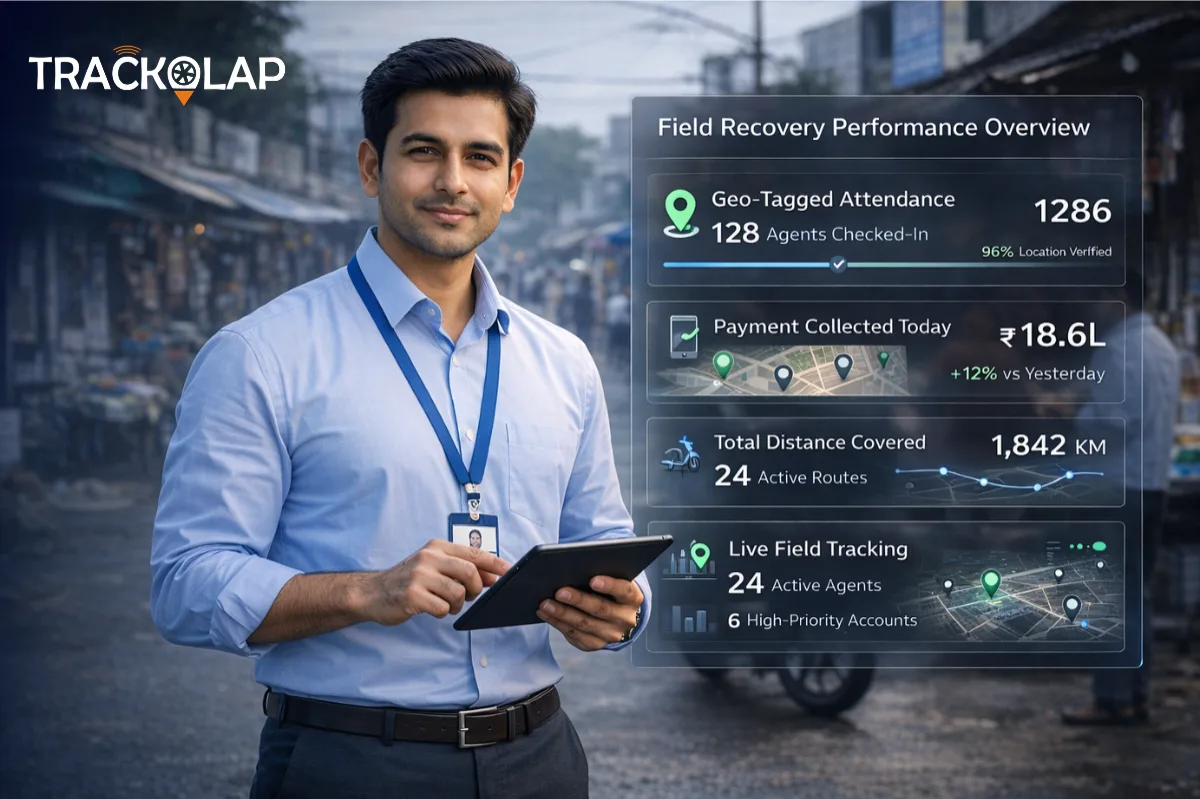
A small number of indicators tell you most of what you need to know:
- Verified attendance compliance — the baseline signal of supervisory control at each branch
- Planned versus actual beat coverage — separates a weak market from weak execution
- Verified visits per officer per day — genuine field productivity, not reported activity
- Lead response time — the earliest indicator of how a new territory will perform
- Expense per productive visit — catches conveyance leakage before it becomes structural
None of these require a data science team. They require the underlying activity to be captured as it happens.
Frequently asked questions
How many gold-loan branches are Indian NBFCs opening?
Non-bank lenders have collectively signalled plans to add roughly 3,000 dedicated gold-loan branches within a twelve-month period, with several large NBFCs announcing individual targets in the hundreds and some revising them upward since.
Why is gold-loan growth outpacing other retail credit?
Three factors are converging: high gold prices, tighter conditions in unsecured lending, and expansion into under-penetrated markets outside South India, where the organised market has historically been concentrated.
What field-level issues has the RBI flagged in gold lending?
Among others: valuation of gold without the customer present, improper custody of collateral, inadequate oversight of third-party sourcing, weak loan-to-value monitoring, insufficient end-use verification and cash disbursements beyond permitted limits.
How does field-force automation support gold-loan compliance?
By capturing attendance, location, visits and task completion digitally at the moment they occur, it creates a timestamped and location-referenced trail. That allows a lender to demonstrate — rather than assert — that prescribed field procedures were followed.
Which TrackOlap capabilities matter most to gold-loan lenders?
Geo-based attendance, live tracking with journey replay, beat planning and route optimisation, visit verification with custom forms, lead and task management, expense management with approval workflows, HR and payroll, and a unified analytics dashboard.
Conclusion: Growth Is a Field-Operations Problem
The gold-loan opportunity in India is real and durable. Household gold holdings are enormous, the organised market still serves a fraction of them, and the geographic runway outside the South is substantial.
But the lenders that come through this cycle with clean portfolios and clean inspection reports will not be the ones that opened the most branches. They will be the ones that opened branches with the plumbing already in place — where every field employee's presence, movement, customer interaction and expense was captured as structured data from the first day of trading.
Three thousand branches can be opened in twelve months. Whether they can be governed in twelve months depends entirely on what is running underneath them.
TrackOlap provides that layer — field force automation, geo-based attendance, beat planning, live tracking, lead and task management, expense control and unified analytics — used by BFSI and NBFC field teams scaling distributed operations across India.




 D-5, Logix Infotech Park, Sector 59, Noida - 201301, Uttar Pradesh (India)
 contactus@trackolap.com
 7011494501






 Demo
at free of cost
Demo
at free of cost