
















 Back to Blogs
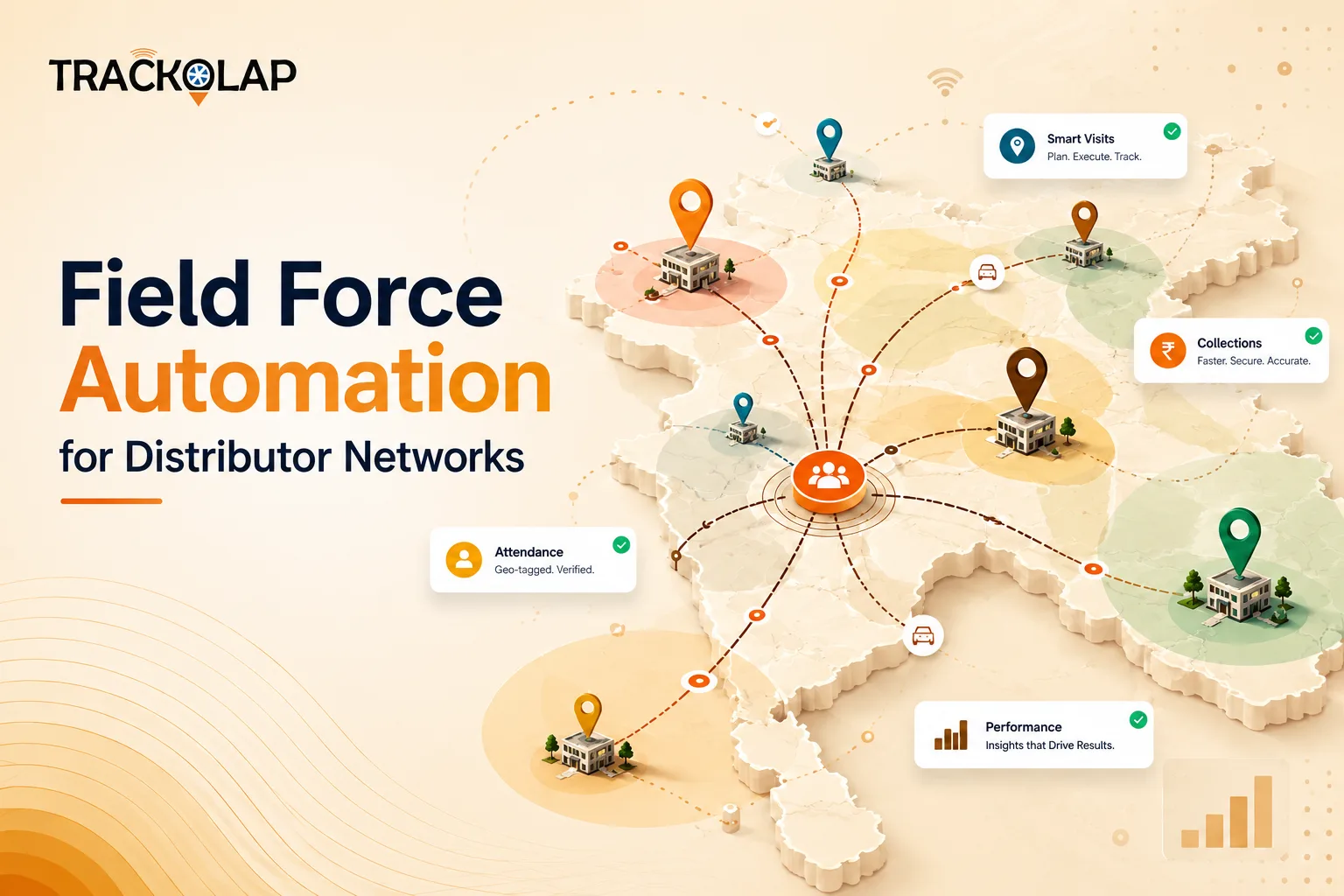
In short: Field force automation software gives manufacturing distributors a single, live view of dealer visits, field expenses, attendance, and payment collection. It swaps spreadsheets and end-of-day phone calls for GPS-verified visits, automated tasks, AI attendance, and on-the-spot UPI payments. Distributors who adopt it usually see expense leakage drop by 35–40% and collection cycles shorten by about a week.
Ask any distribution head in India where their money quietly disappears, and the answer is rarely the product. It is the field. A rep marks a visit that never happened. A fuel claim comes in 200 kilometres heavier than the route allows. A dealer's outstanding payment slips another two weeks because nobody followed up in time. None of these are dramatic on their own, but across a few hundred dealers and a few dozen reps, they add up fast.
Distributor networks run the manufacturing supply chain in this country, and the people holding those networks together are field teams visiting dealers, checking stock, taking orders, and chasing dues. The trouble is that most distributors still manage that work the way they did a decade ago, through spreadsheets, paper bills, and a flurry of WhatsApp messages. That setup leaves managers half-blind, and half-blind is expensive.
This is the gap field force automation software like TrackOlap is built to close. Below is a practical look at what it does, where it actually saves money, and how to pick a platform that fits a distribution business.
What is field force automation software?
Field force automation (FFA) software is a mobile-first system that captures everything a field team does on the ground, from dealer visits and order entry to attendance, expenses, and payment collection. It usually sits alongside or inside a broader sales force automation (SFA) and distributor management system (DMS) setup, and it replaces self-reported updates with GPS-stamped, time-stamped data that a manager can watch unfold on a dashboard.
Put plainly, it turns a field operation that runs on trust and memory into one that runs on evidence.
Where distributor visibility breaks down
A distributor is doing several demanding jobs at the same time: keeping dealers visited and ordering, holding expenses in check without squeezing margins, collecting dues before they age, keeping records clean enough to survive an audit, and making sure the team is actually productive.
The Confederation of Indian Industry has put the cost of poorly managed field operations as high as 25–30% of revenue, lost to padded expenses, missed collections, and plain inefficiency. When you are covering hundreds of dealers, there is no manual way to stay on top of all of it.
• The visibility gap: Managers can't confirm whether dealers were visited on time or whether stock was even checked.
• Expense leakage: Reps file vague claims and round travel and mileage up.
• Slow collections: Outstanding dealer payments drift because no one's chasing them with any urgency.
• No accountability: With no proof of visit, there is no reliable way to know what got done.
• Paper records: Email and paper trails turn every audit into a scavenger hunt.
Each of these is fixable once the work is digital.

How automation changes the dealer visit
Visits you can actually verify
FFA software shows a manager where every rep is, which visits are finished, and what came out of them, in real time, without a single confirmation call. With GPS-verified visits and geofencing baked in, TrackOlap lets a distributor confirm visits automatically, hold teams to their planned beat plan and routes, trim travel time through smarter routing, and even see how long each dealer interaction actually lasted.
Making sure the work gets done, not just logged
Knowing a rep reached a dealer is only half the picture. Task management software confirms the right work happened there, whether that's verifying stock, placing an order, capturing market intelligence, checking displays and merchandising, or logging feedback.
Across fifty or a hundred outlets, you can't chase that by hand. Automated task assignment with live completion tracking, backed by photos from the field, does it for you and leaves an audit trail that holds up under compliance review.
Clean data, in the right language
Field data is only useful if it is consistent. Good task forms now validate language at the point of entry, letting admins set fields to accept English only, or English and Hindi together. The system catches unsupported characters before a rep can submit, which keeps records clean, avoids breaking downstream integrations, and saves someone the job of fixing entries later. For teams spread across regions and languages, that matters more than it sounds.
Reining in field expenses
Field expenses are one of the few big costs a distributor can directly control, and without checks in place they erode margin a few rupees at a time.
Verification that catches the obvious problems
The better FFA platforms now verify expenses as they come in. With TrackOlap, reps back up claims with photos, like odometer readings before and after a visit, fuel bills, or toll slips, and the system quietly flags anything that doesn't add up. A 500-kilometre claim against dealers that are only 200 kilometres apart gets pulled for review. So does anything over a set threshold. Claimed distances get checked against the actual route. That kind of automated flagging can knock unauthorised claims down by as much as 40%, and that goes straight to the margin on every visit.
Expenses you see daily, not monthly
Rather than waiting for month-end reconciliation, managers get a running view: spend by rep each day, flagged claims waiting on approval, anomalies, and how the team is tracking against budget.
|
Expense
control metric |
Before
automation |
After
automation |
|
Monthly
unauthorised expense per rep |
₹8,000–12,000 |
₹2,000–3,000 |
|
Expense
reconciliation time |
15–20
days |
2–3
days |
|
Expense
approval cycle |
25–30
days |
Same-day |
|
Compliance
documentation rate |
40–50% |
95%+ |
|
Cost
per dealer visit |
₹2,500–3,500 |
₹1,800–2,200 |
Across those lines, cost per visit typically falls 25–35% while the records actually become audit-ready.
Getting paid faster
Collections decide how healthy your working capital is, and distributors lose far too much of it waiting on dealers to pay.
UPI collection inside the visit
TrackOlap puts UPI collection right into the visit itself. The rep generates a QR code pre-filled with the outstanding amount, the dealer scans it and pays through whatever UPI app they already use, and the bank confirms it on the spot. No cash to carry, no "I've already transferred it" that never shows up, and the money is credited then and there. Every payment leaves a clean record of who paid, when, and how.
A collections view that's always current
Managers can see which dealers still owe money, what each visit collected, how the team is doing against target, and which dealers consistently pay late. That makes follow-up proactive instead of reactive, which is what pulls day sales outstanding (DSO) down and tightens the cash cycle.

Attendance and accountability
Attendance you can trust
Attendance management software has come a long way from a punch-in button. TrackOlap uses AI face recognition to let reps mark attendance and prove they're actually at the assigned dealer location. They register a face profile once, then authenticate during visits, which makes proxy attendance and buddy punching close to impossible. The payoff is honest attendance data, no payroll fraud, and a fair, automated check that doesn't feel like surveillance to the team.
Turning field data into decisions
All this data is worth nothing if it sits in a report no one reads. The stronger platforms now run AI analytics over visit data, collections, and performance, and increasingly let managers just ask questions in plain language instead of building pivot tables. Instead of an afternoon lost to spreadsheets, a manager gets a quick summary of field activity, the trends worth noticing, early warnings on collection risk, routing suggestions, and a read on which dealers are pulling their weight. The time that used to go into assembling reports goes back into strategy.
What distributors actually get out of it
When a distributor rolls this out properly, the numbers move in ways you can point to:
• Field productivity climbs 20–30% on better routing and less paperwork.
• Expense leakage drops 35–40% once verification and flagging are in place.
• Collection cycles shorten by five to seven days on average.
• Audits get shorter because the activity trail is already complete.
• Performance conversations get easier when the tracking is transparent.
• Reporting gets reliable because the data was captured cleanly to begin with.

How to choose a platform
A few things separate a tool that sticks from one that gets abandoned in three months:
1. One platform, not five: Tracking, tasks, attendance, expenses, and payments should live together, not in bolted-on point tools.
2. Hindi and English: Language support is what gets a regional team to actually use it.
3. Room to grow: It should handle more reps and dealers without slowing down.
4. Clean integration: It has to talk to your existing ERP, DMS, and accounting stack.
5. Simple enough to skip the training: If reps need a manual, adoption suffers.
6. Security and compliance: Encryption, regulatory fit, and audit-ready reports are non-negotiable.
7. Real intelligence: Analytics that turn the field data into something you can act on.
The takeaway
With distributor margins as thin as they are, field force automation software isn't an IT line item, it is a way to protect the money the field operation already makes. Bring visibility, accountability, and a bit of intelligence to the ground game, and collections, costs, and productivity all move in the right direction at once.
The alternative is to keep running on spreadsheets that leak revenue and leave you exposed at audit time. Your field teams are the engine that brings the money in. Give them the right tools, and give yourself the visibility to actually steer. Try TrackOlap today.
Frequently asked questions
How can manufacturing distributors reduce field expense leakage?
Expense management software that uses odometer tracking and photo proof cuts padded claims significantly. Intelligent flagging picks up suspicious mileage and anomalies, and real-time dashboards let managers approve the same day instead of waiting for month-end, which helps both cash flow and margins.
What is the fastest way to improve dealer payment collections?
Built-in UPI collection lets a rep raise a QR code for the outstanding amount during the visit, with the bank confirming payment instantly. Live collection dashboards track pending dues and payment status, which shortens collection cycles and frees up working capital.
How do distributors ensure dealer-visit compliance across multiple locations?
GPS-verified tracking confirms visits automatically across a spread-out network. Routes and schedules are monitored continuously, and photo-backed task completion proves what happened at each stop, so visits stop getting missed and execution stays consistent.
How can field routes be optimised to cut travel time and cost?
Beat plan software works out efficient routes between dealers, while live tracking checks that reps stick to them. Automated suggestions and territory clustering cut fuel spend and travel time, which lifts how much a rep can get done in a day.
Which field force automation features are essential for large dealer networks?
Real-time GPS tracking, automated task management, AI attendance, expense controls, UPI payments, collection dashboards, digital audit trails, and AI analytics, with Hindi-English support for adoption and ERP or DMS integration so the data flows cleanly.
How do you prevent proxy attendance and improve accountability?
AI face-recognition attendance makes reps authenticate at the assigned location, which produces tamper-proof records and shuts down payroll fraud. Because it is automated and fair, it does this without making the team feel watched.
How does real-time task management ensure consistent execution?
Automated task assignment with live completion tracking holds reps accountable at scale. Each activity, from stock checks and orders to market intelligence, displays, and feedback, is logged with photo proof, which standardises execution and improves sales and inventory outcomes.



 D-5, Logix Infotech Park, Sector 59, Noida - 201301, Uttar Pradesh (India)
 contactus@trackolap.com
 7011494501






 Demo
at free of cost
Demo
at free of cost