















 Back to Blogs
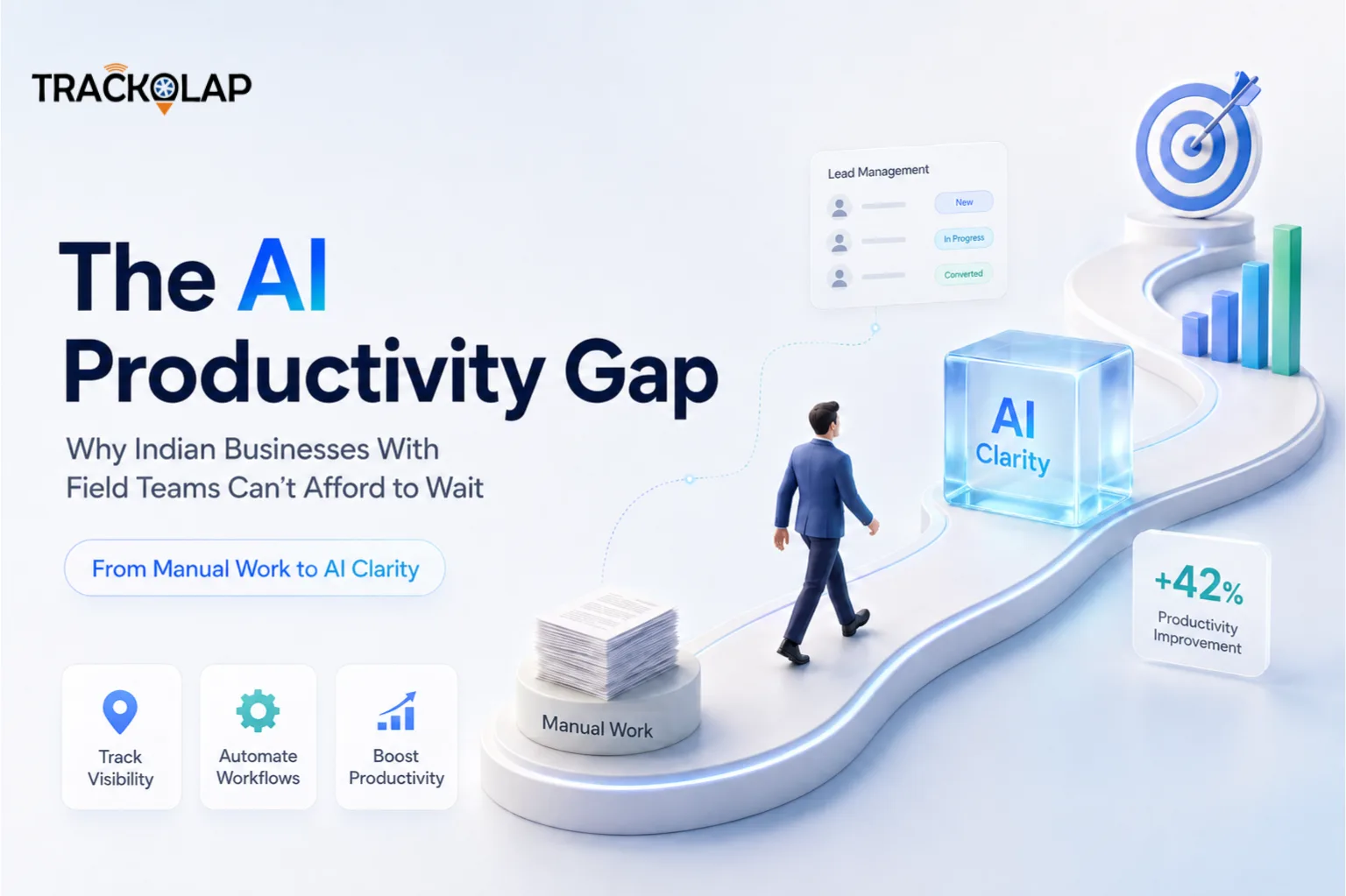
Quick answer: The AI productivity gap is the widening performance difference between teams that use automation and AI to remove manual work and teams that still run on spreadsheets, phone calls, and end-of-day reports. For Indian companies with field sales reps and distributed employees, that gap is where deals, hours, and margins quietly leak away — and it’s exactly the gap the right automation tools are built to close.
Two distribution companies in the same city can sell the same products to the same retailers. One knows, in real time, where every field rep is, which leads are going cold, and how the day’s targets are tracking. The other
finds out tomorrow morning, from a WhatsApp summary that may or may not be accurate. Over a quarter, the first company pulls ahead — not because its people work harder, but because its work is visible and
automated.
That distance has a name now: the AI productivity gap. And for businesses running field teams across India, it’s becoming the difference between scaling and stalling.
The gap is real — and the data is hard to argue with
You don’t need a hundred statistics to see the trend. Three numbers tell the story.
First, the productivity payoff is now measurable. The Federal Reserve Bank of St. Louis found that workers using AI tools save time equal to about 5.4% of their work hours — roughly 2.2 hours every week ( St. Louis Fed ) Two hours a week, per person, across a sales team is not a rounding error — it’s the time a rep needs for two or three extra customer visits.
Second, the gains aren’t shared equally. Government surveys in major economies show large, organised firms adopting automation far faster than smaller ones — the U.S. Census Bureau found AI use jumps from roughly 18% of firms to about 32% once you weight by employment, because the bigger, better-run operations move first (U.S. Census Bureau). Early movers compound their lead; everyone else plays catch-up.
Third, India is betting big on closing this gap. The Government of India approved the IndiaAI Mission with an outlay of ₹10,371.92 crore, a clear signal that AI and automation are now national priorities, not optional
experiments ( Press Information Bureau, Government of India ).
The takeaway for a business owner is simple. The tools to compete are available and affordable. The companies that adopt them are already saving hours and winning visibility. The ones that wait are the ones the gap
leaves behind.

Where the gap hides in a field-driven business
For a desk-based team, the productivity gap shows up as slow reports and clunky tools. For a business with people on the road, it hides in places that are harder to see — which is exactly why it’s so costly.
It hides in attendance you can’t verify. Without proper employee time tracking software in India, you’re trusting that the day started when the rep says it did. Punch-ins from the wrong location, late starts, and “I was
stuck in traffic” become unprovable — and unmanageable.
It hides in leads that slip through the cracks. When enquiries live in notebooks, personal phones, and memory instead of lead tracking software, follow-ups get missed and hot prospects go cold. Nobody decided to lose
those deals; they just leaked out of a process that was never built to hold them.
It hides in a field team you can’t see. If you don’t have a field employee tracking app showing where reps actually are during working hours, route planning is guesswork and a half-day of idle time looks identical to a
half-day of hard selling on paper.
And it hides in desk work nobody’s accountable for. For office and remote staff, desktop monitoring tools in India are increasingly how managers separate genuine output from busy-looking screens — not to police
people, but to understand where the real hours go.
Each of these is a small leak. Together, they are the AI productivity gap — and the company that plugs them runs faster than the one that doesn’t.
How to close the AI productivity gap in a field-driven business
This is where the abstract idea of “AI productivity” turns into something you can actually deploy. The fix isn’t another standalone app — it’s bringing the manual, invisible parts of a field business into one automated
system, so the hours the data says you can reclaim, you actually do. A platform like TrackOlap is built around exactly these four jobs:
• Make every field day visible: Good field employee tracking software gives you real-time location, route history, and on-ground activity for your team. Instead of waiting for an evening summary, you see the day as it
happens — the single biggest source of reclaimed time for managers running people on the road.
• Turn field sales into a system: not a scramble. Field sales automation software handles beat plans, visit check-ins, order capture, and daily reporting automatically. Reps spend less time filling forms and more time in front of customers — which is precisely the 2-plus hours a week the productivity research points to.
• Stop losing leads: Reliable lead tracking software and a practical sales CRM keep every enquiry, follow-up, and stage in one place, with reminders so nothing goes cold. The pipeline stops living in people’s heads and starts living in a system you can manage and forecast.
• Account for the hours — fairly: Employee time tracking software built for Indian businesses, plus desktop monitoring tools for office and remote staff, give you an honest picture of attendance, working hours, and
output across both field and desk teams.
The goal is to remove the manual reporting, status-chasing, and data entry that quietly drain your team — so AI-era productivity becomes your default, not your competitor’s advantage.

How to measure whether you’re closing the gap
You can’t manage a gap you don’t measure. The good news is the metrics are simple, and they map directly to what an automated field platform captures.
Start with time saved: how long does daily reporting, attendance, and lead updating take your team today, versus after automation? The St. Louis Fed’s “hours saved per person per week” is the cleanest place to begin,
and it’s a number your finance team will understand.
Then watch output, not just activity: customer visits logged per rep, lead response time, deals moved through the pipeline. Reclaimed time only counts when it’s reinvested into selling.
Finally, track adoption depth — how many people actually use the tools every day. The official data is clear that the firms pulling ahead aren’t the ones that bought automation; they’re the ones that use it across the
whole team.
Give it a quarter, look for compounding gains rather than overnight miracles, and the direction of your own productivity gap will be obvious.
The bottom lin
The AI productivity gap isn’t a far-off threat — it’s already separating the field-driven businesses that automate from the ones that don’t. The data shows real hours saved, faster-moving leaders, and a government in India
treating AI adoption as a priority. The deciding factor isn’t access to technology; almost everyone has that. It’s whether you turn visibility and automation into your everyday way of working.
For Indian companies with field sales teams and distributed staff, TrackOlap is a practical place to start — bringing field employee tracking, sales CRM, lead tracking, and employee time tracking into one system, so the
gap closes on your side of it.
Frequently asked questions
What is the AI productivity gap?
It’s the widening performance difference between teams that use AI and automation to remove manual work and those that still rely on manual reporting and guesswork. For field-driven businesses, it shows up as lost hours, missed leads, and poor visibility into on-ground work.
How much time can automation actually save?
Research from the Federal Reserve Bank of St. Louis found that workers using AI tools save around 5.4% of their work hours — about 2.2 hours per person each week. Across a sales team, that’s room for several more customer visits a week.
How does TrackOLAP help close the gap?
TrackOLAP combines field sales automation software, a field employee tracking app, lead tracking software, sales CRM, and employee time tracking and desktop monitoring tools for Indian businesses into one platform — automating the manual work that drains field and desk teams.
Is this only useful for large companies?
No. Government data shows large firms adopt automation fastest, which is exactly why smaller and mid-sized businesses benefit most from catching up early — before the gap with bigger competitors becomes hard to close.



 D-5, Logix Infotech Park, Sector 59, Noida - 201301, Uttar Pradesh (India)
 contactus@trackolap.com
 7011494501






 Demo
at free of cost
Demo
at free of cost